
Actimo Labs
Actimo Labs offers ActiMap, an advanced AI-powered platform for precise and rapid epitope mapping. Designed for researchers in …
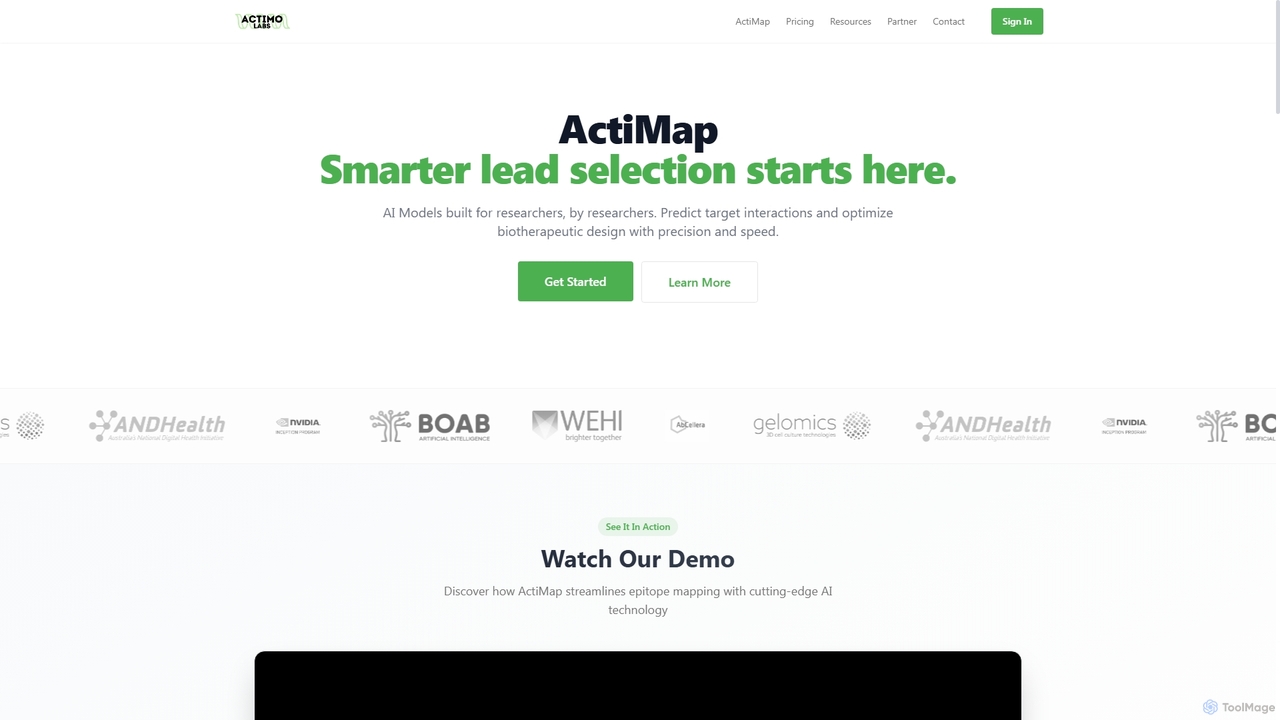
Actimo Labs offers ActiMap, an advanced AI-powered platform for precise and rapid epitope mapping. Designed for researchers in academia, pharma, and biotech, it accelerates antibody discovery and biotherapeutic design by predicting target interactions from protein sequences in minutes, significantly reducing costs and development timelines.
About Computational Biology
Computational Biology tools are AI-powered platforms that apply advanced computational methods to analyze and interpret complex biological data. These tools leverage algorithms, machine learning, and statistical models to simulate biological systems, predict molecular interactions, and uncover hidden patterns within vast datasets. They are essential for accelerating scientific discovery within the broader field of research, enabling breakthroughs in areas like drug development, personalized medicine, and understanding disease mechanisms.
Core Features
- Genomic & Proteomic Analysis: Perform sequence alignment, variant calling, gene expression analysis, and predict protein structures and functions.
- Drug Discovery & Design: Facilitate virtual screening, molecular docking, and lead optimization to identify and refine potential therapeutic compounds.
- Systems Biology Modeling: Build and simulate complex biological networks and pathways to understand cellular processes and disease progression.
- Bioinformatics Data Visualization: Generate interactive visualizations for multi-omics data, aiding in the interpretation of complex biological relationships.
- Biomarker Identification: Utilize machine learning to discover novel biomarkers for disease diagnosis, prognosis, and treatment response prediction.
Use Cases
Researchers in pharmacology use these tools to identify potential drug targets and design new therapies. Geneticists apply them to analyze patient genomic data for disease predisposition and personalized treatment. Biotechnologists leverage computational models to optimize bioprocesses and engineer novel biological systems.
How to Choose
When selecting Computational Biology tools, consider their compatibility with various biological data formats (e.g., FASTQ, PDB), the sophistication of their underlying AI/ML algorithms for specific tasks, and their scalability to handle large datasets. Evaluate integration capabilities with existing lab workflows and the user-friendliness of the interface for your team's expertise level.
Computational BiologyUse Cases
Genomic Variant Analysis for Disease Research
Genetic researchers use computational biology tools to analyze whole-genome or exome sequencing data from patient cohorts. They identify novel genetic variants, predict their functional impact, and correlate them with disease phenotypes. This enables the discovery of disease-causing mutations, understanding genetic predispositions, and pinpointing potential therapeutic targets, significantly accelerating precision medicine initiatives.
Accelerating Drug Target Identification
Pharmaceutical researchers use computational biology platforms to analyze vast genomic and proteomic datasets, identifying novel disease-associated genes or proteins. By applying machine learning algorithms, they can prioritize potential drug targets, significantly reducing the time and cost associated with traditional experimental screening methods and focusing resources on the most promising candidates.
Predicting Protein Structures for Drug Targets
Structural biologists and pharmaceutical researchers utilize computational biology tools to accurately predict the three-dimensional structures of novel proteins. By inputting amino acid sequences, AI-powered algorithms generate detailed protein models, which are crucial for identifying potential drug binding sites. This capability significantly accelerates the initial stages of drug discovery, reducing the need for costly and time-consuming experimental methods like X-ray crystallography or cryo-EM, and enabling faster identification of lead compounds.
Protein Structure Prediction & Drug Target Identification
Pharmaceutical scientists employ AI-driven computational biology platforms to predict the 3D structures of proteins from their amino acid sequences, especially for challenging targets. By simulating protein-ligand interactions and virtual screening of compound libraries, they can identify promising drug candidates and optimize their binding affinity, drastically reducing the time and cost associated with experimental drug discovery.
Personalized Cancer Treatment Planning
Oncologists and clinical researchers leverage computational biology tools to analyze a patient's tumor genome and proteome. These tools identify specific mutations and protein expressions, allowing for the prediction of drug response and resistance. This enables the development of highly personalized treatment plans, optimizing therapeutic outcomes and minimizing adverse effects for individual cancer patients.
Analyzing Large-Scale Genomic Sequencing Data
Geneticists and bioinformaticians employ these tools to process and interpret massive amounts of genomic sequencing data from patient cohorts or model organisms. Advanced algorithms perform variant calling, annotation, and functional prediction, identifying single nucleotide polymorphisms (SNPs), insertions, deletions, and structural variations. This allows researchers to pinpoint disease-associated genetic variants, understand genetic predispositions, and develop more precise diagnostic and personalized treatment strategies based on an individual's unique genetic makeup.
Metabolic Pathway Modeling for Bioengineering
Synthetic biologists and bioengineers utilize computational models to simulate and optimize metabolic pathways in microorganisms. By analyzing gene expression data and reaction kinetics, they can predict the effects of genetic modifications on metabolite production. This is crucial for designing microbial strains that efficiently produce biofuels, pharmaceuticals, or industrial chemicals, enhancing biomanufacturing processes.
Predicting Protein Structure for Vaccine Design
Structural biologists and immunologists employ computational biology software to predict the 3D structure of viral or bacterial proteins. By inputting amino acid sequences, AI models can rapidly generate accurate structural models. This capability is vital for understanding pathogen function, identifying key epitopes, and designing more effective vaccines or antiviral therapies by targeting specific protein regions.
Virtual Screening for Novel Drug Candidates
Medicinal chemists and drug discovery scientists leverage computational biology for virtual screening, a process that identifies potential drug molecules from vast chemical libraries. Tools perform molecular docking simulations to predict how millions of compounds might bind to a specific target protein. Machine learning models further enhance scoring and prioritization, allowing scientists to efficiently filter and select the most promising candidates for experimental validation, thereby significantly shortening the drug discovery timeline and reducing resource expenditure.
Single-Cell RNA Sequencing Data Interpretation
Immunologists and developmental biologists use computational tools to process and interpret complex single-cell RNA sequencing (scRNA-seq) data. These tools enable clustering cells into distinct types, identifying marker genes, and reconstructing developmental trajectories. This provides unprecedented insights into cellular heterogeneity, immune responses, and tissue development at a granular level.
Optimizing Agricultural Crop Yield and Disease Resistance
Agricultural scientists use computational biology to analyze plant genomics data, identifying genes associated with desirable traits like drought resistance or increased yield. Machine learning models predict the impact of genetic modifications or breeding strategies. This allows for the accelerated development of improved crop varieties, enhancing food security and reducing reliance on pesticides.
Modeling Biological Pathways and Networks
Systems biologists and biomedical engineers use computational biology tools to construct and simulate complex biological networks, such as metabolic pathways, gene regulatory networks, or protein-protein interaction networks. These models help in understanding the intricate interplay between different cellular components and how they respond to various stimuli or disease states. By simulating these systems, researchers can gain insights into system-level behaviors, predict responses to perturbations, and identify key regulatory nodes for potential therapeutic intervention.
Evolutionary Analysis of Viral Strains
Virologists and epidemiologists apply computational biology methods to analyze viral genomic sequences collected globally. By constructing phylogenetic trees and tracking mutations, they can monitor the evolution and spread of pathogens, identify new variants, and predict potential drug resistance. This information is vital for public health surveillance, vaccine development, and outbreak management.
Modeling Disease Progression and Drug Efficacy
Biomedical researchers utilize computational biology tools to build complex simulations of biological systems, such as cellular pathways or organ interactions. These models can simulate disease progression under various conditions and predict the efficacy and potential side effects of new drug compounds before costly in-vivo trials. This provides critical insights into disease mechanisms and therapeutic interventions.
Identifying Biomarkers for Disease Diagnosis and Prognosis
Clinical researchers and oncologists apply computational biology tools, particularly machine learning algorithms, to analyze multi-omics data (genomics, proteomics, metabolomics) to discover novel biomarkers. These molecular signatures can indicate the presence of a disease, its stage, or predict a patient's response to a specific treatment. By identifying robust biomarkers, these tools contribute to the development of more accurate diagnostic tests, enable patient stratification for targeted therapies, and facilitate non-invasive monitoring of disease progression.
Personalized Medicine Treatment Recommendation
Clinical researchers and oncologists leverage computational biology to integrate a patient's multi-omics data (genomics, transcriptomics, proteomics) with clinical records. AI algorithms analyze these complex datasets to predict individual responses to various cancer therapies, identify optimal drug combinations, and forecast disease progression. This supports highly personalized treatment strategies, improving patient outcomes.
Analyzing Microbiome Data for Gut Health Insights
Nutritionists and gastroenterologists apply computational biology platforms to analyze vast datasets from gut microbiome sequencing. These tools identify specific microbial species, their abundances, and metabolic pathways. By correlating microbiome composition with health outcomes, researchers can uncover links to digestive disorders, metabolic diseases, and even mental health, guiding personalized dietary and probiotic interventions.
Designing Optimized CRISPR-Cas9 Guide RNAs
Genetic engineers and molecular biologists utilize computational biology tools to design highly specific and efficient guide RNAs (gRNAs) for CRISPR-Cas9 gene editing applications. These tools employ AI-driven algorithms to predict gRNA efficacy and minimize off-target effects by analyzing sequence features and genomic context. By optimizing gRNA design computationally, researchers can enhance the precision and safety of gene editing experiments, accelerating fundamental research in functional genomics and the development of gene therapies with reduced unintended consequences.