AI_Database
AI_Database is a premium, curated list of over 300 vetted AI affiliate programs. Designed for bloggers, marketers, and …
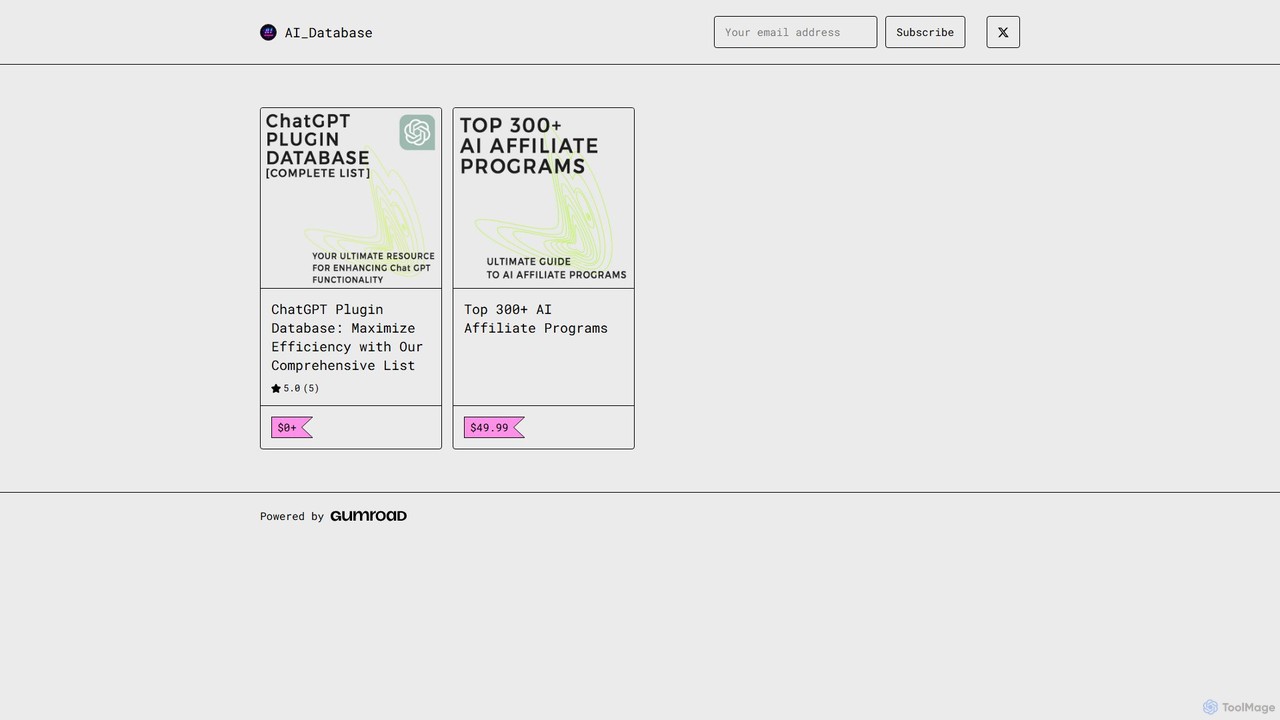
AI_Database is a premium, curated list of over 300 vetted AI affiliate programs. Designed for bloggers, marketers, and influencers, it saves 80+ hours of research, helping users monetize their content by connecting with high-commission AI tools and services across various niches.
About Databases
AI Databases are specialized data repositories designed to store, manage, and serve the data required for training, evaluating, and deploying machine learning models. These platforms are optimized for handling large-scale datasets, complex data types like vector embeddings, and high-throughput queries common in AI applications. They provide the foundational resources—from curated public datasets to high-performance vector stores—that fuel intelligent systems. Using a dedicated AI database ensures data quality, accessibility, and performance, which are critical for building accurate and scalable AI solutions.
Core Features
- Vector Storage & Search: Efficiently stores high-dimensional vector embeddings and performs rapid similarity searches (ANN).
- Data Curation & Versioning: Provides tools for cleaning, labeling, and versioning datasets to ensure reproducibility and model quality.
- High Scalability: Engineered to handle petabytes of data and millions of queries per second to support production-grade AI systems.
- Framework Integration: Offers native APIs and integrations for popular machine learning frameworks like PyTorch and TensorFlow.
Use Cases
AI Databases are essential for data scientists, machine learning engineers, and AI researchers. They are used for training computer vision models with large image datasets, powering semantic search and recommendation engines with vector databases, and fine-tuning large language models (LLMs) with domain-specific text corpora. They also form the backbone of MLOps by providing a centralized location for feature stores and experiment tracking.
How to Choose
When selecting an AI Database, consider the primary data type (e.g., vectors, images, text, tabular). Evaluate its scalability and query performance against your expected workload. Assess its integration capabilities with your existing AI stack and MLOps tools. Finally, examine the data licensing for public datasets and the pricing model for managed database services to ensure it aligns with your project's budget and usage rights.
DatabasesUse Cases
Powering a Semantic Search Engine
A developer at an e-commerce company is tasked with improving product discovery. Instead of relying on keyword matching, they use a vector database. Product descriptions and images are converted into high-dimensional vectors (embeddings) and stored. When a user searches for 'comfortable shoes for running,' the system converts the query into a vector and uses the database to find the most similar product vectors. This allows the search engine to understand user intent and context, returning more relevant results like running sneakers with cushioned soles, even if the exact keywords aren't in the product title.
Training a Custom Image Recognition Model
A data scientist at a healthcare startup needs to build a model to detect anomalies in medical scans. They use a curated, public dataset of thousands of labeled medical images (e.g., X-rays, MRIs). This database serves as the ground truth for training their convolutional neural network (CNN). By feeding the model these high-quality, pre-labeled images, they can train it to accurately identify specific conditions, significantly speeding up the development process compared to collecting and labeling data from scratch. The dataset's versioning feature also allows them to reproduce experiments reliably.
Fine-Tuning an LLM for Legal Document Analysis
A law firm wants to use an AI assistant to summarize legal contracts. A general-purpose Large Language Model (LLM) lacks the specific terminology. An NLP engineer uses a specialized database containing a vast corpus of legal documents, case law, and statutes. They use this domain-specific data to fine-tune a pre-trained LLM. The resulting model understands complex legal jargon and can accurately summarize contracts, identify clauses, and flag potential risks, providing a valuable tool for lawyers and paralegals that saves hours of manual review.
Building a Knowledge Graph for a Q&A System
A large enterprise wants to create an internal Q&A bot to answer employee questions about company policies and procedures. A machine learning engineer uses a graph database to build a knowledge graph. They ingest data from various sources like HR documents, internal wikis, and policy PDFs. The database stores entities (e.g., 'employee', 'vacation policy') and their relationships (e.g., 'is eligible for'). When an employee asks, 'How many vacation days do I get?', the AI can traverse this graph to find the direct answer based on the employee's role and tenure, providing a much more accurate and context-aware response than a simple document search.
Benchmarking AI Model Performance
An AI research lab develops a new algorithm for object detection. To prove its effectiveness, they need to compare it against existing state-of-the-art models. They use a standardized benchmark database like COCO (Common Objects in Context). This database provides a large set of images with standardized annotations and a defined evaluation metric (e.g., mean Average Precision). By running their new model on this dataset and comparing the score to published results from other models, they can objectively demonstrate performance improvements. This process is crucial for academic publications and for validating the real-world viability of new AI techniques.
Managing a Feature Store for MLOps
An MLOps team at a financial services company manages dozens of models in production. To ensure consistency and avoid redundant work, they use a feature store, which is a specialized database. It stores pre-computed features (e.g., 'customer_7day_transaction_volume') that can be reused across different models. When a new model for fraud detection is developed, the data scientist can pull validated, production-ready features directly from the store. This database ensures that the features used for training are consistent with those used for real-time inference, reducing training-serving skew and improving model reliability.