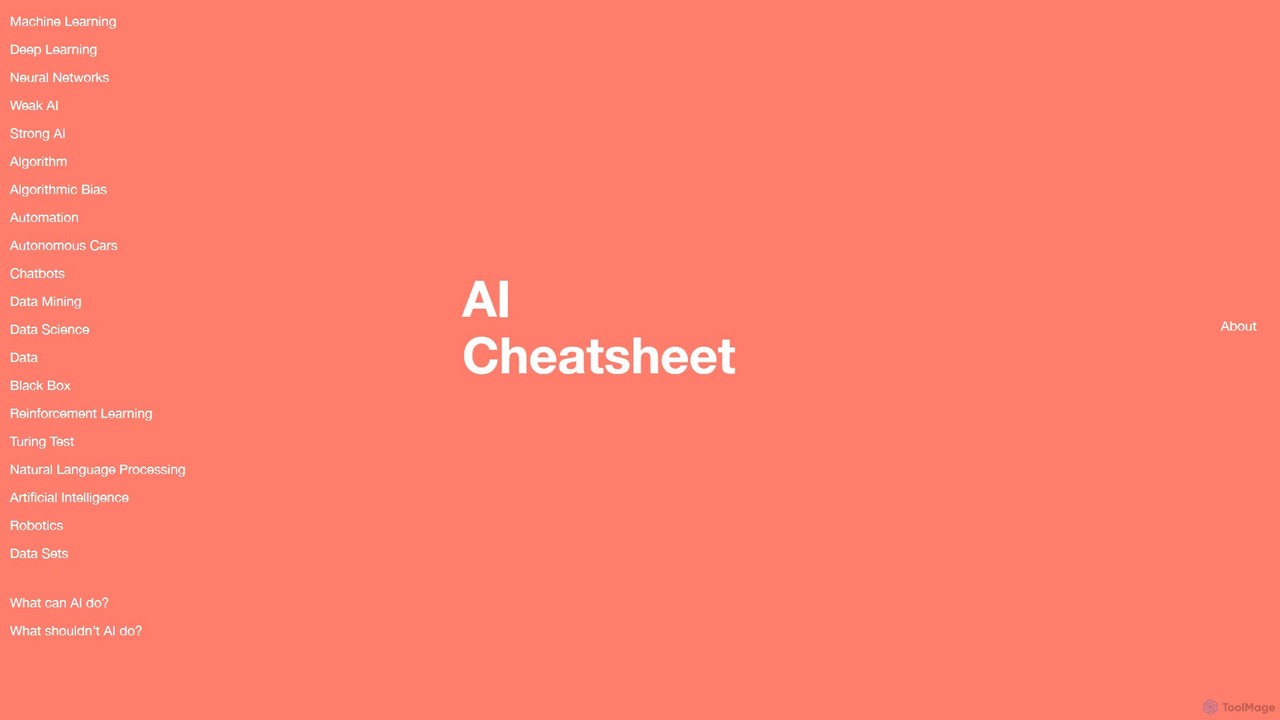
AI Cheatsheet - Comuzi
A free, community-driven educational resource designed to demystify artificial intelligence. It provides simple, clear explanations of complex AI …
A free, community-driven educational resource designed to demystify artificial intelligence. It provides simple, clear explanations of complex AI concepts like Machine Learning and Deep Learning for a non-technical audience, making AI knowledge accessible to everyone.
About Glossary
An AI Glossary is a specialized, curated collection of terms and definitions related to artificial intelligence. These resources are designed to demystify the complex jargon and concepts prevalent in the AI field, serving as a foundational knowledge base. They provide clear, accurate explanations of everything from basic principles to advanced algorithms, making the world of AI more accessible. For anyone looking to learn, teach, or work with AI technologies, a comprehensive glossary is an essential reference for ensuring clear communication and understanding.
Core Features
- Comprehensive Definitions: Provides detailed, context-rich explanations of AI terms, not just simple dictionary definitions.
- Categorization and Tagging: Organizes terms by sub-fields like Machine Learning, NLP, or Computer Vision for structured learning.
- Search Functionality: Allows users to quickly find and look up specific terminology.
- Interlinked Concepts: Connects related terms, enabling users to explore concepts and understand their relationships.
- Illustrative Examples: Often includes examples, diagrams, or analogies to clarify abstract concepts.
Use Cases
AI Glossaries are widely used by students and educators for academic purposes, providing a reliable reference for coursework and research. Content creators, marketers, and journalists rely on them to ensure accuracy when writing about AI. Additionally, developers and product managers use them to maintain consistent terminology within teams, while business leaders consult them to better understand the technologies driving their strategic decisions.
How to Choose
When selecting an AI Glossary, prioritize authority and accuracy by checking the credibility of the publisher (e.g., a research institution or reputable tech company). Assess its comprehensiveness—does it cover a wide range of topics and is it updated regularly? The clarity of explanations is crucial; definitions should be understandable to the target audience. Finally, consider the user experience, including ease of navigation and search functionality.

GlossaryUse Cases
Onboarding New Technical Staff
A project manager at a software company is responsible for onboarding new developers onto an AI-focused project. To ensure everyone shares a common understanding of key concepts like 'transformer models', 'vector embeddings', and 'RAG', the manager directs them to the company's curated AI glossary. New hires can independently study these terms, understand their context within the project, and quickly get up to speed. This process reduces training time and prevents miscommunication during critical development phases.
Creating Accurate Marketing Content
A content marketer is tasked with writing a white paper on the company's new AI-powered analytics platform. To explain the technology accurately to a semi-technical audience, they frequently consult an AI glossary. They use it to verify the definitions of 'natural language processing' and 'sentiment analysis' and find simpler ways to explain 'unsupervised learning'. This ensures the final document is not only persuasive but also technically credible, building trust with potential customers.
Academic Study and Research
A university student writing a dissertation on the ethics of generative AI uses a glossary as a foundational reference. They look up terms like 'hallucination', 'bias in AI', and 'model alignment' to build a strong theoretical framework. The glossary provides clear, authoritative definitions that they can cite in their work. It also helps them discover related concepts, deepening their research and ensuring they use terminology correctly and consistently throughout their paper.
Journalistic Reporting on AI Topics
A technology journalist is covering a story about a breakthrough in large language models. To explain the significance to a general audience, they use an AI glossary to understand the nuances between 'pre-training' and 'fine-tuning'. The glossary helps them break down complex ideas into simple, accurate analogies, ensuring their article is informative and accessible without sacrificing technical accuracy. This practice helps build their reputation as a reliable source for technology news.
Informing Business Strategy
A CEO of a non-tech company wants to explore how AI can optimize their supply chain. Before meeting with technology vendors, they use an AI glossary to understand terms like 'predictive analytics', 'reinforcement learning', and 'digital twin'. This self-education empowers them to ask more informed questions, better evaluate vendor proposals, and make strategic decisions that are grounded in a real understanding of the technology's capabilities and limitations, rather than just marketing buzzwords.
Curriculum Development for Educators
A computer science professor is designing a new introductory course on Artificial Intelligence. They use a comprehensive AI glossary to structure the curriculum, ensuring a logical progression from fundamental concepts like 'algorithms' and 'data sets' to more complex topics like 'neural networks'. The glossary serves as a checklist to ensure all essential terminology is covered and provides standardized definitions to use in lecture materials and exams, ensuring consistency and clarity for students.