
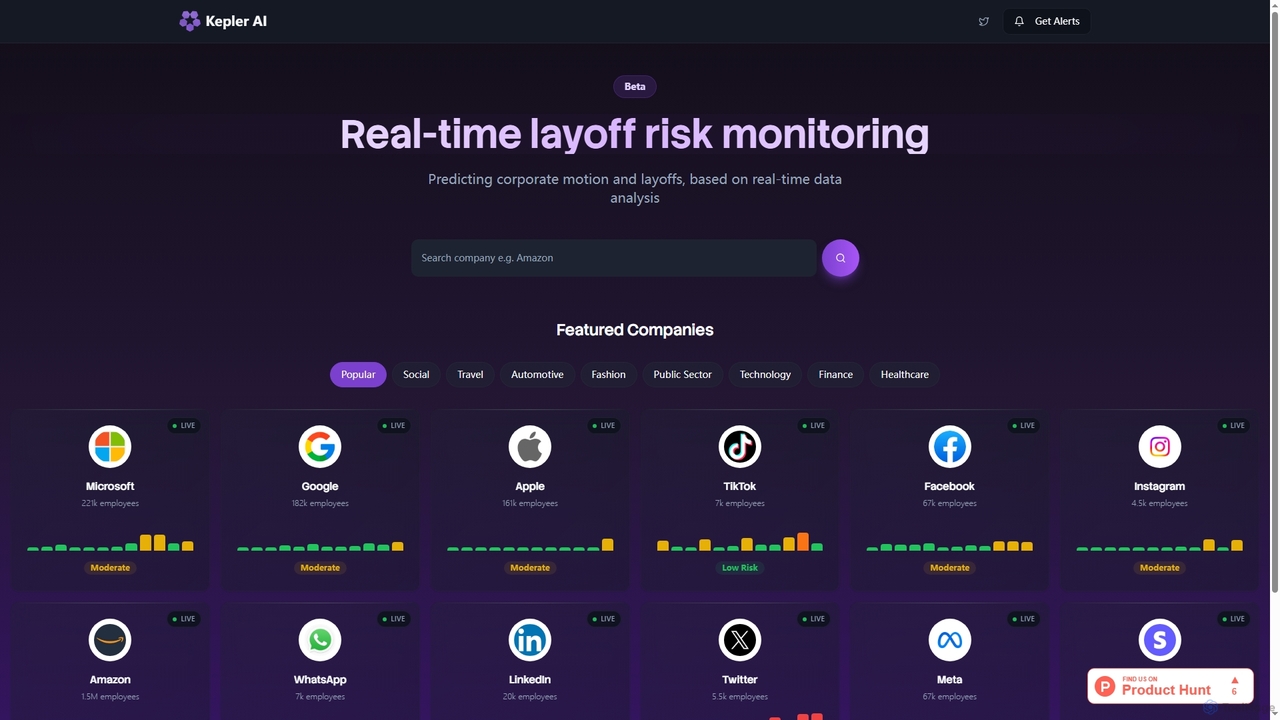
Best 1 Corporate Monitoring AI tools for Risk Management
Popular Corporate Monitoring AI tools in Risk Management include Kepler, helping you work more efficiently.
About Corporate Monitoring
Corporate Monitoring tools are AI-powered solutions designed to continuously observe, analyze, and report on various aspects of an organization's operations, performance, and compliance. These tools leverage advanced algorithms to process vast amounts of data, identify patterns, detect anomalies, and provide actionable insights. They are crucial for proactive risk management, ensuring regulatory adherence, and optimizing business processes across different departments.
Core Features
- Real-time Data Analysis: Continuously collects and processes data from diverse sources to provide up-to-the-minute insights.
- Anomaly Detection: Automatically identifies unusual activities or deviations from established norms that may indicate risks or inefficiencies.
- Compliance Tracking: Monitors adherence to internal policies, industry regulations, and legal requirements, flagging potential violations.
- Performance Metrics Monitoring: Tracks key performance indicators (KPIs) across departments to assess operational health and efficiency.
- Automated Reporting: Generates customizable reports and alerts based on predefined thresholds or detected events.
Applicable Scenarios
Corporate Monitoring tools are indispensable for financial institutions needing to comply with stringent regulations, large enterprises overseeing complex global operations, and legal departments ensuring contract and policy adherence. They provide a centralized view of organizational health, enabling timely intervention and informed decision-making.
How to Choose
When selecting a Corporate Monitoring tool, consider its data integration capabilities with existing systems, the breadth of its monitoring scope (financial, operational, compliance), customization options for specific business rules, and the robustness of its security and privacy features. Evaluate its reporting and alert mechanisms, scalability, and user-friendliness for various stakeholders.
Corporate Monitoring use cases
1
Detecting Financial Irregularities and Fraud
Financial compliance officers and internal auditors utilize Corporate Monitoring tools to continuously scan transaction data, expense reports, and financial records for unusual patterns or anomalies. By leveraging AI, these tools can flag suspicious activities, such as unauthorized payments, duplicate invoices, or unusual spending habits, significantly reducing the time and effort required for manual audits and enabling proactive fraud prevention.
2
Ensuring Regulatory Compliance Across Departments
Compliance managers in highly regulated industries, such as healthcare or banking, deploy Corporate Monitoring tools to track adherence to complex regulatory frameworks like GDPR, HIPAA, or SOX. The tools automatically monitor data access logs, policy changes, and employee training records, alerting the team to any potential non-compliance issues or outdated certifications, thereby mitigating legal and reputational risks.
3
Monitoring Employee Behavior for Policy Adherence
HR departments and security teams use Corporate Monitoring tools to ensure employees adhere to company policies, especially regarding data security, acceptable use, and ethical conduct. These tools can monitor digital communications, access patterns to sensitive information, and unusual login activities. By identifying deviations, organizations can proactively address potential insider threats, data breaches, or non-compliant behavior, maintaining a secure and ethical work environment.
4
Tracking Brand Reputation and Public Sentiment
Marketing and PR teams leverage Corporate Monitoring tools to continuously scan social media, news outlets, and online forums for mentions of their brand, products, or key executives. These tools use natural language processing (NLP) to analyze sentiment, identify emerging crises, and track competitor activities. This enables companies to respond quickly to negative feedback, manage public perception, and protect their brand's reputation in real-time, preventing minor issues from escalating.
5
Optimizing Operational Performance and Efficiency
Operations managers and process improvement specialists use Corporate Monitoring tools to gain real-time visibility into various operational workflows, such as manufacturing lines, customer service queues, or logistics routes. By analyzing performance metrics, identifying bottlenecks, and predicting potential failures, these tools help optimize resource allocation, streamline processes, and improve overall efficiency, leading to cost savings and enhanced productivity across the organization.
6
Proactive Supply Chain Risk Assessment
Procurement and supply chain managers utilize Corporate Monitoring tools to continuously assess risks within their global supply networks. These tools integrate data from various sources, including supplier performance metrics, geopolitical news, weather patterns, and logistics data, to identify potential disruptions. By predicting supply chain vulnerabilities, companies can proactively implement mitigation strategies, diversify suppliers, and ensure business continuity, minimizing the impact of unforeseen events.
Related categories
Corporate Monitoring FAQ
What are AI Corporate Monitoring tools?
AI Corporate Monitoring tools are software solutions that use artificial intelligence to continuously observe, analyze, and report on an organization's internal and external activities. They leverage machine learning to detect anomalies, track compliance, and provide insights into operational performance, helping businesses proactively manage risks and ensure adherence to policies and regulations. These tools are a key component of modern risk management strategies.
How to choose the right AI Corporate Monitoring tool?
Choosing the right AI Corporate Monitoring tool involves several key considerations. First, assess its data integration capabilities with your existing systems (ERPs, CRMs, HR platforms). Second, evaluate the breadth of its monitoring scope, ensuring it covers financial, operational, compliance, and reputational aspects relevant to your business. Third, look for robust anomaly detection and customizable alert mechanisms. Finally, prioritize tools with strong data security, privacy features, scalability, and user-friendly reporting dashboards to ensure effective adoption and long-term value.
What are the main benefits of using AI for Corporate Monitoring?
Leveraging AI for Corporate Monitoring offers significant benefits. It enhances the speed and accuracy of data analysis, allowing for real-time detection of risks and anomalies that might be missed by manual processes. AI-driven tools provide proactive insights, enabling organizations to address issues before they escalate, thus reducing potential financial losses, legal penalties, and reputational damage. Furthermore, they automate routine monitoring tasks, freeing up human resources for more strategic activities and improving overall operational efficiency.
How does Corporate Monitoring differ from general Business Intelligence (BI)?
While both Corporate Monitoring and Business Intelligence (BI) involve data analysis, their primary focus and application differ. BI typically provides retrospective analysis of historical data to identify trends, understand past performance, and support strategic planning. Corporate Monitoring, especially with AI, is more proactive and real-time. It continuously observes ongoing activities, detects anomalies, and alerts stakeholders to potential risks or deviations from established norms as they happen, enabling immediate intervention and continuous compliance, rather than just reporting on past events.
What are common challenges in implementing AI Corporate Monitoring tools?
Implementing AI Corporate Monitoring tools can present several challenges. A primary concern is data integration, as these tools often need to pull data from disparate legacy systems, which can be complex and time-consuming. Data privacy and security are also critical, requiring careful handling of sensitive information and compliance with regulations like GDPR. Other challenges include managing false positives from anomaly detection, ensuring user adoption across different departments, and the initial investment cost for advanced AI solutions. Effective implementation requires a clear strategy and robust change management.