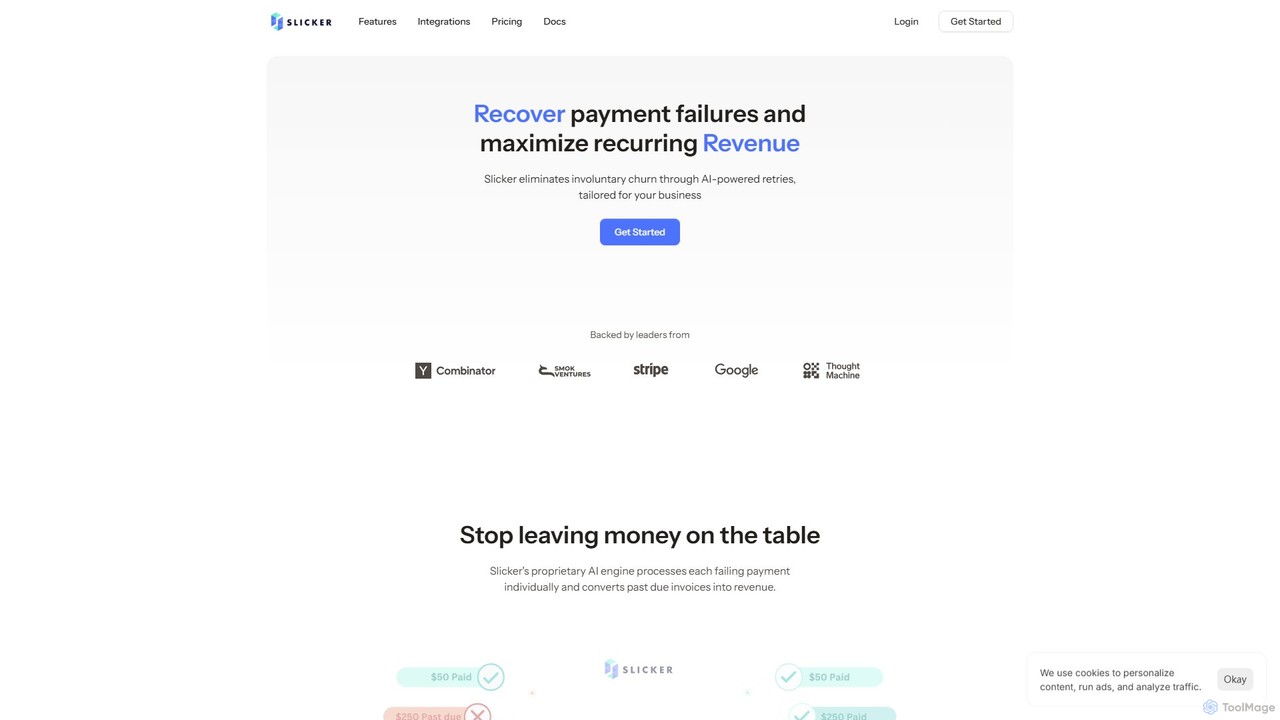
Slicker
Slicker is an AI-powered platform designed to automatically recover failed recurring payments and reduce involuntary churn for subscription-based …
Slicker is an AI-powered platform designed to automatically recover failed recurring payments and reduce involuntary churn for subscription-based businesses. By using a state-of-the-art machine learning model, it optimizes payment retry attempts at the most opportune times, significantly boosting revenue recovery rates compared to standard billing systems.
About Subscription Management
Subscription Management tools are specialized SaaS platforms designed to automate and handle the entire customer subscription lifecycle. They operate by integrating with payment gateways to manage recurring billing, invoicing, and revenue recognition processes. These platforms are crucial for businesses with recurring revenue models, as they streamline complex financial operations, reduce churn, and provide key growth metrics. Many modern tools leverage AI for predictive analytics, such as forecasting churn or optimizing dunning strategies.
Core Features
- Recurring Billing Automation: Automatically charges customers on monthly, annual, or custom schedules and handles prorations for plan changes.
- Dunning Management: Intelligently manages failed payments by automatically retrying charges and sending customized reminders to reduce involuntary churn.
- Subscription Lifecycle Control: Provides workflows for handling upgrades, downgrades, pauses, cancellations, and free trials seamlessly.
- Revenue Recognition & Analytics: Delivers crucial metrics like MRR, ARR, churn rate, and LTV, while ensuring compliance with accounting standards.
- Customer Self-Service Portal: Empowers customers to manage their own plans, update payment information, and view billing history.
Use Cases
These tools are essential for any business model based on recurring payments. This includes Software-as-a-Service (SaaS) companies, digital media publishers with paywalls, e-learning platforms, subscription box services, and membership-based organizations. They help finance, operations, and product teams manage revenue streams efficiently.
How to Choose
When selecting a Subscription Management tool, evaluate its integration capabilities with your existing CRM, accounting software, and payment gateways. Consider its ability to support various pricing models (tiered, usage-based, flat-rate) and its scalability to handle future growth. Also, assess its compliance with global tax regulations and data security standards like PCI DSS.

Subscription ManagementUse Cases
Automating Billing for a SaaS Startup
A growing SaaS company uses a subscription management platform to automate its entire billing process. Instead of manually creating invoices, the system automatically charges customers monthly or annually based on their chosen plan. When a user upgrades to a higher tier mid-cycle, the platform calculates the prorated amount and adjusts the next invoice accordingly. This eliminates manual accounting errors, saves dozens of hours for the finance team, and ensures a smooth, professional billing experience for customers.
Reducing Involuntary Churn with Smart Dunning
An online media publisher faces significant revenue loss from failed credit card payments (involuntary churn). They implement a subscription management tool with a smart dunning feature. The system doesn't just retry the payment; it uses AI to determine the optimal time and frequency for retries based on historical data. It also sends a series of automated, friendly email reminders to customers with expiring cards, prompting them to update their details. This proactive approach can recover a significant percentage of otherwise lost revenue.
Empowering Customers with a Self-Service Portal
An e-learning platform wants to reduce the load on its customer support team. By integrating a subscription management tool, they provide a secure self-service portal for their students. Through this portal, users can independently upgrade to an annual plan, pause their subscription during a break, update their credit card information, or download past invoices for their records. This improves customer satisfaction by giving them control and frees up support agents to handle more complex inquiries.
Analyzing Key Growth Metrics for Product Decisions
A product manager for a mobile app needs to understand user behavior and revenue trends. The subscription management platform's analytics dashboard provides real-time data on Monthly Recurring Revenue (MRR), customer churn rate, and Lifetime Value (LTV). By segmenting this data, the manager can identify which pricing plans have the highest retention and which features are driving upgrades. These insights are critical for making informed decisions about the product roadmap and pricing strategy.
Managing a Physical Subscription Box Service
A company selling curated coffee subscription boxes needs to manage complex logistics and billing. Their subscription management tool handles recurring payments for different box sizes and delivery frequencies (e.g., weekly, monthly). It allows customers to easily skip a month or change their subscription preferences through a self-service portal. The platform integrates with their shipping software, ensuring that payments are confirmed before a box is dispatched, streamlining the entire order-to-fulfillment process.
Ensuring Global Tax and Revenue Compliance
A software company sells its product to customers worldwide and struggles with complex international tax laws. They adopt a subscription management platform that automates tax compliance. The system automatically identifies a customer's location and applies the correct VAT, GST, or sales tax rate to each invoice. It also generates revenue recognition reports that comply with accounting standards like ASC 606 and IFRS 15, simplifying financial audits and ensuring the company remains compliant as it scales globally.