
TranscriptionAI
TranscriptionAI is an advanced AI-powered platform designed to automate the transcription, analysis, and understanding of business calls. It …
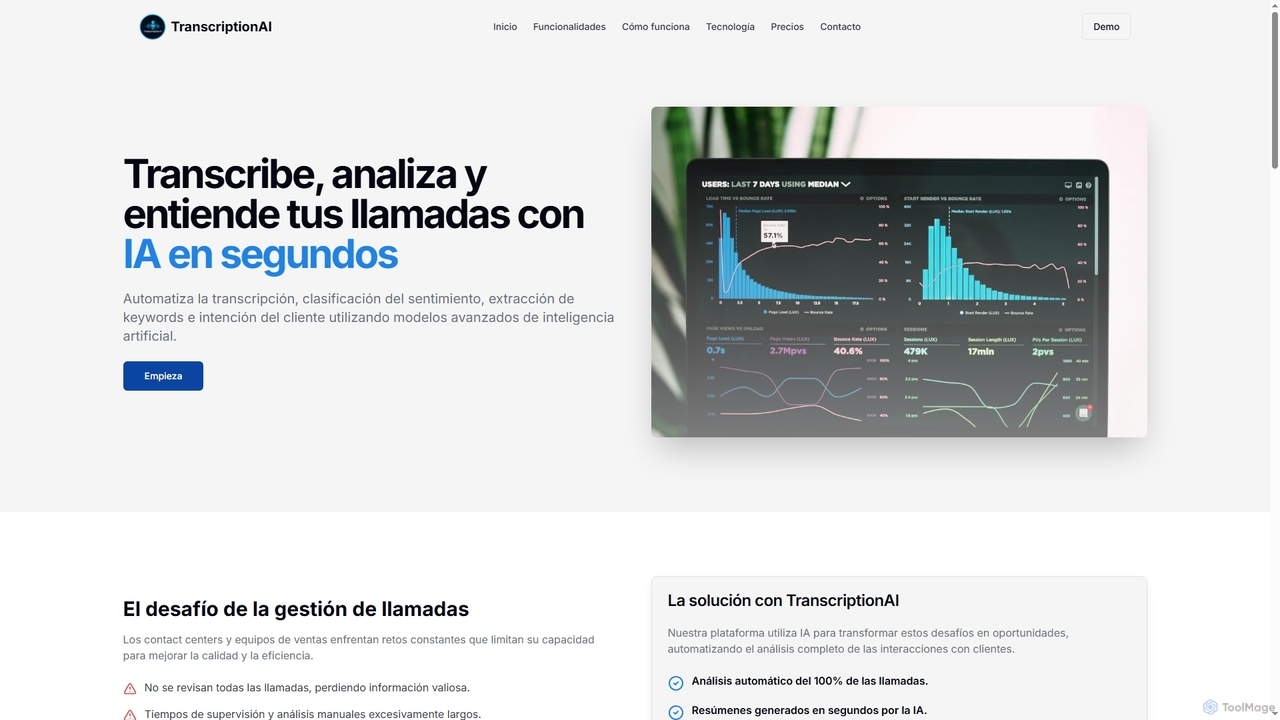
TranscriptionAI is an advanced AI-powered platform designed to automate the transcription, analysis, and understanding of business calls. It helps contact centers and sales teams gain valuable insights by classifying sentiment, extracting keywords, identifying customer intent, and generating concise summaries, significantly improving operational efficiency and customer satisfaction.
About Performance Monitoring
Performance Monitoring tools are AI-powered solutions designed to track, analyze, and optimize the efficiency and effectiveness of sales operations. Leveraging advanced analytics and machine learning, these tools provide real-time insights into key sales metrics, identifying trends and bottlenecks. They empower sales teams and managers to make data-driven decisions, improve productivity, and ultimately boost revenue within the broader sales ecosystem.
Core Features
- Real-time Data Dashboards: Visualize sales performance metrics, pipeline status, and team activities instantly.
- Predictive Analytics: Forecast future sales trends, revenue, and potential risks based on historical data.
- Anomaly Detection: Automatically identify unusual patterns or deviations in sales performance that require attention.
- Sales Forecasting: Generate accurate sales predictions to aid in resource allocation and strategic planning.
- Automated Reporting: Create customizable reports on sales KPIs, team performance, and individual contributions without manual effort.
Applicable Scenarios
Sales managers use these tools to oversee team performance, identify coaching opportunities, and ensure targets are met. Sales operations teams leverage them to optimize pipeline stages, improve conversion rates, and streamline workflows. Additionally, sales executives rely on performance monitoring for strategic planning and understanding overall business health.
How to Choose
When selecting a Performance Monitoring tool, consider its data integration capabilities with existing CRMs and other sales platforms. Evaluate the level of customization offered for dashboards and reports to match your specific KPIs. Assess the accuracy of its predictive analytics and anomaly detection features, and ensure it offers scalability to grow with your team. Finally, a user-friendly interface is crucial for widespread adoption and effective use by all sales personnel.
Performance MonitoringUse Cases
Optimizing Sales Team Productivity
A sales manager uses a Performance Monitoring tool to track individual sales representative activities, call logs, and email outreach. By analyzing engagement metrics and conversion rates, the manager identifies top performers' strategies and areas where underperforming reps need coaching, leading to targeted training programs and a measurable increase in team-wide productivity.
Optimizing Individual Sales Rep Performance
Sales managers use these tools to track individual sales representative KPIs such as call volume, email outreach, meeting schedules, and closed deals. This allows for identifying top performers, pinpointing areas for improvement, and providing targeted coaching to enhance overall team productivity and achieve sales quotas.
Real-time Sales Pipeline Monitoring
Sales managers use AI performance monitoring tools to visualize the entire sales pipeline in real-time. They can quickly identify stalled deals, bottlenecks in specific stages, or reps needing support, enabling proactive intervention to keep deals moving and prevent revenue loss.
Identifying Sales Pipeline Bottlenecks
A sales operations specialist leverages the tool's pipeline analysis features to visualize deal progression across different stages. The system highlights stages where deals frequently stall or drop off, indicating potential issues with lead qualification or proposal delivery. This insight allows the team to refine their sales process and improve conversion rates.
Enhancing Sales Pipeline Efficiency
Analyze conversion rates at each stage of the sales funnel, from lead generation to deal closure. By visualizing bottlenecks and drop-off points, sales operations can refine their processes, improve lead qualification, and implement strategies to accelerate deal velocity and increase overall pipeline conversion.
Identifying Underperforming Sales Reps
Sales team leaders leverage these tools to analyze individual sales rep performance against KPIs like call volume, conversion rates, and deal size. AI algorithms can pinpoint reps consistently falling below targets or showing unusual patterns, allowing for targeted coaching and training to improve their effectiveness.
Forecasting Quarterly Sales Revenue
A sales director utilizes the predictive analytics capabilities of the Performance Monitoring tool to forecast quarterly revenue with greater accuracy. By analyzing historical sales data, current pipeline health, and external market trends, the tool provides data-driven projections, enabling better resource allocation and strategic planning for the upcoming quarter.
Real-time Revenue Tracking and Forecasting
Business leaders and finance teams monitor current revenue generation against targets in real time. AI-powered predictive analytics help forecast future sales trends and potential revenue, enabling proactive adjustments to sales strategies, resource allocation, and inventory management to meet financial objectives.
Predicting Future Sales Trends
Sales operations teams utilize predictive analytics within performance monitoring platforms to forecast future sales volumes and revenue based on historical data, market trends, and current pipeline health. This helps in resource allocation, inventory planning, and setting realistic sales targets for upcoming quarters.
Personalizing Sales Coaching for Representatives
An individual sales representative reviews their personal performance dashboard to understand their strengths and weaknesses. The tool might show lower conversion rates on initial calls but high success in closing deals. This self-awareness, combined with manager insights from the tool, allows for personalized coaching focused on improving specific stages of their sales cycle.
Identifying Sales Process Bottlenecks
Operations and sales enablement teams leverage performance data to pinpoint inefficiencies within the sales workflow. This includes analyzing response times, identifying stalled deals, or uncovering training gaps, leading to process improvements that streamline operations and reduce sales cycle length.
Optimizing Sales Campaign Effectiveness
Marketing and sales teams collaborate using performance monitoring to track the direct impact of specific sales campaigns or promotions on conversion rates, lead quality, and overall revenue. By analyzing these metrics, they can quickly identify successful strategies and optimize underperforming campaigns for better ROI.
Evaluating Sales Campaign Effectiveness
A marketing and sales alignment team uses the tool to monitor the impact of specific marketing campaigns on sales performance. By correlating campaign launch dates with lead generation, pipeline growth, and closed deals, they can accurately measure ROI, identify successful campaign elements, and optimize future marketing efforts for better sales outcomes.
Evaluating Sales Campaign Effectiveness
Marketing and sales teams assess the impact of specific marketing campaigns or sales initiatives on lead quality, conversion rates, and overall sales performance. This data-driven approach helps optimize future campaign strategies, allocate budgets more effectively, and maximize ROI.
Detecting Sales Performance Anomalies
Business analysts employ AI-driven anomaly detection features to automatically flag unusual spikes or drops in sales metrics, such as sudden declines in a specific product's sales or unexpected increases in customer churn. This allows for rapid investigation into root causes, whether it's a market shift, competitor action, or internal issue.
Ensuring CRM Data Accuracy and Compliance
A sales operations manager employs the Performance Monitoring tool to audit CRM data entry and usage patterns. The tool can flag incomplete records, inconsistent data, or missed follow-ups, ensuring that the sales team adheres to data entry protocols. This improves data quality, which is crucial for accurate reporting and compliance.
Proactive Customer Churn Prediction
Account management and sales teams monitor customer engagement, usage patterns, and satisfaction metrics to predict potential customer churn. Early identification allows for proactive outreach, personalized retention strategies, and timely interventions to maintain customer loyalty and recurring revenue.
Automating Sales Performance Reporting
Sales directors and executives use these tools to generate automated, customizable reports on overall sales performance, team achievements, and individual contributions. This eliminates manual data compilation, saving significant time and ensuring stakeholders receive consistent, up-to-date insights for strategic decision-making.