Siml.ai
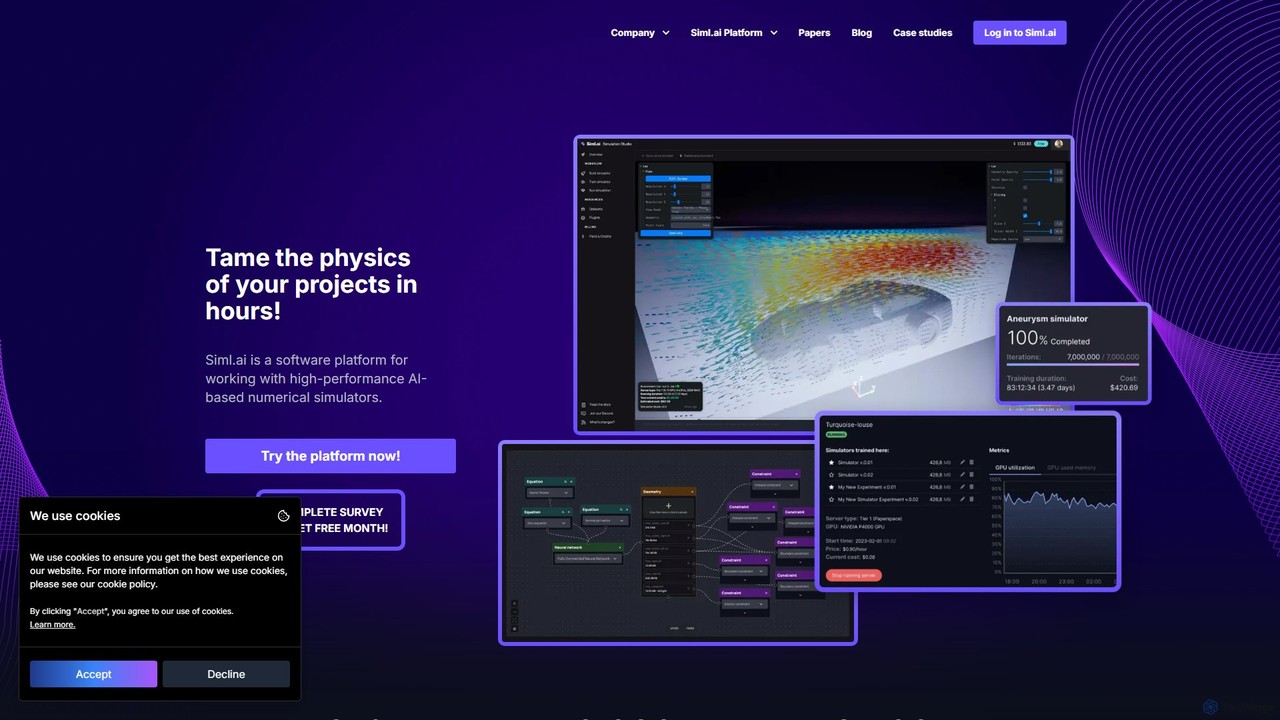
Siml.ai is an AI-powered software platform designed for high-performance physics simulations. It enables engineers and researchers to train …
Siml.ai is an AI-powered software platform designed for high-performance physics simulations. It enables engineers and researchers to train AI models that accelerate simulations by up to 100,000x, transforming weeks of computation into hours. The web-based platform allows for the creation of interactive, real-time digital twins with high-fidelity visualization, democratizing access to advanced scientific simulation tools.

Praxy Labs
Praxy Labs offers immersive 3D virtual laboratories and AI-powered simulations for STEM education. It enables students to conduct …
Praxy Labs offers immersive 3D virtual laboratories and AI-powered simulations for STEM education. It enables students to conduct realistic experiments in physics, chemistry, and biology in a safe, accessible, and interactive online environment, enhancing learning outcomes and engagement.
About Simulation
AI Simulation tools are advanced platforms that leverage artificial intelligence to create, run, and analyze virtual models of real-world or hypothetical systems. These tools utilize machine learning and deep learning algorithms to enhance model accuracy, predict outcomes with greater precision, and optimize complex processes within a controlled digital environment. They serve as a critical component in scientific research and development, enabling researchers and engineers to test hypotheses, iterate designs, and understand system behaviors without physical constraints or risks, thereby accelerating innovation across various fields.
Core Features
- AI-driven Model Generation: Automatically constructs complex simulation models from diverse datasets, significantly reducing manual effort and accelerating initial setup.
- Predictive Analytics & Optimization: Forecasts future states and identifies optimal parameters or configurations to achieve desired outcomes efficiently, from resource allocation to system performance.
- Scenario Testing & Validation: Systematically evaluates performance and robustness under a wide range of conditions, including rare or extreme edge cases, for comprehensive risk assessment and design improvement.
- Real-time Visualization & Interaction: Provides dynamic, interactive graphical representations of simulation progress and results, aiding in intuitive understanding, collaborative analysis, and rapid decision-making.
- Reinforcement Learning Integration: Facilitates the training and refinement of AI agents or autonomous systems within safe, virtual environments, accelerating learning cycles and reducing the need for costly physical prototypes.
Applicable Scenarios
AI Simulation tools are indispensable across various scientific and engineering disciplines, offering a powerful means to explore complex phenomena. They are extensively used in drug discovery to model molecular interactions and predict compound efficacy, in aerospace for testing new aircraft designs under extreme environmental conditions, and in environmental science to predict climate change impacts and evaluate mitigation strategies. Furthermore, these tools are vital in manufacturing for process optimization, in logistics for supply chain modeling, and in robotics for developing and refining autonomous systems, allowing for rapid iteration and validation that significantly reduces the time and cost associated with physical experimentation and real-world deployment.
How to Choose
When selecting an AI Simulation tool, it is crucial to consider its model fidelity and complexity handling, ensuring it can accurately represent the intricacies of your target system and manage large-scale data. Evaluate its integration capabilities with your existing data sources, analysis platforms, and other AI models to ensure a seamless workflow. Assess the platform's scalability and computational efficiency for handling large datasets, high-frequency simulations, and parallel processing demands. Finally, examine the user interface and customization options, looking for intuitive design, robust API access, and flexibility to adapt to your team's technical expertise and specific project requirements, ensuring long-term utility and adoption.
SimulationUse Cases
Optimizing Drug Discovery Pathways
Pharmaceutical researchers leverage AI simulation to model complex molecular interactions and predict the efficacy, toxicity, and pharmacokinetic properties of new drug candidates. By simulating thousands of potential compounds in a virtual environment, they can rapidly identify the most promising molecules, significantly reducing the time and cost associated with traditional laboratory testing and accelerating the drug development pipeline from initial discovery to clinical trials.
Testing Autonomous Vehicle Algorithms
Automotive engineers utilize AI simulation to create highly realistic virtual environments for rigorously testing autonomous driving algorithms. These simulations can replicate diverse road conditions, weather patterns, traffic scenarios, and unexpected events, allowing developers to refine perception, decision-making, and control systems safely and efficiently. This process helps identify potential failures, improve system robustness, and validate safety protocols before real-world deployment, saving millions in physical testing costs.
Enhancing Supply Chain Resilience
Logistics and supply chain managers employ AI simulation to model intricate global networks, including manufacturing plants, warehouses, transportation routes, and customer demand. By simulating various disruptions—such as natural disasters, geopolitical events, or sudden demand spikes—they can assess vulnerabilities, optimize inventory levels, identify alternative routes, and develop robust contingency plans. This proactive approach helps build more resilient and efficient supply chains, minimizing operational risks and ensuring timely delivery.
Informing Sustainable Urban Planning
Urban planners and policymakers use AI simulation to model the long-term impacts of city development projects, population growth, and resource consumption. They can simulate traffic flow, energy usage, waste generation, and public transport efficiency under different planning scenarios. This enables data-driven decisions on infrastructure investments, zoning regulations, and environmental policies, leading to more sustainable, livable, and efficient urban environments for residents.
Accelerating Robotics Development & Training
Robotics engineers utilize AI simulation to provide a safe and controlled virtual sandbox for training and testing robotic systems. Robots can learn complex tasks, refine motor skills, and adapt to new environments through reinforcement learning within these simulations, without the risk of damaging physical hardware or endangering humans. This accelerates the development cycle, allows for rapid iteration of control algorithms, and prepares robots for deployment in real-world industrial or service applications.
Predicting Financial Market Behavior
Financial analysts and quantitative traders use AI simulation to model complex financial markets, including stock price movements, commodity fluctuations, and economic indicators. By simulating various market conditions, trading strategies, and economic shocks, they can test hypotheses, assess risk exposure, and optimize investment portfolios. This allows for more informed decision-making, helping to identify potential opportunities and mitigate financial risks in volatile market environments.