Flora Incognita
Flora Incognita is a free, AI-powered mobile app that enables users to identify over 30,000 plant species with …
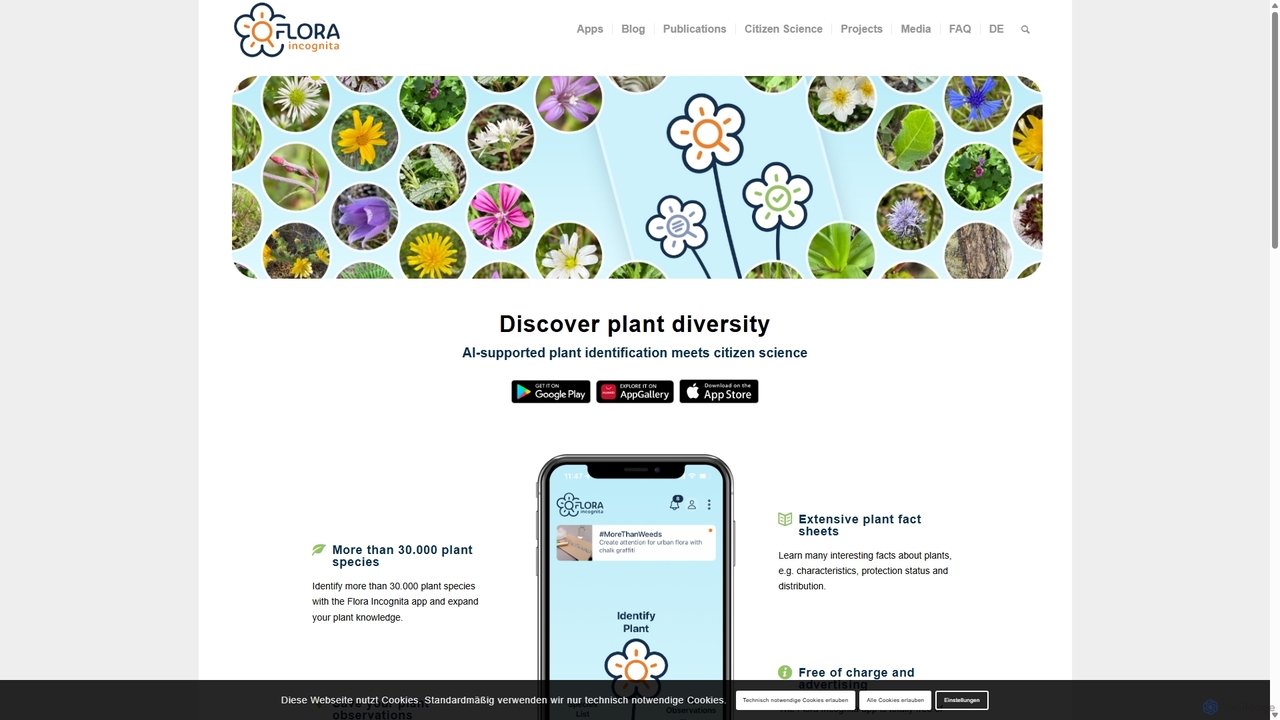
Flora Incognita is a free, AI-powered mobile app that enables users to identify over 30,000 plant species with high accuracy. It functions as a citizen science project, allowing users to contribute valuable data for biodiversity and climate change research. The app is ad-free and works offline.

Flora Incognita
An AI-powered mobile app for highly accurate plant identification. Developed by German research institutions, it identifies over 30,000 …
An AI-powered mobile app for highly accurate plant identification. Developed by German research institutions, it identifies over 30,000 species, provides detailed plant profiles, and functions as a citizen science platform. It's completely free, ad-free, and includes an offline mode, making it ideal for students, nature enthusiasts, and researchers.
About Science
Science AI tools are AI-powered platforms and applications designed to accelerate discovery, enhance analysis, and automate processes across various scientific disciplines. These tools leverage advanced machine learning, deep learning, and computational techniques to process vast datasets, generate hypotheses, and simulate complex phenomena. They empower researchers, academics, and industry professionals to overcome traditional research bottlenecks, leading to faster breakthroughs and more efficient scientific inquiry.
Core Features
- Advanced Data Analysis: Processes and interprets large, complex scientific datasets, identifying hidden patterns and correlations.
- Predictive Modeling & Simulation: Creates accurate models to predict outcomes, simulate experiments, and explore theoretical scenarios without physical trials.
- Automated Hypothesis Generation: Analyzes scientific literature and experimental data to propose novel hypotheses and research directions.
- Experimental Design Optimization: Recommends optimal parameters and designs for experiments, reducing trial-and-error and resource consumption.
- Image & Signal Processing: Analyzes scientific images (e.g., microscopy, medical scans, astronomical data) and signals for feature extraction and anomaly detection.
Applicable Scenarios
Science AI tools are indispensable in fields like pharmaceutical research for drug discovery, materials science for novel compound design, and climate modeling for environmental predictions. They assist biologists in genomic data interpretation, chemists in reaction optimization, and physicists in complex simulation analysis, driving innovation across the scientific spectrum.
How to Choose
When selecting Science AI tools, consider their domain specificity (e.g., biology, chemistry), data handling capabilities (volume, type, format), and the interpretability of their models. Evaluate integration with existing lab equipment and software, scalability for future research needs, and the robustness of their validation and reproducibility features to ensure reliable scientific outcomes.
ScienceUse Cases
Accelerating Drug Discovery & Development
Pharmaceutical researchers utilize Science AI tools to rapidly screen vast libraries of compounds, predict drug-target interactions, and optimize molecular structures. This significantly reduces the time and cost associated with identifying promising drug candidates, moving them faster from concept to clinical trials and ultimately to patients.
Designing Novel Materials with Desired Properties
Materials scientists employ AI to predict the properties of hypothetical compounds and design new materials with specific characteristics, such as enhanced strength or conductivity. By simulating molecular interactions and predicting outcomes, AI minimizes the need for extensive physical experimentation, accelerating innovation in fields like aerospace and energy.
Enhancing Climate Change Modeling Accuracy
Climatologists leverage Science AI tools to analyze massive environmental datasets, including satellite imagery, sensor readings, and historical weather patterns. AI helps refine complex climate models, improving the accuracy of long-term predictions for temperature changes, sea-level rise, and extreme weather events, which is crucial for policy-making and disaster preparedness.
Interpreting Complex Genomic and Proteomic Data
Biologists and geneticists use AI to process and interpret vast amounts of genomic and proteomic data, identifying genetic markers for diseases, understanding gene functions, and discovering new biological pathways. This accelerates personalized medicine, disease diagnosis, and the development of targeted therapies.
Optimizing Chemical Reaction Pathways
Chemists apply AI to predict optimal reaction conditions, catalysts, and synthetic routes for complex chemical processes. By analyzing vast databases of chemical reactions and simulating outcomes, AI tools help minimize waste, improve yield, and discover more efficient and sustainable methods for chemical synthesis.
Analyzing Astronomical Data for New Discoveries
Astronomers utilize Science AI tools to sift through petabytes of data from telescopes and observatories, identifying subtle patterns, classifying celestial objects, and detecting transient phenomena like supernovae or exoplanets. This automation allows for discoveries that would be impossible with manual analysis, pushing the boundaries of our understanding of the universe.