Doco
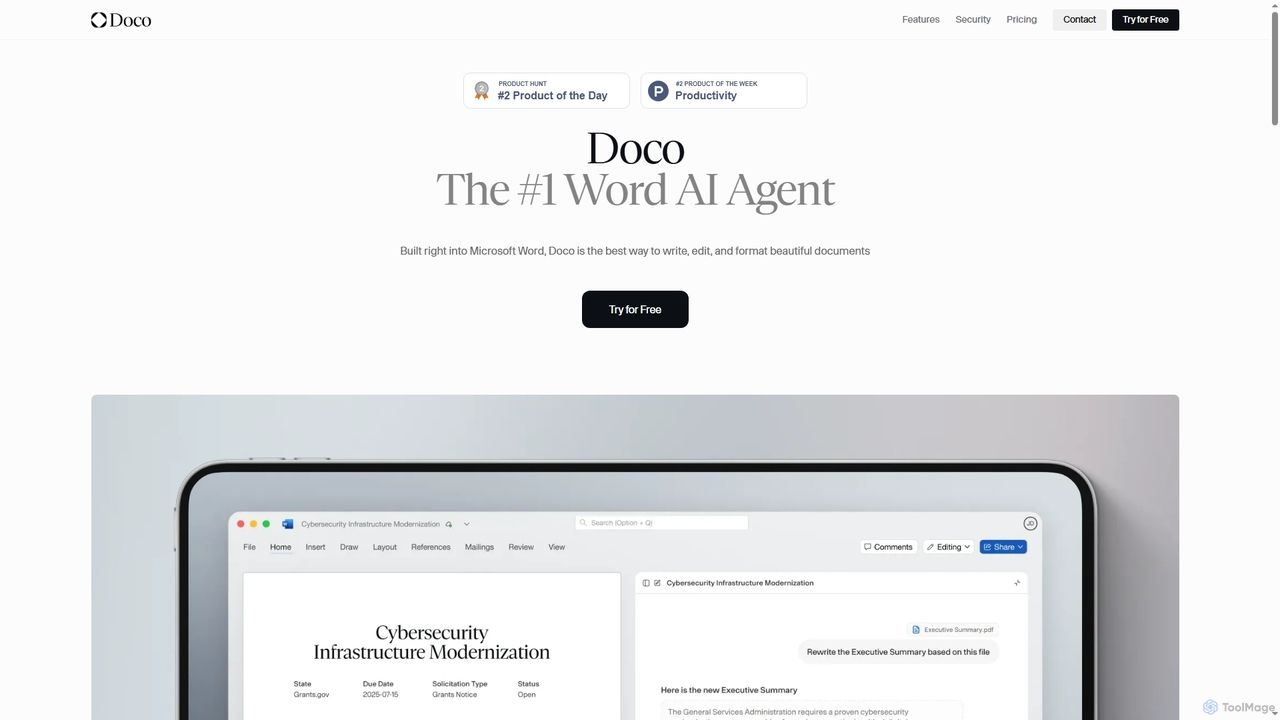
Doco is an AI agent that integrates directly into Microsoft Word, leveraging your existing data and knowledge base …
Doco is an AI agent that integrates directly into Microsoft Word, leveraging your existing data and knowledge base to draft, edit, and format documents. It learns your workflow, ensures style consistency, and provides enterprise-grade security, transforming complex tasks into a competitive advantage for businesses of all sizes.
About Data Privacy
Data Privacy tools are a specialized category of AI-powered software designed to identify, manage, and protect personally identifiable information (PII) and other sensitive data. These tools leverage machine learning for tasks like automated data discovery, classification, and anonymization, helping organizations comply with regulations like GDPR and CCPA. By transforming raw data into a privacy-safe format, they enable data utilization for analytics and development without compromising individual privacy. This focus on protecting the data itself distinguishes them within the broader Security landscape.
Core Features
- PII Detection and Classification: Automatically scans structured and unstructured data sources to find and categorize sensitive information like names, addresses, and credit card numbers.
- Data Anonymization and Masking: Replaces or obfuscates sensitive data with realistic but fictional information, preserving data utility for testing or analysis.
- Synthetic Data Generation: Creates statistically representative artificial datasets from real data, eliminating the risk of exposing personal information.
- Compliance Monitoring and Reporting: Tracks data usage, manages user consent, and generates reports to demonstrate adherence to privacy regulations.
Applicable Scenarios
These tools are crucial for industries handling large volumes of personal data, such as finance, healthcare, and e-commerce. Development teams use them to create safe testing environments with synthetic data. Compliance officers employ them to conduct data audits and ensure regulatory adherence. Data analysts can work with anonymized datasets to extract insights without privacy risks.
Selection Criteria
When choosing a Data Privacy tool, consider the specific regulations you must comply with (e.g., GDPR, HIPAA). Evaluate its ability to handle your data types (databases, documents, images) and integrate with your existing systems. Assess the trade-off between the level of anonymization and the resulting data's utility for your specific needs. Also, consider the tool's accuracy in PII detection and the quality of its synthetic data generation.
Data PrivacyUse Cases
Enable Safe Software Development and Testing
A software development team at a fintech company needs to test a new transaction processing feature. Instead of using real, sensitive customer data, which poses a significant security risk, they use a Data Privacy tool to generate a high-fidelity synthetic dataset. This artificial data perfectly mimics the structure, patterns, and statistical properties of the production data without containing any real PII. As a result, developers and QA engineers can conduct thorough, realistic testing in a secure environment, accelerating the development lifecycle while ensuring full compliance with financial data regulations.
Conduct Privacy-Preserving Medical Research
A medical research institute wants to analyze a large dataset of patient records to identify trends in a specific disease. To comply with HIPAA regulations, they must not use any personally identifiable information. They employ a Data Privacy tool to automatically scan and anonymize the entire dataset. The tool redacts names and addresses, shifts dates, and generalizes location data while preserving the clinical information crucial for the study. This allows researchers to perform large-scale data analysis and publish their findings without compromising the privacy of any individual patient.
Automate GDPR Right-to-be-Forgotten Requests
A compliance officer at a large e-commerce company receives a 'right to be forgotten' request from a customer under GDPR. Manually finding and deleting all of the customer's data across dozens of systems (CRM, billing, marketing, support) is a complex and error-prone task. The company uses a Data Privacy tool that integrates with all these systems. The officer enters the customer's identifier, and the tool automatically locates all associated PII, anonymizes it in systems where records must be kept for legal reasons (e.g., transaction history), and flags it for deletion elsewhere. This automates and documents the process, ensuring timely and verifiable compliance.
Securely Share Data with External Partners
A retail company wants to collaborate with a third-party analytics firm to analyze customer purchasing patterns. Sharing the raw customer database would violate privacy policies. Using a Data Privacy tool, the company's data team creates a masked version of the database. The tool replaces real names with pseudonyms, groups exact ages into age brackets, and generalizes zip codes to broader regions. The resulting dataset is shared securely with the partner, who can perform meaningful analysis on purchasing behavior without ever accessing a single piece of real customer PII, ensuring both utility and privacy.
Perform Internal Data Audits for Compliance
A Data Protection Officer (DPO) is tasked with ensuring their organization is CCPA compliant. They use a Data Privacy tool to perform a comprehensive audit of all internal data stores, including cloud storage, databases, and shared drives. The tool's AI-powered discovery feature automatically scans terabytes of data to identify and map all instances of California residents' PII. It generates a detailed report showing where sensitive data is located, who has access to it, and whether it is adequately protected. This allows the DPO to identify compliance gaps, remediate risks, and produce documentation for regulatory review.
Redact Sensitive Information from Customer Support Logs
A customer support manager wants to analyze chat transcripts and call recordings to improve agent performance. However, these logs often contain sensitive PII like credit card numbers, addresses, and account passwords, which cannot be stored or analyzed freely. The company implements a Data Privacy tool that automatically processes all support logs in real-time. The tool uses natural language processing (NLP) to identify and redact (black out) any PII. The resulting clean logs can be safely fed into analytics platforms or used for agent training, providing valuable insights without creating a data privacy liability.