Cronos
Cronos is a privacy-first web browser integrating 100% local AI, offering unparalleled data protection and enhanced performance. It …
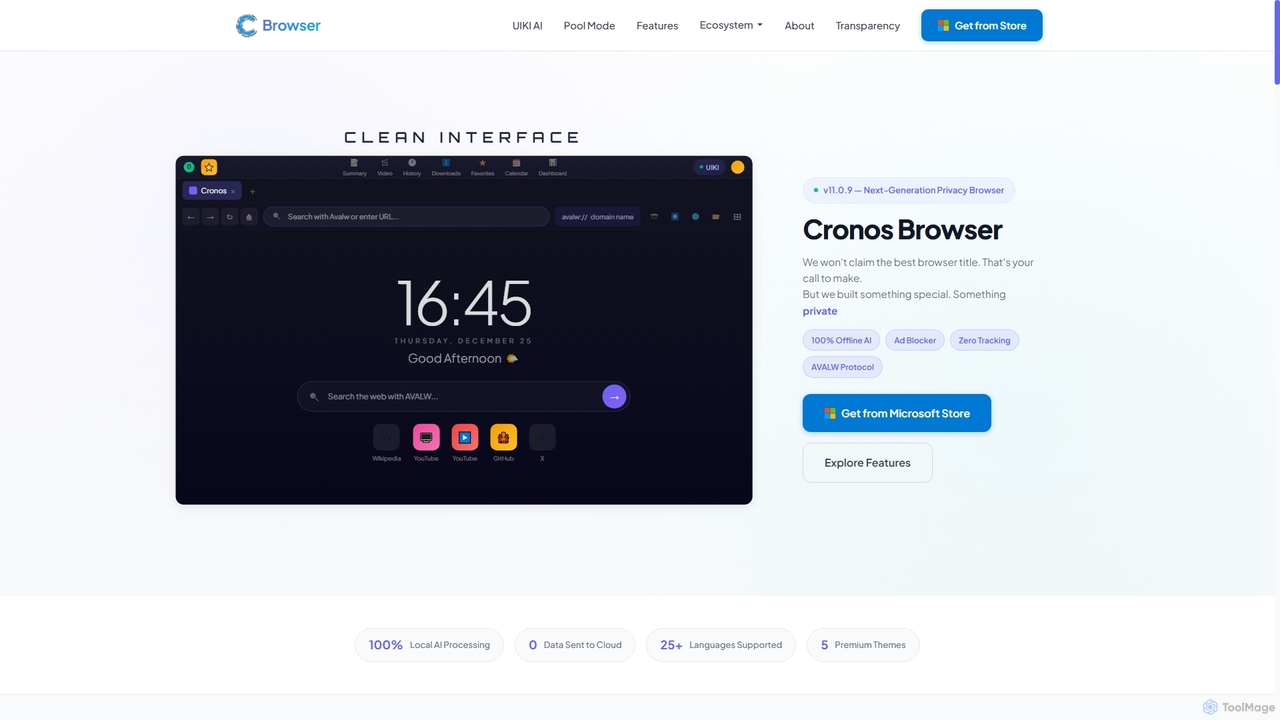
Cronos is a privacy-first web browser integrating 100% local AI, offering unparalleled data protection and enhanced performance. It features an offline AI assistant, a decentralized network, built-in ad blocking, and advanced security protocols, ensuring your browsing experience is fast, secure, and completely private without cloud data transmission.
About Data Protection
Data Protection AI tools are designed to safeguard sensitive information, ensuring privacy, compliance, and preventing unauthorized access or breaches. These AI-powered solutions leverage advanced algorithms to identify, classify, and protect data across various environments. They provide proactive measures to mitigate risks, automate compliance checks, and enhance the overall security posture of an organization's digital assets. By intelligently managing data lifecycle and access, they help maintain trust and adhere to regulatory requirements.
Core Features
- Data Classification & Discovery: Automatically identifies and categorizes sensitive data across systems, databases, and cloud environments.
- Automated Compliance Monitoring: Continuously checks data handling practices against regulations like GDPR, HIPAA, and CCPA, flagging non-compliance.
- Data Loss Prevention (DLP): Prevents sensitive data from leaving controlled environments through unauthorized channels, whether accidental or malicious.
- Anonymization & Pseudonymization: Transforms identifiable data into non-identifiable formats while preserving its analytical utility.
- Threat Detection & Response: Uses AI to detect unusual access patterns or data exfiltration attempts, enabling rapid incident response.
Use Cases
Organizations across finance, healthcare, and government utilize Data Protection AI tools to manage vast amounts of sensitive customer and operational data. They are crucial for maintaining regulatory compliance, protecting intellectual property, and preventing costly data breaches. For instance, a bank might use these tools to ensure customer financial data is encrypted and access is strictly controlled, while a hospital could employ them for anonymizing patient records for research purposes.
How to Choose
When selecting Data Protection AI tools, consider the scope of data types and environments it supports (on-premise, cloud, hybrid). Evaluate its compliance reporting capabilities for relevant regulations and its integration with existing security infrastructure. Assess the accuracy of its AI models in identifying sensitive data and its ability to minimize false positives, alongside its scalability and ease of deployment.
Data ProtectionUse Cases
Automated GDPR Compliance Monitoring
Data privacy officers in European companies use AI Data Protection tools to continuously scan and monitor all data processing activities. The AI automatically identifies personal data, flags non-compliant handling, and generates audit reports, significantly reducing manual effort and ensuring adherence to GDPR regulations.
Preventing Sensitive Data Leakage
Enterprise security teams deploy Data Loss Prevention (DLP) AI tools to monitor outgoing communications and data transfers. The AI detects and blocks attempts to send confidential documents, customer lists, or intellectual property outside the organization's network, whether through email, cloud storage, or USB drives, preventing accidental or malicious data exfiltration.
Securely Anonymizing Patient Records for Research
Healthcare researchers and data scientists utilize AI Data Protection solutions to anonymize vast datasets of patient health information (PHI). The AI intelligently removes or masks direct identifiers while preserving statistical integrity, allowing for valuable medical research without compromising individual patient privacy, adhering to HIPAA and other privacy laws.
Real-time Detection of Insider Threats
IT security analysts in financial institutions employ AI-powered Data Protection tools to analyze user behavior and access patterns. The AI identifies anomalous activities, such as an employee accessing unusual databases or downloading large volumes of sensitive files outside working hours, indicating potential insider threats or compromised accounts, and triggers immediate alerts.
Classifying and Protecting Cloud Data
Cloud architects and security administrators use AI Data Protection tools to discover, classify, and apply appropriate security policies to data stored across multiple cloud platforms (AWS, Azure, GCP). The AI automatically identifies sensitive data like PII or financial records and ensures it is encrypted, access-controlled, and compliant with corporate policies and industry standards.
Automating Data Access Governance
Compliance managers in large corporations leverage AI Data Protection tools to automate and enforce data access policies. The AI dynamically adjusts user permissions based on roles, projects, and data sensitivity, ensuring that only authorized personnel can access specific datasets, thereby minimizing the risk of unauthorized data exposure and simplifying audit processes.