ToolMage
Sign in

Best 1 Conversion Optimization AI tools for Seo & Website

Popular Conversion Optimization AI tools in Seo & Website include TestMyWebsite.AI, helping you work more efficiently.

TestMyWebsite.AI
Freemium

TestMyWebsite.AI

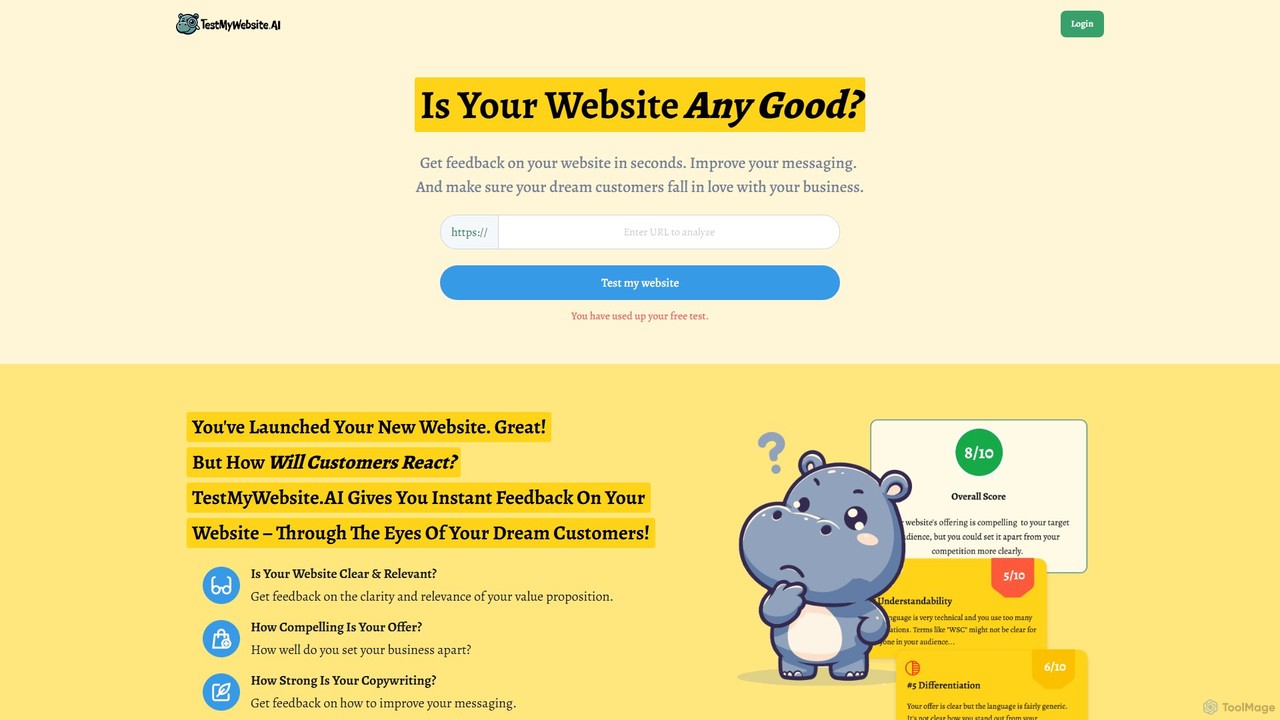
TestMyWebsite.AI is an AI-powered tool that provides instant feedback on your website's messaging, clarity, and value proposition. It acts as a virtual marketing advisor, analyzing your site through proven marketing frameworks to give you actionable tips for improvement. Ensure your dream customers fall in love with your business by optimizing your website's first impression.

Website Analytics
Visits 3.4KFavorites 117Likes 119

About Conversion Optimization

Conversion Optimization tools are AI-powered platforms designed to increase the percentage of website visitors who complete a desired action, such as a purchase or sign-up. They leverage machine learning to analyze user behavior, identify friction points, and automatically test variations of web pages, pop-ups, and calls-to-action. By personalizing user experiences in real-time and providing data-driven insights, these tools help businesses maximize the value of their existing traffic. Unlike traditional A/B testing, AI-driven optimization can test numerous combinations simultaneously, leading to faster and more significant improvements.

Core Features

  • A/B/n & Multivariate Testing: Automatically test multiple versions of headlines, images, and layouts to find the winning combination.
  • AI Personalization Engine: Dynamically change website content, offers, and recommendations based on individual user behavior.
  • Behavioral Analytics: Utilize heatmaps, scroll maps, and session replays to visually understand how users interact with your site.
  • Intelligent Pop-ups & Forms: Trigger targeted overlays and lead capture forms based on user intent, such as exit-intent or time on page.
  • Predictive Analytics: Forecast which user segments are most likely to convert and identify opportunities for intervention.

Use Cases

These tools are essential for e-commerce managers aiming to reduce cart abandonment, digital marketers looking to improve landing page performance, and UX/UI designers seeking to eliminate user friction points. They are widely applied in SaaS to boost trial sign-ups and in publishing to increase subscriber conversions.

How to Choose

When selecting a tool, consider its testing capabilities (A/B vs. multivariate), the depth of its personalization engine, and its integration with your existing platforms like Google Analytics, Shopify, or Salesforce. Also, evaluate the user interface—whether it offers a no-code visual editor for marketers or requires developer support for implementation.

Featured tool rankings

Conversion Optimization use cases

1

Optimizing E-commerce Checkout Conversion Rates

An e-commerce manager notices a high cart abandonment rate on their website. Using an AI conversion optimization tool, they run a multivariate test on the checkout page. The AI simultaneously tests different button colors, call-to-action texts (e.g., 'Buy Now' vs. 'Complete Purchase'), form field layouts, and trust badges. The platform automatically allocates more traffic to better-performing variations and identifies the optimal combination, resulting in a 15% reduction in cart abandonment and a significant uplift in sales without manual analysis.

2

Increasing Sign-ups on a SaaS Landing Page

A marketing team for a SaaS company wants to increase free trial sign-ups. They use a personalization engine to show different headlines and testimonials based on the visitor's industry, detected from their IP address or referral source. For visitors from the finance sector, it shows a case study from a bank. For tech startups, it highlights integration features. This targeted messaging resonates more strongly with each audience segment, increasing the overall sign-up rate by 25%.

3

Identifying User Friction with Session Replays

A UX designer for a new web application needs to understand why users are dropping off during the onboarding process. They use a conversion optimization tool's session replay feature to watch anonymized recordings of user sessions. By observing where users hesitate, 'rage-click' on non-responsive elements, or navigate away, the designer identifies confusing UI elements and a broken link. After redesigning the flow based on these insights, the onboarding completion rate increases by 40%.

4

Capturing Leads with Exit-Intent Pop-ups

A B2B company wants to capture more leads from visitors who are about to leave their pricing page without taking action. They implement an AI tool that triggers an exit-intent pop-up. The AI analyzes the user's on-site behavior and presents a tailored offer. For a user who spent time on integration features, it offers a 'Complete Guide to API Integration'. For another who viewed enterprise pricing, it offers a 'Request a Custom Quote' form. This contextual approach increases lead capture from abandoning visitors by 30%.

5

Personalizing Content Recommendations for Publishers

An online news portal aims to increase time on site and ad revenue. They implement an AI tool that analyzes a reader's browsing history in real-time. Based on the articles they've read (e.g., technology, finance), the tool dynamically populates 'Recommended for You' sections with highly relevant content. This personalization goes beyond simple tags, understanding nuanced topics and user interests, which significantly increases page views per session and reduces the overall bounce rate.

6

Dynamic Call-to-Action (CTA) Testing for Campaigns

A digital marketer is running a campaign with a dedicated landing page. To maximize conversions, they use an AI tool to test different CTAs. The system tests variations like 'Get Started,' 'Request a Demo,' and 'Try for Free.' Instead of a traditional 50/50 split, the AI uses a multi-armed bandit algorithm to automatically allocate more traffic to the best-performing CTA in real-time. This ensures the campaign achieves the highest possible conversion rate from day one, without waiting for a test to conclude before making a change.

Conversion Optimization FAQ

What are AI Conversion Optimization tools?

AI Conversion Optimization tools are software platforms that use artificial intelligence and machine learning to increase the percentage of website visitors who complete a desired goal (a 'conversion'). They go beyond traditional A/B testing by automatically analyzing user behavior, personalizing content for individual visitors in real-time, and testing numerous webpage variations simultaneously to quickly find the most effective design and messaging.

How to choose the right Conversion Optimization tool?

To choose the right tool, consider these key factors:

  • Testing Capabilities: Determine if you need simple A/B testing, more complex multivariate testing, or server-side testing for deep application changes.
  • Personalization Depth: Assess whether you need basic rule-based segmentation or an advanced AI engine that adapts experiences in real-time.
  • Integrations: Ensure it connects seamlessly with your essential platforms, such as Google Analytics, your CRM (e.g., Salesforce), and your e-commerce platform (e.g., Shopify).
  • Ease of Use: Decide if you need a user-friendly visual editor for marketers or a more powerful, developer-centric tool.
What's the difference between Conversion Optimization (CRO) and SEO?

SEO (Search Engine Optimization) and CRO (Conversion Rate Optimization) are two distinct but complementary disciplines. SEO focuses on attracting more visitors to your website from search engines by improving rankings. Its goal is to increase the quantity of traffic. In contrast, CRO focuses on maximizing the value of the traffic you already have by encouraging more visitors to take desired actions. Its goal is to improve the quality of engagement and outcomes. A successful strategy needs both: SEO to bring people in, and CRO to turn them into customers.

What are the main features of a Conversion Optimization tool?

Key features of modern Conversion Optimization tools typically include:

  • A/B and Multivariate Testing: To scientifically compare different versions of a webpage.
  • AI-Powered Personalization: To show tailored content, offers, and recommendations to different user segments.
  • Behavioral Analytics: Tools like heatmaps, click maps, and session replays to visualize user behavior.
  • On-site Surveys and Polls: To gather direct qualitative feedback from visitors.
  • Intelligent Overlays: AI-driven pop-ups and forms triggered by specific user behaviors like exit-intent.
Who should use Conversion Optimization tools?

These tools are valuable for a wide range of roles. Digital Marketers use them to improve campaign landing pages and lead generation forms. E-commerce Managers leverage them to optimize product pages and reduce cart abandonment. UX/UI Designers utilize them to identify and fix usability issues with data. Product Managers apply them to test new features and improve user onboarding flows. Essentially, anyone responsible for improving the performance of a website or digital product can benefit from using these tools.