Services Best in category 1 results Tutoring AI Tool

Popular AI tools in the Tutoring field of Services include CollegeEssay, etc., helping you quickly improve efficiency.

CollegeEssay

CollegeEssay

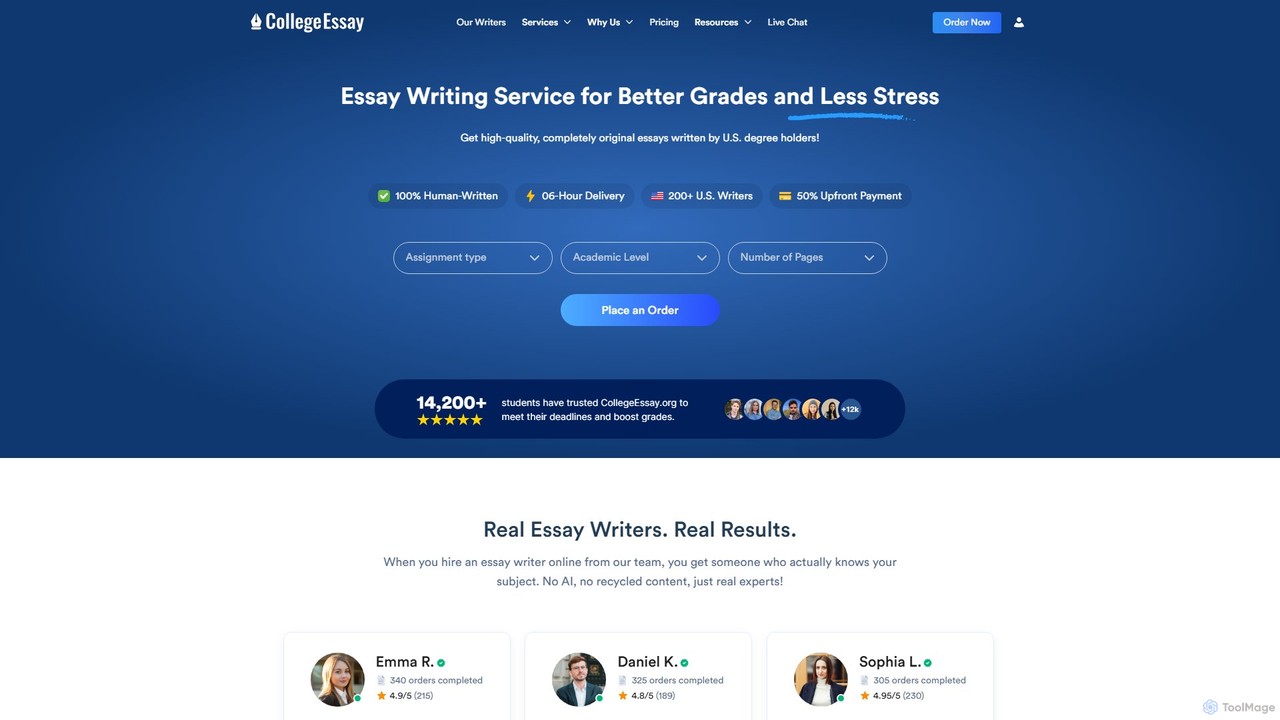
CollegeEssay.org is a professional academic writing service that connects students with expert human writers. It offers custom, AI-free …

35.9K

About Tutoring

AI Tutoring tools are a specialized category of services providing personalized, one-on-one academic support using artificial intelligence. These platforms leverage machine learning algorithms to analyze a student's learning patterns, identify knowledge gaps, and deliver customized lessons and practice problems in real-time. The primary value of AI tutors lies in their ability to offer instant, 24/7 assistance, making high-quality education more accessible and adaptive. They cater to individual pacing, offering a scalable and effective supplement to traditional learning methods.

Core Features

  • Personalized Learning Paths: The AI assesses performance to create unique study plans that focus on weak areas.
  • Instant Feedback & Explanations: Provides immediate, step-by-step solutions for homework and practice questions.
  • Adaptive Questioning: Automatically adjusts the difficulty of problems based on the user's answers to ensure optimal challenge.
  • Socratic Method Dialogue: Engages students in a guided conversation to help them discover answers on their own, fostering critical thinking.
  • Progress Tracking: Offers detailed analytics and reports for students and parents to monitor learning improvements over time.

Use Cases

AI Tutoring tools are widely used by K-12 and university students for challenging subjects like mathematics, physics, and computer science. They are also valuable for professionals seeking to learn new skills, such as coding or a new language, at their own pace. Educational institutions integrate these tools to provide supplementary, scalable support for their students outside of classroom hours.

How to Choose

When selecting an AI Tutoring tool, first consider the subject matter expertise and curriculum alignment. Evaluate the level of personalization and the quality of its feedback mechanism—does it just give answers or explain concepts? Also, assess the user interface for engagement and ease of use, especially for younger learners. Finally, compare pricing models, such as monthly subscriptions or pay-per-use, to find one that fits your budget and learning frequency.

TutoringUse Cases

1

Mastering Complex Math Homework

A high school student struggling with calculus concepts uses an AI Tutor to get unstuck on their homework. Instead of just getting the final answer, the student can ask the AI to explain a specific step, define a theorem, or provide a similar practice problem. The AI provides instant, step-by-step guidance, breaking down complex derivatives or integrals into manageable parts. This 24/7 availability means the student can get help late at night without needing to wait for a teacher, reinforcing concepts as they learn them and building confidence.

2

Preparing for Standardized Tests (SAT/ACT)

A university applicant uses an AI Tutor to prepare for the SAT. The tool first administers a diagnostic test to identify the student's strengths and weaknesses in math and verbal sections. Based on the results, it generates a personalized study schedule with adaptive practice quizzes. When the student answers a question incorrectly, the AI doesn't just show the right answer; it explains the underlying concept and links to relevant mini-lessons. This targeted approach helps the student efficiently close knowledge gaps and maximize their score potential.

3

Practicing Conversational Language Skills

A language learner uses an AI Tutor to practice speaking Spanish. They can engage in open-ended conversations with the AI, which provides real-time feedback on pronunciation, grammar, and word choice. The AI can simulate various scenarios, such as ordering food at a restaurant or asking for directions. Unlike a static app, the AI tutor adapts its responses and can ask follow-up questions, creating a dynamic and immersive practice environment that helps build fluency and confidence without the pressure of speaking with a native speaker.

4

Learning to Code with Guided Support

A beginner programmer is learning Python using an AI Tutoring platform. When they encounter a bug in their code, they can paste it into the AI tutor. Instead of just fixing the code, the AI explains the error (e.g., 'This is a syntax error because you forgot a colon'), suggests a correction, and explains the underlying programming concept. It can also generate small coding challenges to help solidify the user's understanding of loops, functions, or data structures, acting as a patient, always-on coding mentor.

5

Supporting Homeschooling Curriculum

A parent homeschooling their child uses an AI Tutor to supplement their science curriculum. The AI can provide interactive simulations of physics experiments, offer detailed explanations of biological processes, and generate quizzes aligned with the curriculum's learning objectives. If the child struggles with a topic like chemical bonding, the AI can offer multiple analogies and visual aids to explain it. This provides the parent with a powerful teaching assistant, ensuring their child receives expert-level explanations on complex subjects.

6

Identifying and Closing Learning Gaps

A middle school teacher uses an AI Tutoring platform for their class. The platform's dashboard provides the teacher with an overview of each student's progress, highlighting common mistakes and specific topics where the class is struggling. For example, the data might show that 70% of students are confused about fractions. The teacher can then use this insight to reteach the concept in class, while the AI provides personalized practice exercises for each student to work on at their own pace, effectively addressing individual and class-wide learning gaps.

TutoringFrequently Asked Questions
