Sayfli
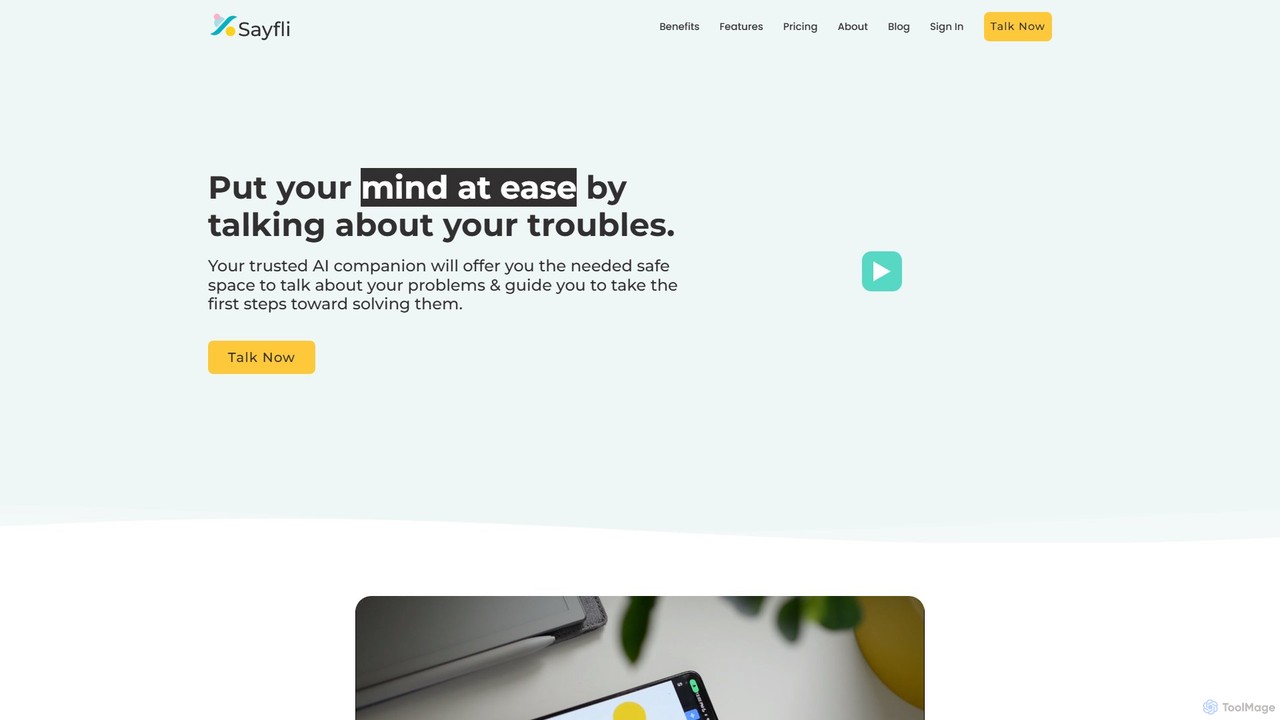
Sayfli is a trusted AI conversation partner designed to provide a safe, private, and non-judgmental space for users …
Sayfli is a trusted AI conversation partner designed to provide a safe, private, and non-judgmental space for users to express their thoughts and feelings. It supports 30 languages with various voices, ensuring 24/7 availability. It's a tool for self-expression and emotional support, not a replacement for professional therapy.
About Conversation
AI Conversation tools are a specialized category of software designed to simulate, manage, and analyze human-like dialogue. They leverage Natural Language Processing (NLP) and machine learning to understand user intent, maintain context, and provide relevant, coherent responses. These tools are primarily used to automate customer support, generate interactive content, and provide personalized user experiences at scale. Their key advantage lies in their ability to handle complex, multi-turn conversations, moving beyond simple keyword-based interactions.
Core Features
- Natural Language Understanding (NLU): Accurately interprets user input, recognizing intent and extracting key information (entities).
- Dialogue Management: Maintains the context of a conversation over multiple turns to ensure coherent and relevant interactions.
- Multi-channel Deployment: Enables deployment across various platforms like websites, mobile apps, and messaging services (e.g., WhatsApp, Messenger).
- Sentiment Analysis: Gauges the emotional tone of user messages to tailor responses and escalate issues when necessary.
- Knowledge Base Integration: Connects to internal or external databases to retrieve and provide accurate, specific information.
Use Cases
These tools are widely adopted in sectors requiring high-volume user interaction, such as e-commerce, finance, and healthcare. For instance, an online retailer can use a conversational AI as a shopping assistant to recommend products, while a bank can automate balance inquiries and transaction support, freeing up human agents for more complex tasks.
How to Choose
When selecting an AI Conversation tool, evaluate the sophistication of its NLU engine and its ability to handle industry-specific jargon. Consider its integration capabilities with your existing CRM or helpdesk software. Also, assess the ease of use of its conversation builder and the depth of its analytics for monitoring performance and user behavior.

ConversationUse Cases
Automate 24/7 Customer Support Queries
An e-commerce company uses an AI conversation tool on its website to handle common customer inquiries around the clock. The AI integrates with their order management system to provide real-time updates on shipping status, process return requests, and answer frequently asked questions about product specifications. This automation handles over 60% of incoming queries, allowing human support agents to focus on complex, high-value interactions. As a result, the company reduces average response time from hours to seconds and improves overall customer satisfaction.
Qualify Sales Leads on a Website
A B2B software company embeds a conversational AI on its pricing and product pages. Instead of a static contact form, the AI engages visitors with targeted questions about their company size, role, and specific needs. Based on the responses, it qualifies the lead in real-time. High-quality leads are immediately prompted to book a demo on a sales representative's calendar, while others are directed to relevant case studies or webinars. This interactive approach increases lead conversion rates by 30% and ensures the sales team spends time only on pre-qualified prospects.
Create a Personal Shopping Assistant
An online fashion retailer implements an AI conversation tool to act as a personal shopper. It initiates conversations with visitors, asking about their style preferences, the occasion they're shopping for, and their budget. Using this data, the AI curates a personalized collection of products, suggests matching accessories, and even helps with sizing questions by referencing size charts and customer reviews. This creates a highly engaging and tailored shopping experience, leading to higher average order values and increased customer loyalty.
Streamline Employee Onboarding and HR FAQs
A large corporation deploys an internal AI chatbot for its HR department. New hires can interact with the chatbot to ask questions about company policies, benefits enrollment, and IT setup procedures. The AI provides instant, consistent answers by accessing the company's internal knowledge base. This reduces the administrative load on HR personnel, ensures new employees receive accurate information quickly, and allows them to complete onboarding tasks at their own pace, improving the overall new hire experience.
Develop an Interactive AI Language Tutor
An ed-tech platform creates an AI-powered language tutor for students learning Spanish. Learners can engage in open-ended conversations with the AI, practicing real-life scenarios like ordering at a restaurant or asking for directions. The AI conversation tool provides instant feedback on pronunciation, corrects grammatical errors, and suggests alternative phrasing. This offers a safe, non-judgmental environment for students to build conversational fluency at any time, supplementing traditional classroom instruction and accelerating their learning progress.
Collect In-depth Customer Feedback
A SaaS company uses a conversational AI to gather user feedback after a support ticket is closed. Instead of a simple rating survey, the AI asks open-ended, follow-up questions like, 'What was the most helpful part of the interaction?' or 'If you could change one thing, what would it be?'. This conversational approach encourages users to provide more detailed, qualitative insights. The tool then analyzes and categorizes this unstructured feedback, providing the product team with actionable data to prioritize improvements and better understand user pain points.