Vecteur
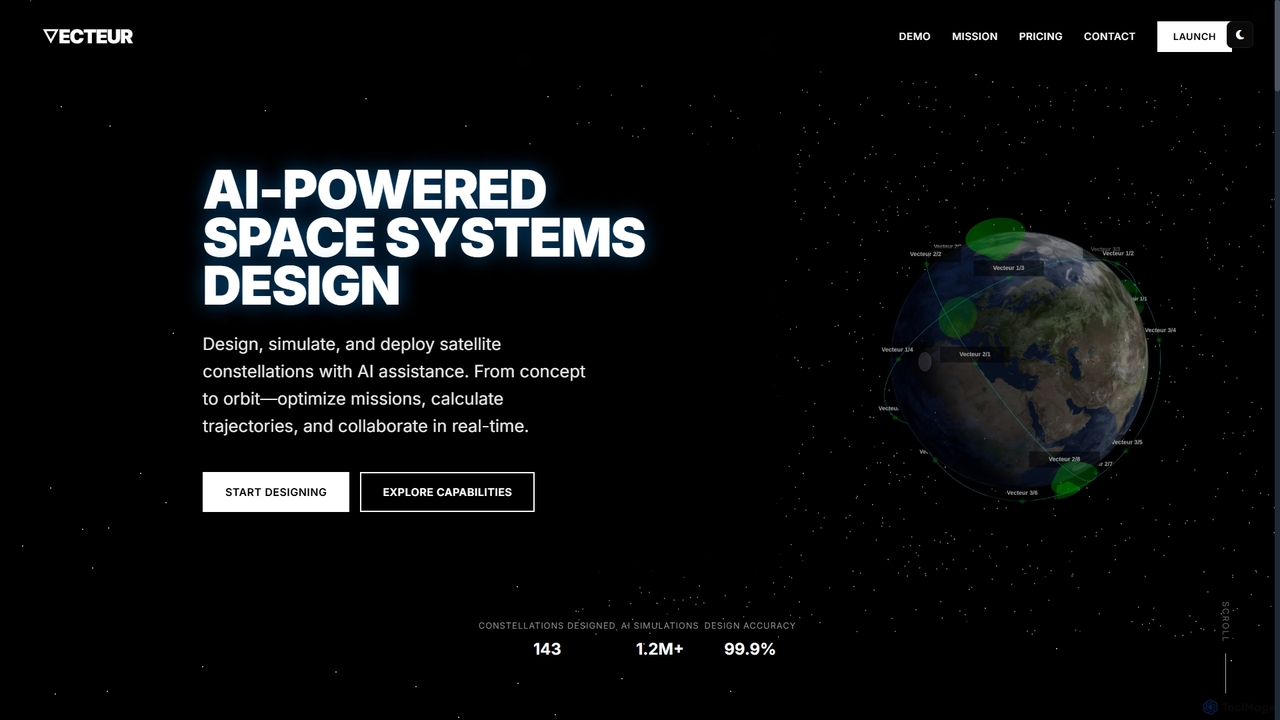
Vecteur is an AI-powered platform revolutionizing space systems engineering, enabling users to design, simulate, and deploy satellite constellations …
Vecteur is an AI-powered platform revolutionizing space systems engineering, enabling users to design, simulate, and deploy satellite constellations with unprecedented speed and accuracy. It offers intelligent design assistance, real-time simulation, and collaborative environments for various space missions.
About Space Technology
Space Technology tools are AI-powered solutions designed to advance space exploration, satellite operations, and celestial research. These tools leverage machine learning, computer vision, and autonomous systems to process vast datasets, automate complex tasks, and enhance decision-making in extreme environments. They are crucial for improving mission safety, optimizing resource utilization, and accelerating scientific discovery across the aerospace industry.
Core Features
- Autonomous Navigation: AI-driven systems for precise spacecraft guidance, trajectory correction, and hazard avoidance in deep space.
- Satellite Data Analysis: Machine learning algorithms to process and interpret Earth observation data, planetary imagery, and astronomical observations.
- Mission Planning & Optimization: AI for complex mission scheduling, resource allocation, and real-time adaptation to unforeseen challenges.
- Robotics for Space Exploration: AI-powered robots enabling autonomous surface exploration, maintenance, and construction in extraterrestrial environments.
- Space Debris Tracking & Mitigation: AI models to monitor, predict, and manage orbital debris, enhancing satellite safety and mission longevity.
Applicable Scenarios
Space agencies utilize these tools for deep space missions and Earth observation programs. Private aerospace companies deploy AI for satellite constellation management, launch optimization, and in-orbit servicing. Research institutions leverage AI for astronomical data analysis and developing next-generation propulsion systems, driving innovation in the sector.
How to Choose
When selecting Space Technology AI tools, consider the specific mission requirements, such as real-time processing capabilities for autonomous operations or the scale of data analysis needed for scientific research. Evaluate integration compatibility with existing ground control systems and spacecraft hardware. Assess the tool's compliance with aerospace safety standards and its scalability to support future mission expansions. Finally, review the vendor's expertise and track record in the highly specialized space industry.

Space TechnologyUse Cases
Autonomous Planetary Rover Navigation
Planetary scientists and mission controllers utilize AI to enable autonomous navigation for rovers on celestial bodies like Mars. By processing sensor data in real-time, AI allows rovers to identify safe paths, avoid obstacles, and prioritize scientific targets without constant human intervention. This significantly accelerates exploration, reduces communication delays, and enhances the efficiency of data collection in challenging extraterrestrial environments.
Real-time Satellite Constellation Management
Satellite operators in commercial aerospace companies employ AI to manage vast constellations of satellites. AI algorithms continuously monitor the health, position, and performance of each satellite, optimizing orbital maneuvers, managing communication bandwidth, and predicting potential anomalies. This ensures seamless global connectivity, extends satellite operational lifespans, and minimizes the need for manual oversight.
Advanced Earth Observation Data Analysis
Environmental researchers and agricultural specialists use Space Technology AI for advanced analysis of Earth observation data from satellites. AI models can rapidly process terabytes of imagery to detect subtle changes in land use, monitor deforestation rates, track crop health, or identify pollution sources. This provides critical, timely insights for climate monitoring, resource management, and disaster response efforts.
Optimizing Rocket Launch & Re-entry Trajectories
Aerospace engineers leverage AI to optimize the complex trajectories for rocket launches and re-entry. AI models analyze numerous variables, including atmospheric conditions, payload mass, and fuel consumption, to calculate the most efficient and safest flight paths. This reduces fuel costs, minimizes environmental impact, and enhances the overall success rate and safety of space missions.
Predictive Maintenance for Deep Space Probes
Engineers managing deep space probes utilize AI for predictive maintenance of critical spacecraft systems. AI algorithms analyze telemetry data from onboard sensors to identify subtle patterns indicative of impending component failures. This allows ground teams to proactively address issues, schedule necessary adjustments, or implement contingency plans, thereby extending mission longevity and preventing catastrophic system breakdowns far from Earth.
AI-Assisted Astronaut Training Simulations
Astronaut trainers and trainees employ AI to create highly realistic and adaptive simulations for mission preparation. AI generates dynamic scenarios, simulates complex system failures, and provides real-time performance feedback, tailoring the training experience to individual needs. This enhances astronauts' decision-making skills, improves their ability to handle emergencies, and ensures readiness for the demanding conditions of spaceflight.