Vecteur
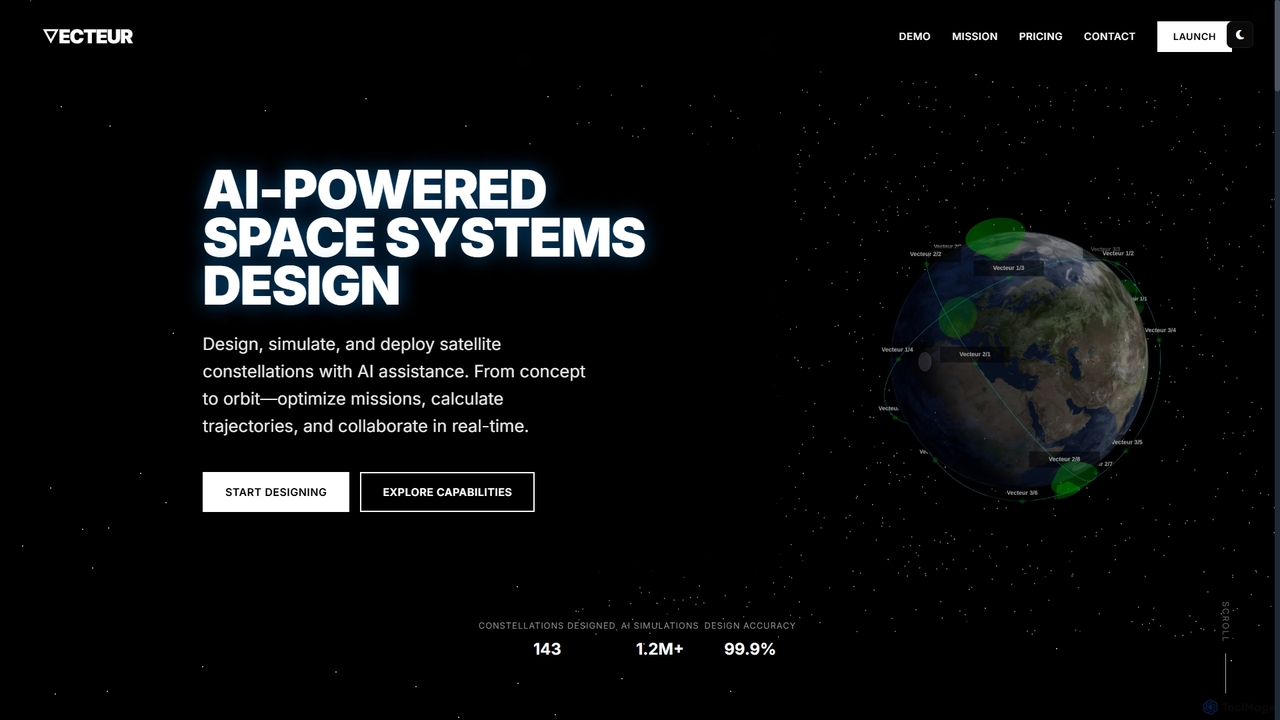
Vecteur is an AI-powered platform revolutionizing space systems engineering, enabling users to design, simulate, and deploy satellite constellations …
Vecteur is an AI-powered platform revolutionizing space systems engineering, enabling users to design, simulate, and deploy satellite constellations with unprecedented speed and accuracy. It offers intelligent design assistance, real-time simulation, and collaborative environments for various space missions.
About Satellite Design
AI Satellite Design tools are specialized software platforms that leverage artificial intelligence to automate and optimize the complex process of creating satellites. They utilize algorithms for generative design, multi-physics simulation, and mission analysis to rapidly generate and validate efficient satellite architectures. These tools empower engineers to explore vast design spaces, reduce component mass, and enhance mission performance, significantly shortening development cycles from concept to orbit. This data-driven approach helps create more resilient and cost-effective satellites for communications, Earth observation, and scientific research.
Core Features
- Generative Design: Automatically creates optimized, lightweight structural components like brackets and antennas based on performance constraints.
- Orbital & Mission Simulation: Models satellite trajectories, coverage, and operational conditions to predict mission success and identify potential risks.
- Automated Multi-Physics Analysis: Simulates thermal, structural, and power system performance under various orbital conditions without manual setup.
- Subsystem Optimization: Uses AI to find the best configuration for power, communication, and propulsion systems to meet mission requirements.
- Constellation Planning: Assists in designing the optimal arrangement and orbital parameters for a network of multiple satellites.
Use Cases
These tools are primarily used by aerospace engineers, mission planners, and systems architects in commercial space companies, government agencies, and research institutions. Common applications include developing next-generation LEO communication constellations, designing lightweight components for deep space probes, and rapidly prototyping CubeSats for academic purposes.
How to Choose
When selecting an AI Satellite Design tool, consider the scope of its simulation capabilities (e.g., thermal, structural, RF), its integration with existing CAD and CAE software, and its support for specific mission types (e.g., LEO, GEO, interplanetary). Also, evaluate the tool's computational requirements and the level of technical expertise needed to operate it effectively.

Satellite DesignUse Cases
Optimizing Structural Components for Launch Cost Reduction
An aerospace structural engineer at a commercial launch provider is tasked with reducing the mass of a satellite's main bus without compromising strength. Using an AI Satellite Design tool, they input load conditions, material properties, and geometric constraints. The platform's generative design algorithm explores thousands of topological variations and produces a highly optimized, lattice-like bracket design that is 30% lighter than the human-designed original while meeting all safety factors. This mass reduction directly translates to lower launch costs and potential for increased payload capacity.
Simulating Thermal Stability for a GEO Satellite
A thermal engineer needs to ensure that sensitive electronic components on a geostationary communications satellite will remain within their operational temperature limits for a 15-year mission. They use an AI tool to build a digital twin of the satellite and simulate its thermal behavior. The software automatically models solar radiation, Earth's infrared emissions, and internal heat generation as the satellite orbits. The analysis identifies potential hotspots, allowing the engineer to proactively adjust the placement of radiators and insulation, ensuring long-term mission reliability.
Planning an Earth Observation Satellite Constellation
A mission planner for an environmental monitoring agency needs to design a constellation of small satellites for continuous global imaging. Using an AI-powered planning tool, they define the required revisit time, sensor resolution, and coverage area. The AI runs complex trade-off analyses, simulating thousands of possible orbital configurations (altitude, inclination, number of satellites). It recommends an optimal constellation design that achieves the scientific objectives with the minimum number of satellites, significantly reducing the overall project budget.
Automating Communication Link Budget Analysis
An RF engineer is designing the communication subsystem for a new satellite. Instead of performing manual link budget calculations, they use an AI design tool. They input parameters like antenna gain, transmitter power, orbital distance, and atmospheric conditions. The tool automatically simulates the communication link's performance, calculating signal-to-noise ratio and data throughput for various scenarios. This allows the engineer to quickly select the right components and predict communication reliability before building any hardware.
Validating Power Systems for a CubeSat Mission
A university student team is developing a CubeSat for a research project with a tight power budget. They use an AI design tool to model their power subsystem, including solar panels, batteries, and power distribution units. The software simulates the satellite's orbit and orientation, accurately predicting the amount of solar energy harvested and the power consumed by onboard systems throughout each orbit. This helps the team verify that their design can generate and store enough power to complete the mission successfully.
Accelerating Preliminary Satellite Design Reviews
A systems engineer at a satellite manufacturing company is preparing for a Preliminary Design Review (PDR). They use an integrated AI design suite to consolidate models from different teams (structural, thermal, power, communications). The platform automatically runs a series of integrated simulations to verify that all subsystems work together harmoniously. It generates comprehensive reports highlighting potential conflicts or areas of concern, allowing the team to address issues early and pass the PDR with confidence, reducing costly late-stage redesigns.