Locally AI
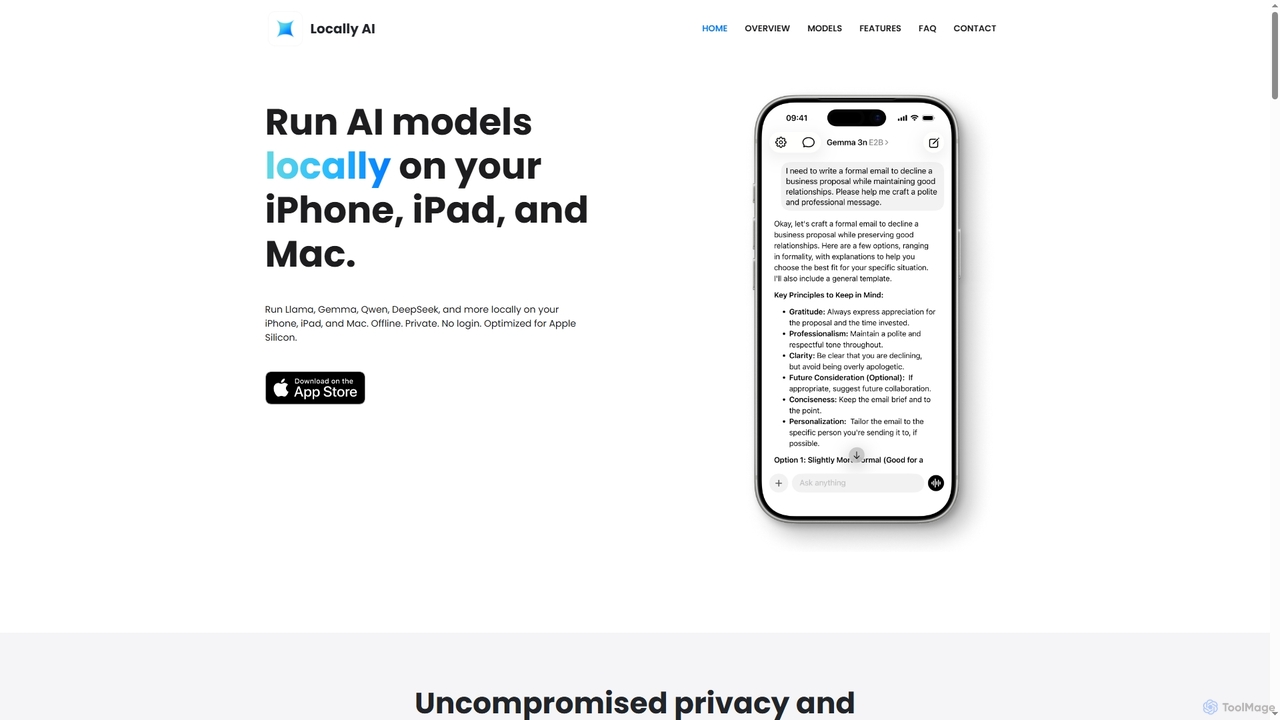
Locally AI enables users to run powerful AI models directly on their iPhone, iPad, and Mac devices. It …
Locally AI enables users to run powerful AI models directly on their iPhone, iPad, and Mac devices. It prioritizes privacy and offers features like offline voice mode, Siri integration, and customizable prompts for text and image processing, all seamlessly integrated within the Apple ecosystem.
About Speech Processing
Speech Processing tools are AI-powered applications designed to analyze, understand, and generate human speech. These tools leverage advanced machine learning models, including deep neural networks, to convert spoken language into text (Speech-to-Text) or text into natural-sounding speech (Text-to-Speech). They enable automation of voice-related tasks, enhance accessibility, and facilitate more intuitive human-computer interaction across various industries. By accurately interpreting vocal nuances and generating lifelike audio, Speech Processing solutions unlock new possibilities for communication and content creation.
Core Features
- Speech-to-Text (STT): Converts spoken audio into written text, often with speaker diarization and punctuation.
- Text-to-Speech (TTS): Generates natural-sounding human speech from written text, supporting various voices and languages.
- Voice Biometrics: Identifies or verifies individuals based on their unique voice characteristics.
- Emotion Detection: Analyzes vocal patterns to identify and interpret human emotions expressed in speech.
- Language Identification: Automatically detects the language spoken in an audio input.
Use Cases
Speech Processing tools are vital for businesses and individuals dealing with large volumes of audio or requiring voice interaction. They are extensively used in customer service for transcribing calls, in media for generating voiceovers, and in healthcare for documenting patient interactions. These tools streamline workflows by automating manual transcription, enabling voice control for devices, and creating personalized audio content efficiently.
How to Choose
When selecting Speech Processing tools, consider the accuracy of STT/TTS for your specific language and accent needs, the range of supported languages and voices, and the ability to customize models for domain-specific vocabulary. Evaluate integration capabilities with existing systems, scalability for processing volume, and the pricing model based on usage. Data privacy and security features are also crucial, especially for sensitive information.
Speech ProcessingUse Cases
Automating Customer Service Call Transcription
Customer service centers utilize Speech-to-Text tools to automatically transcribe incoming and outgoing calls. This allows for efficient analysis of customer interactions, identification of common issues, and training of agents. By converting conversations into searchable text, businesses can quickly retrieve information, ensure compliance, and improve service quality without manual effort, saving significant operational costs.
Creating Multilingual Voiceovers for Videos
Content creators and marketers use Text-to-Speech tools to generate professional voiceovers for videos, podcasts, and e-learning modules. Instead of hiring voice actors for every language, they can input scripts and produce natural-sounding audio in multiple languages with consistent quality. This accelerates content localization, reduces production costs, and expands audience reach globally.
Building Interactive Voice Assistants
Developers integrate Speech Processing APIs into applications to create intelligent voice assistants for smart devices, mobile apps, and enterprise solutions. These assistants use Speech-to-Text to understand user commands and Text-to-Speech to provide verbal responses. This enhances user experience by offering hands-free interaction, making technology more accessible and intuitive for daily tasks.
Providing Live Captions for Broadcasts and Meetings
Broadcasters and event organizers employ real-time Speech-to-Text technology to generate live captions for television programs, online streams, and virtual meetings. This ensures accessibility for hearing-impaired audiences and allows viewers in noisy environments to follow content. The immediate conversion of speech to text improves engagement and compliance with accessibility standards.
Detecting Emotions in Interview Audio
Researchers and HR professionals use emotion detection features within Speech Processing tools to analyze vocal cues in interviews or focus group discussions. By identifying patterns indicative of happiness, frustration, or uncertainty, they gain deeper insights into participants' true sentiments. This helps in refining research methodologies, improving candidate screening, and understanding user feedback more comprehensively.
Streamlining Medical Dictation for Healthcare Professionals
Healthcare providers leverage Speech-to-Text solutions to dictate patient notes, diagnoses, and treatment plans directly into electronic health records (EHR) systems. This significantly reduces the time spent on manual data entry and transcription, allowing doctors to focus more on patient care. The accuracy and speed of these tools improve documentation efficiency and reduce administrative burden.