StratosIQ
StratosIQ is an AI-powered assistant designed for product managers, startups, and researchers. It streamlines market research and product …
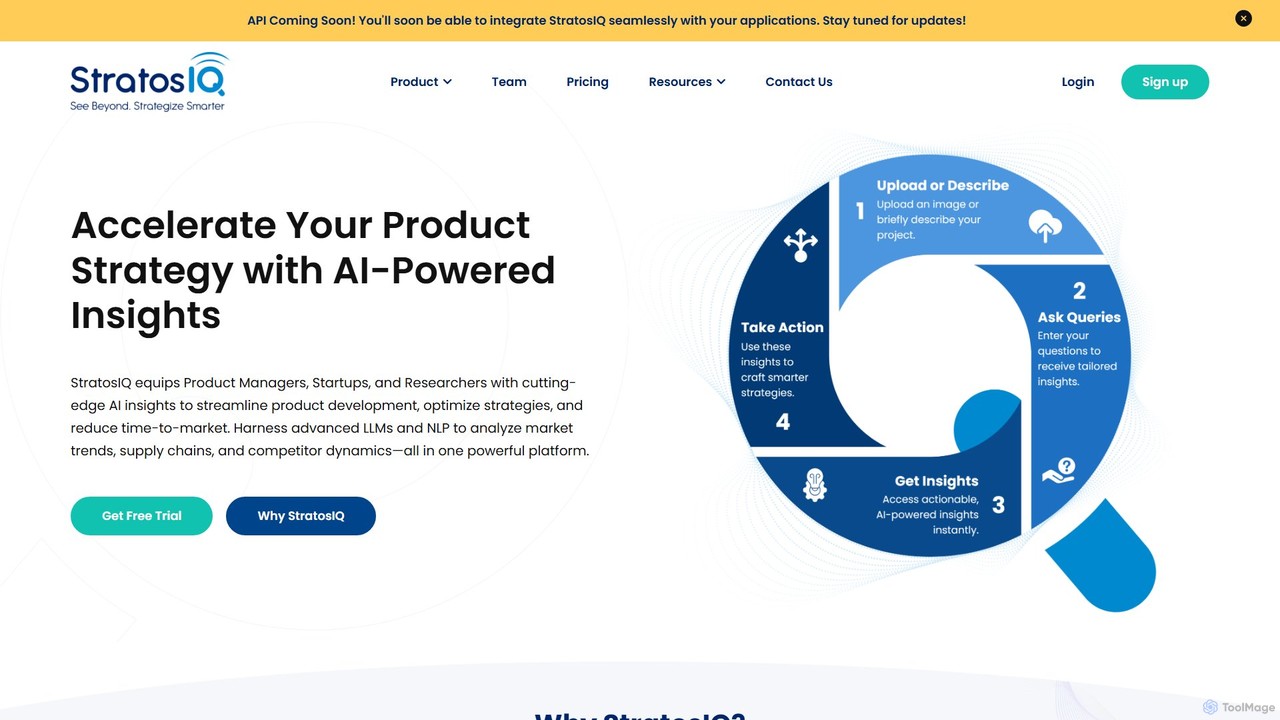
StratosIQ is an AI-powered assistant designed for product managers, startups, and researchers. It streamlines market research and product development by analyzing market trends, competitor dynamics, and supply chains. The platform transforms complex data into actionable, visualized insights to accelerate decision-making and reduce time-to-market.
About Business Strategy
AI Business Strategy tools are a specialized category of software designed to assist in high-level corporate planning and data-driven decision-making. They leverage machine learning and large language models to analyze vast datasets, including market trends, competitor actions, and internal performance metrics. These tools empower founders and executives to formulate robust growth plans, identify untapped market opportunities, and proactively mitigate risks. As a key component of Startup Tools, they focus specifically on the 'why' and 'what' of a business's direction, rather than the 'how' of daily execution.
Core Features
- Market Trend Analysis: Automatically scans and synthesizes information from news, reports, and social data to identify emerging industry trends and shifts in consumer behavior.
- Competitive Intelligence: Continuously tracks competitors' product launches, pricing adjustments, marketing campaigns, and customer sentiment.
- Automated Strategic Frameworks: Generates structured analyses like SWOT (Strengths, Weaknesses, Opportunities, Threats) or Business Model Canvas based on provided data.
- Scenario Modeling & Forecasting: Simulates potential market scenarios and their impact on business outcomes to assess risks and test strategic hypotheses.
- Data-Driven Recommendations: Provides actionable suggestions for market entry, product positioning, or resource allocation based on comprehensive data analysis.
Use Cases
These tools are primarily used by startup founders, corporate strategists, product managers, and business analysts. They are invaluable during annual planning cycles, new product development, market expansion initiatives, and preparation for fundraising rounds. For instance, a founder can use them to validate a business idea with market data, while a large corporation can use them to monitor threats from disruptive newcomers.
How to Choose
When selecting an AI Business Strategy tool, consider the breadth and quality of its data sources. Evaluate the sophistication of its analytical models and the range of strategic frameworks it supports. Assess its integration capabilities with your existing BI, CRM, or project management systems. Finally, consider the user interface's intuitiveness and whether the pricing model aligns with your team's size and usage frequency.
Business StrategyUse Cases
Formulating a Market Entry Strategy
A startup founder planning to launch a new fintech app uses an AI business strategy tool to analyze the target market. By inputting their business concept, the tool scans financial regulations, competitor offerings, and consumer banking trends. It generates a detailed report highlighting the most promising customer segments, suggests a competitive pricing model, and identifies potential partnership opportunities with established banks. This data-backed plan forms the core of their go-to-market strategy, significantly improving their pitch to investors.
Monitoring the Competitive Landscape
A product manager at an established e-commerce company uses an AI strategy tool to continuously monitor key competitors. The tool is configured to track pricing changes, new product listings, major marketing campaigns, and shifts in online customer reviews. It sends weekly automated digests and real-time alerts for significant events. This allows the product manager to react swiftly, adjust their own pricing or marketing strategy, and identify gaps in the market that their competitors are not addressing, informing future product development.
Automating Quarterly Business Review (QBR) Preparation
A corporate strategy team prepares for their QBR by feeding sales data, marketing campaign results, and customer support metrics into an AI business strategy tool. The tool automatically generates a comprehensive SWOT analysis, identifying that while sales are strong (Strength), customer churn has increased (Weakness). It also flags a new competitor's technology as a Threat and a growing adjacent market as an Opportunity. This automated analysis saves days of manual work and allows the team to focus on developing strategic responses rather than data compilation.
Assessing Risk for Product Diversification
An established manufacturing company wants to enter the smart home device market. They use an AI strategy tool to perform a risk assessment. The tool models various scenarios, such as supply chain disruptions, aggressive pricing from competitors, and slower-than-expected consumer adoption. It quantifies the potential financial impact of each risk, helping the executive team make an informed decision. The analysis suggests a phased rollout strategy, starting with a niche product to mitigate initial financial exposure before a full-scale launch.
Generating Data-Driven Investor Pitch Decks
An early-stage startup is preparing its seed funding pitch deck. The founders use an AI business strategy tool to generate key slides. They input their core idea, and the tool pulls market size data from industry reports, identifies key competitors and their market share, and projects a 5-year revenue forecast based on comparable company growth rates. This provides objective, third-party validation for their claims, making the pitch deck more credible and compelling to venture capitalists who value data-driven decision-making.
Identifying Strategic Partnership Opportunities
A business development manager at a SaaS company is tasked with finding new integration partners. They use an AI strategy tool to scan industry news, tech blogs, and company databases. The tool identifies companies whose technology is complementary and who serve a similar customer profile but are not direct competitors. It ranks potential partners based on strategic fit, market influence, and recent growth, providing a prioritized list for the manager to begin outreach. This data-driven approach uncovers opportunities that might be missed through manual research alone.