OmMuse
A comprehensive AI-powered platform for musicians and music companies. OmMuse revolutionizes music workflow with centralized storage, global collaboration …
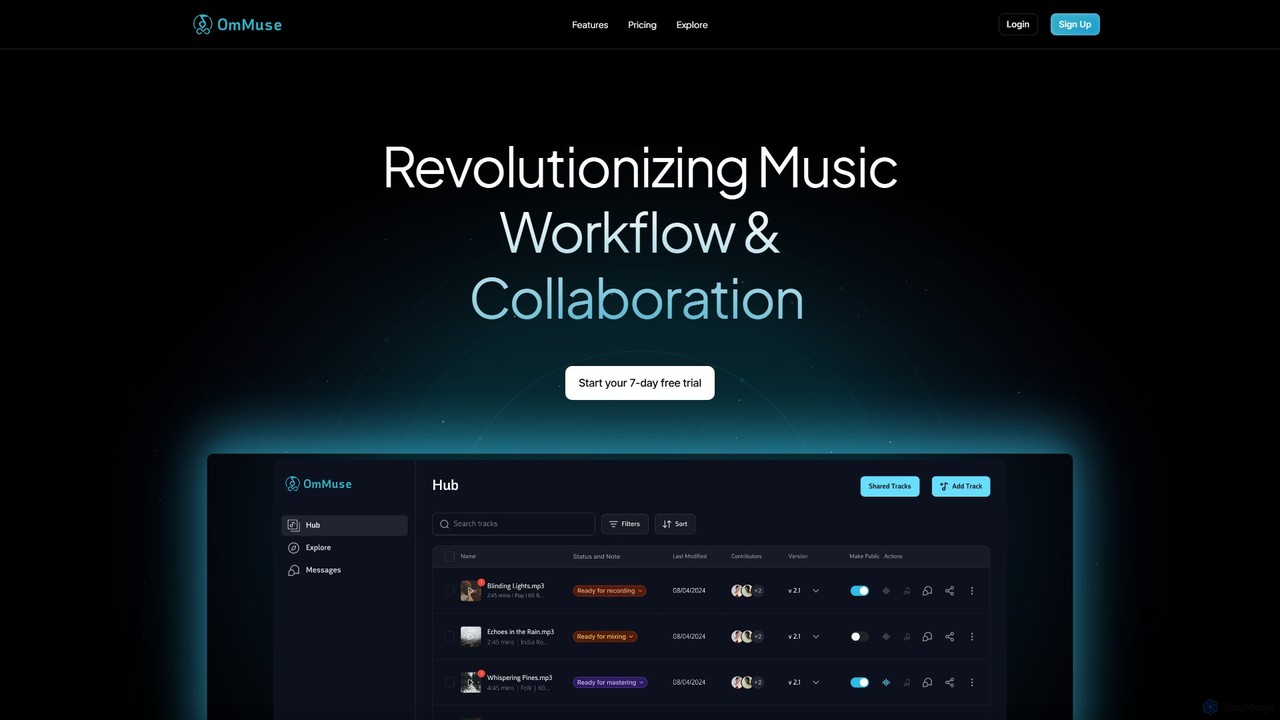
A comprehensive AI-powered platform for musicians and music companies. OmMuse revolutionizes music workflow with centralized storage, global collaboration tools, AI-based organization, integrated mastering, and future-ready distribution and royalty management. It's designed to help artists store, create, collaborate, and share their music seamlessly.
About Storage
AI Storage tools are intelligent platforms that use artificial intelligence to manage, organize, and analyze large volumes of digital data. Unlike traditional storage, these tools leverage machine learning and natural language processing to understand the content of files, enabling features like automated tagging, semantic search, and predictive data management. This transforms static data repositories into dynamic, searchable knowledge bases, helping users find information faster, optimize storage costs, and enhance data security. They are particularly effective for handling unstructured data like documents, images, and videos.
Core Features
- Intelligent Search & Discovery: Utilizes AI to search for content based on context, concepts, or objects within files, not just filenames or manual tags.
- Automated Data Classification & Tagging: Automatically analyzes and categorizes files, applying relevant metadata and tags to images, documents, and videos.
- Predictive Analytics & Tiering: Analyzes data access patterns to predict future needs and automatically moves data between storage tiers to optimize cost and performance.
- Enhanced Security & Anomaly Detection: Employs AI algorithms to monitor access patterns, detect unusual behavior, and identify potential security threats in real-time.
Use Cases
AI Storage solutions are widely used in data-intensive industries. For example, media and entertainment companies use them to manage vast libraries of video assets, making them easily searchable for editors. In the legal and financial sectors, these tools help in organizing case files and compliance documents, enabling rapid discovery and risk assessment. Research institutions also rely on them to manage and analyze massive datasets from experiments and simulations.
How to Choose
When selecting an AI Storage tool, first evaluate its search and classification capabilities for your specific data types (e.g., video, legal documents). Consider its integration with your existing software ecosystem and workflows. Assess the platform's security features, including AI-driven threat detection and compliance certifications. Finally, analyze the scalability and pricing model to ensure it aligns with your data growth and budget.
StorageUse Cases
Automated Media Asset Management for Creative Agencies
A marketing agency manages thousands of photos, videos, and design files for multiple clients. By using an AI Storage platform, every new asset uploaded is automatically scanned. The AI identifies objects, people, logos, and even the mood of the image, applying relevant tags like 'urban', 'business meeting', or 'product launch'. This allows designers and social media managers to instantly find the perfect visual by searching for concepts like 'happy customer using a laptop' instead of browsing through countless folders, reducing search time by up to 90%.
Intelligent Document Archiving for Legal Firms
A law firm needs to manage millions of documents, including contracts, case files, and evidence. An AI Storage system ingests these documents and uses Natural Language Processing (NLP) to understand their content. It automatically classifies them by case type, identifies clauses, extracts key entities like names and dates, and flags sensitive information (PII). This enables paralegals to perform semantic searches like 'find all contracts with a non-compete clause signed in 2022', retrieving precise results in seconds instead of days of manual review.
Optimizing Corporate Knowledge Base Management
An enterprise stores all its internal documentation—reports, presentations, HR policies, and technical manuals—in a centralized AI Storage system. When an employee has a question, such as 'What is our travel reimbursement policy for international trips?', they can ask the system in natural language. The AI searches across the entire knowledge base, understands the context of the documents, and provides a direct answer with links to the source documents. This transforms the storage into an interactive corporate brain, improving knowledge sharing and reducing repetitive queries to support departments.
Predictive Storage Tiering for Cost Optimization
An IT department manages a multi-petabyte data lake with varying access needs. An AI Storage platform continuously analyzes data access patterns. It identifies 'hot' data (frequently accessed) and keeps it on expensive, high-performance SSDs. It also identifies 'cold' data (rarely accessed, e.g., archives older than one year) and automatically moves it to cheaper, slower cloud archival storage. This process is dynamic and predictive, ensuring optimal performance for active data while significantly reducing overall storage costs by up to 40% without manual intervention.
AI-Powered Security Monitoring for Data Repositories
A financial institution uses an AI Storage solution to protect sensitive client data. The AI establishes a baseline of normal user access patterns. It then actively monitors for anomalies, such as an employee suddenly downloading an unusually large number of files, or access attempts from an unrecognized geographic location. If suspicious activity is detected, the system can automatically trigger an alert to the security team and temporarily block the user's access, preventing potential data breaches before they escalate. This provides a proactive layer of security beyond traditional firewalls.
Smart Photo Organization for Personal Use
An individual user has tens of thousands of personal photos stored across various devices. They consolidate them into an AI Storage service. The AI automatically scans all photos, identifies faces and groups them by person, recognizes landmarks and locations (e.g., 'Eiffel Tower', 'Hawaii'), and categorizes images by events like 'weddings' or 'birthdays'. The user can then easily create albums or find specific memories by searching for 'photos of my daughter at the beach in 2021', transforming a chaotic collection into a perfectly organized and searchable library of life moments.