ToolMage
Sign in

Best 1 Revision AI tools for Students

Popular Revision AI tools in Students include Rewiseai, helping you work more efficiently.

Rewiseai
Freemium

Rewiseai

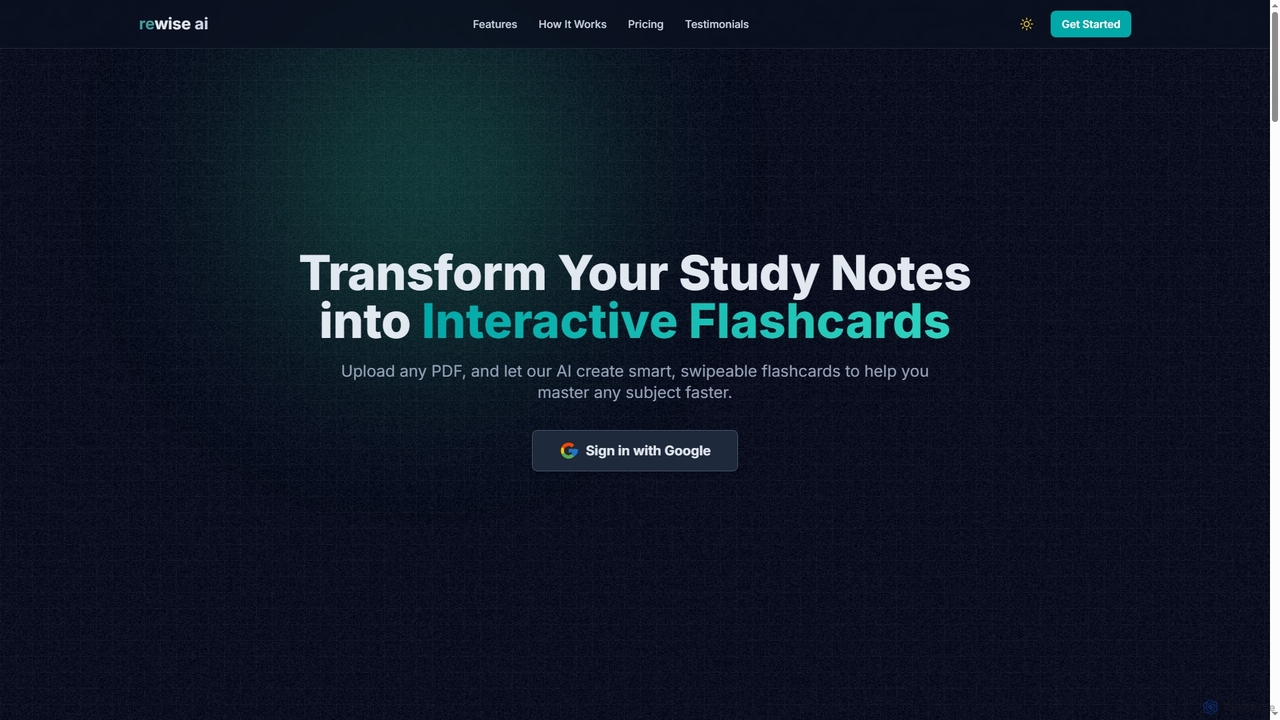
Rewiseai is an AI-powered study tool that transforms PDF documents like lecture notes and textbooks into interactive, swipeable flashcards. It leverages AI to generate chapter-based card decks, track your progress with spaced repetition, and provide AI tutor explanations for difficult concepts, making learning more efficient and engaging.

Study Tools
Visits 6.7KFavorites 132Likes 138

About Revision

AI Revision tools are specialized applications designed to help students optimize their study and review processes. They leverage algorithms like spaced repetition and active recall to analyze learning patterns, identify knowledge gaps, and create personalized study schedules. This data-driven approach enhances long-term memory retention and makes exam preparation more efficient and effective. Unlike simple digital flashcards, these tools actively adapt to a user's performance to focus on weaker areas.

Core Features

  • Personalized Study Plans: Generates adaptive revision schedules based on your learning pace and performance data.
  • Automated Quiz Generation: Instantly creates practice questions, flashcards, and summaries from your notes, textbooks, or lectures.
  • Knowledge Gap Analysis: Identifies and highlights topics or concepts where you have weaker understanding for focused review.
  • Spaced Repetition System (SRS): Intelligently schedules when to review specific topics to maximize long-term retention.
  • Performance Analytics: Provides detailed reports and visualizations of your study progress and mastery levels.

Use Cases

These tools are primarily used by high school, college, and university students preparing for exams across various subjects like science, law, medicine, and languages. They are also valuable for professionals undergoing certification exams or anyone needing to memorize and retain large amounts of information efficiently.

How to Choose

When selecting an AI Revision tool, consider its ability to import different content formats (PDF, text, images), the sophistication of its spaced repetition algorithm, the quality of its analytics and feedback, and its integration with other study platforms. Also, evaluate the user interface for ease of use during intensive study sessions.

Revision use cases

1

Automating Exam Preparation with Lecture Notes

A university student preparing for final exams uploads their semester's worth of lecture notes in PDF format to an AI Revision tool. The tool automatically processes the documents, identifies key concepts, and generates hundreds of interactive flashcards and multiple-choice questions. It then creates a personalized study schedule using a spaced repetition algorithm, prompting the student to review specific topics just before they are likely to forget them. This transforms passive note-reading into an active recall practice, significantly improving retention and exam scores.

2

Mastering Medical Terminology

A medical student faces the challenge of memorizing thousands of complex anatomical and pharmacological terms. They use an AI Revision tool to create digital flashcard decks. By simply pasting lists of terms and definitions, the AI generates the cards. The student then engages in daily review sessions managed by the tool's spaced repetition system. The system tracks their accuracy for each term, prioritizing cards they struggle with. This targeted approach reduces study time and builds the long-term memory crucial for their medical career.

3

Identifying Knowledge Gaps in a Subject

A high school student feels unsure about their understanding of chemistry before a major test. They use an AI Revision tool's diagnostic quiz feature. The tool generates a comprehensive quiz covering all topics from the semester. After completing the quiz, the student receives a detailed analytics report. The report visually highlights their weakest areas, such as 'Stoichiometry' and 'Gas Laws', while confirming their strength in 'Atomic Structure'. Based on this data, the student can now focus their limited study time precisely where it's needed most, rather than reviewing everything equally.

4

Learning a New Language with Smart Flashcards

An individual learning Japanese uses an AI Revision tool to manage vocabulary acquisition. Instead of manually creating flashcards, they input lists of new words, and the AI automatically fetches translations, example sentences, and even audio pronunciations to create rich, multi-sensory cards. The platform's algorithm schedules daily review sessions, mixing new words with older ones that are due for review. This ensures a steady learning curve and prevents them from being overwhelmed, making the process of learning hundreds of kanji and vocabulary words more manageable and effective.

5

Summarizing Textbook Chapters for Quick Review

A history student has a dense, 50-page textbook chapter to review before a class discussion. Instead of re-reading the entire text, they upload the PDF to an AI Revision tool with summarization capabilities. The AI analyzes the text and generates a concise, bullet-point summary highlighting the key events, dates, and figures. It also creates a short list of potential discussion questions. This allows the student to quickly refresh their memory on the core content in under 15 minutes, enabling them to participate confidently in the discussion without hours of re-reading.

6

Collaborative Study with Shared Quiz Decks

A study group for a law course uses an AI Revision tool to prepare for their torts exam. Each member is assigned a different topic. They use the tool to create a set of practice questions and flashcards based on their assigned readings. They then merge their individual decks into a single, comprehensive master deck within the platform. The group can then collectively practice with the full set of questions, track their group's overall proficiency on different topics, and identify areas where they need to focus their next study session together. This collaborative approach ensures all topics are covered thoroughly.

Revision FAQ

What are AI Revision tools for students?

AI Revision tools are software applications that use artificial intelligence to make studying more effective. They go beyond simple digital flashcards by creating personalized study plans, automatically generating quizzes from your notes, and using methods like spaced repetition to help you remember information for longer. Their main goal is to help you identify and focus on your weakest subjects to optimize your revision time.

How to choose the right AI Revision tool?

When choosing an AI Revision tool, consider these four factors:

  • Content Import: Can it easily import your existing materials, like PDFs, text from websites, or images? The less manual entry required, the better.
  • Algorithm Quality: Does it use proven learning science principles like spaced repetition and active recall effectively?
  • Analytics and Feedback: Does it provide clear insights into your progress and highlight your specific weak points?
  • Ease of Use: Is the interface intuitive and fast? A complicated tool can discourage you from using it consistently.
How do AI Revision tools differ from simple flashcard apps?

Simple flashcard apps are digital versions of paper cards; you create them, and you decide when to review them. AI Revision tools are much more dynamic. They actively manage your learning by:

  • Automating Creation: Generating cards and quizzes from your documents.
  • Personalizing Schedules: Using spaced repetition systems (SRS) to tell you the optimal time to review each card based on your performance.
  • Analyzing Performance: Providing data on which concepts you've mastered and which you haven't.
In short, AI tools act as a personal tutor, while simple flashcard apps are just a passive medium.

Can AI Revision tools work for any subject?

AI Revision tools are most effective for subjects that require memorizing a large volume of factual information. This includes fields like:

  • Languages: Vocabulary and grammar rules.
  • Medicine and Law: Terminology, case law, and complex regulations.
  • Sciences: Formulas, definitions, and biological classifications.
  • History: Dates, events, and key figures.
While they can be adapted for more conceptual subjects by creating questions that test understanding, their primary strength lies in reinforcing fact-based knowledge through active recall and spaced repetition.

Is using an AI Revision tool considered cheating?

No, using AI Revision tools is generally not considered cheating. These tools are designed to enhance and optimize the learning process, not to produce work for you. They function like advanced study aids, similar to working with a tutor or being part of a study group. They help you practice active recall and manage your study schedule more efficiently. However, it's always important to adhere to your institution's specific academic integrity policies. The key distinction is that these tools help you learn the material yourself, rather than generating answers or writing essays for you.