Students Best in category 1 results Study Tools AI Tool

Popular AI tools in the Study Tools field of Students include StudyRaid, etc., helping you quickly improve efficiency.

StudyRaid

StudyRaid

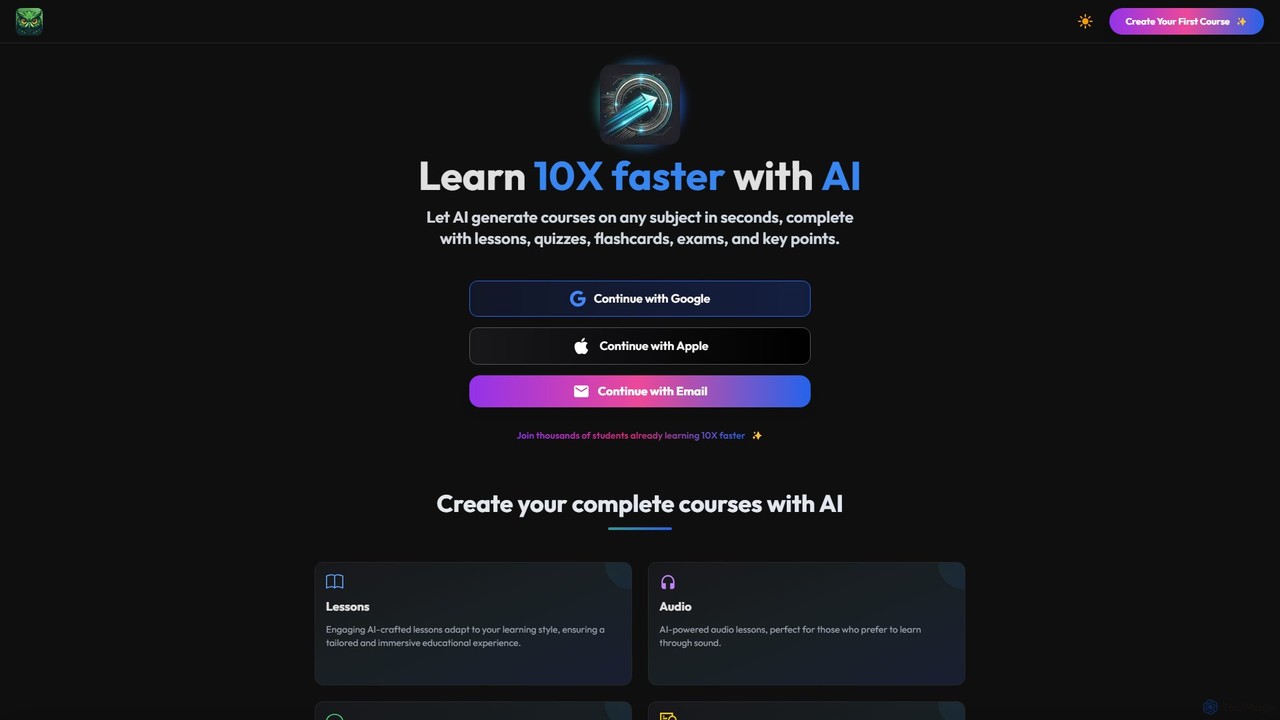
StudyRaid is an AI-powered learning platform that generates complete courses on any subject in seconds. It creates tailored …

30.9K

About Study Tools

AI Study Tools are applications that leverage artificial intelligence to enhance and personalize the learning process. These tools utilize technologies like Natural Language Processing (NLP) to summarize complex texts, generate quizzes, and answer questions about your study materials. Their primary value lies in automating tedious tasks, improving information retention, and providing adaptive learning experiences tailored to individual user needs. This allows students and lifelong learners to study more efficiently and effectively.

Core Features

  • Automated Summarization: Condenses long articles, research papers, or lecture notes into concise summaries, highlighting key concepts.
  • Intelligent Flashcard & Quiz Generation: Automatically creates interactive flashcards and practice tests from uploaded documents or text.
  • Personalized Learning Paths: Adapts the difficulty and focus of study materials based on a user's performance and identified weak spots.
  • Contextual Q&A: Allows users to ask specific questions about their study materials and receive instant, AI-generated answers.
  • Research & Writing Assistance: Helps find relevant sources, check for plagiarism, and improve grammar and sentence structure.

Applicable Scenarios

These tools are widely used in academic and professional settings. University students use them for efficient exam preparation and thesis research. Researchers and analysts leverage them to quickly digest large volumes of academic papers or reports. Professionals also use them for corporate training and continuous skill development, quickly mastering new technical documentation or industry knowledge.

Selection Criteria

When choosing an AI Study Tool, consider the specific subjects you study, as some tools excel in STEM while others are better for humanities. Evaluate the supported input formats (PDF, URL, text, audio). Assess the depth of its features—do you need simple summarization or advanced adaptive quizzing? Finally, consider the pricing model and any integrations with other platforms like Notion or Zotero.

Study ToolsUse Cases

1

Efficient Exam Preparation

A university student preparing for final exams uploads weeks of lecture notes, textbook chapters, and PDF slides into an AI study tool. The tool automatically generates concise summaries for each topic, allowing the student to quickly review key concepts. It also creates interactive flashcards and multiple-choice quizzes based on the material. The AI tracks the student's performance on quizzes, identifying weaker areas and suggesting specific topics for further review, transforming a passive reading process into an active and personalized study session.

2

Automating Research Paper Analysis

A graduate researcher needs to conduct a literature review involving over 50 academic papers. Instead of reading each one fully, they upload the PDFs to an AI study tool. The AI provides a structured summary for each paper, including the abstract, methodology, and key findings. The researcher can then ask specific questions like "What were the main limitations of this study?" to quickly extract relevant information. This process reduces the time spent on initial screening by hours, allowing the researcher to focus on analyzing and synthesizing the most relevant papers.

3

Mastering a New Language

A language learner wants to improve their vocabulary and comprehension. They use an AI study tool to import news articles and short stories in their target language. The tool identifies key vocabulary and generates digital flashcards with definitions, example sentences, and audio pronunciation. The learner can also highlight a confusing sentence and ask the AI to explain the grammar in their native language. This creates an immersive and interactive learning environment that is more engaging than traditional textbook methods.

4

Clarifying Complex Technical Concepts

A software engineering student is struggling to understand a dense technical document about machine learning algorithms. They upload the document to an AI study tool and use the Q&A feature to ask specific questions like "Explain the difference between supervised and unsupervised learning in simple terms" or "What is the purpose of a loss function?". The AI provides clear, easy-to-understand explanations with analogies, breaking down complex information into manageable pieces. This targeted approach helps the student overcome learning blocks without having to search through multiple external sources.

5

Corporate Training and Onboarding

A new employee at a tech company is given a 100-page employee handbook and several technical manuals to read. To speed up the onboarding process, they use an AI study tool to process these documents. They can quickly get summaries of company policies and ask direct questions like "What is the process for requesting vacation days?". For technical manuals, they can generate quizzes to test their understanding of the product. This empowers the new hire to find information independently and become productive faster, reducing the training burden on senior staff.

6

Creating Collaborative Study Guides

A study group for a history class uses a collaborative AI tool. Each member uploads their notes on different chapters. The AI merges and synthesizes the information, creating a comprehensive master study guide and identifying any conflicting information for discussion. It then generates a shared set of flashcards and a practice exam that the whole group can use. This streamlines collaboration, ensures all key topics are covered, and provides a standardized set of materials for everyone to review, making group study sessions more structured and productive.

Study ToolsFrequently Asked Questions