Scematics
Scematics is an all-in-one data annotation and labeling platform that provides strategic data solutions to optimize AI models. …
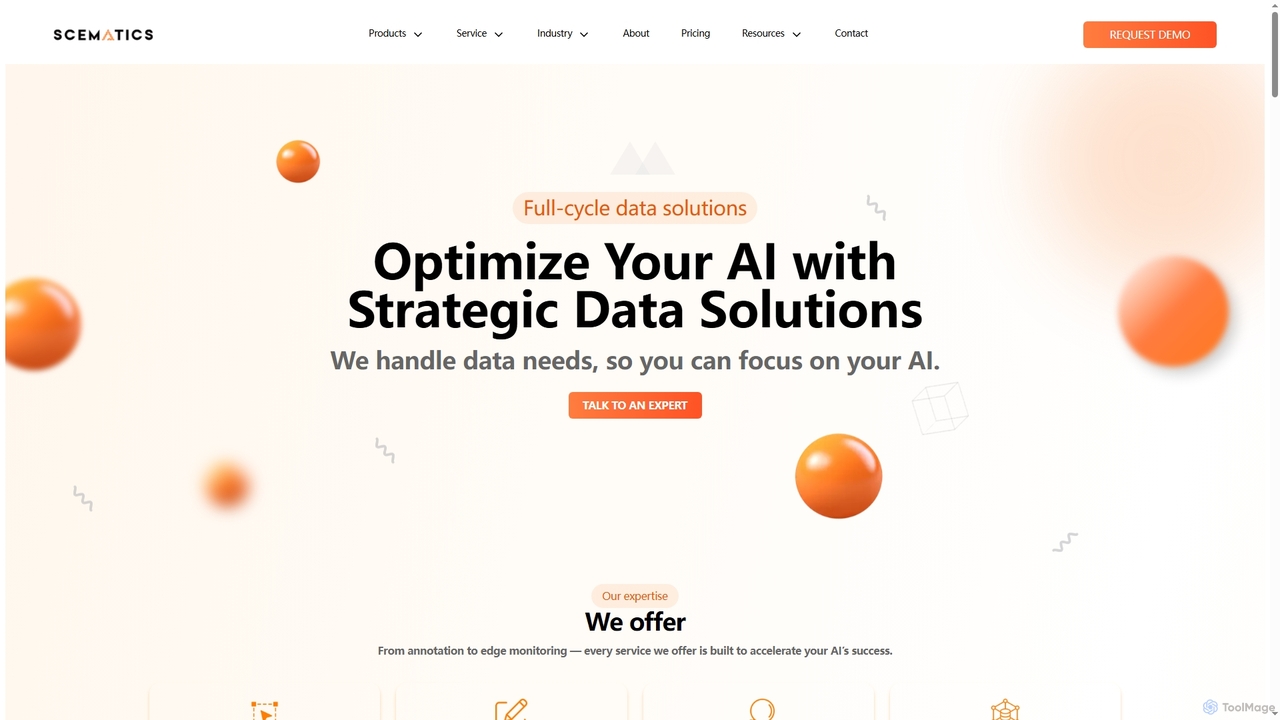
Scematics is an all-in-one data annotation and labeling platform that provides strategic data solutions to optimize AI models. It offers intuitive tools, expert annotation services, edge case monitoring, and synthetic data generation, enabling teams to build high-quality, scalable training datasets for various AI applications across diverse industries.
About Synthetic Data
Synthetic Data tools are AI-powered solutions that generate artificial datasets mimicking the statistical properties of real-world information. These tools leverage advanced machine learning models, such as GANs and VAEs, to create high-fidelity, privacy-preserving data. They enable organizations to overcome data scarcity, protect sensitive user information, and accelerate the development and testing of AI models. This technology is crucial for innovation in data-sensitive industries and for enhancing model robustness.
Core Features
- Privacy Preservation: Generates data that maintains statistical utility while protecting original sensitive information.
- Data Augmentation: Expands limited datasets to improve the training and performance of machine learning models.
- Bias Mitigation: Creates balanced datasets to reduce inherent biases present in real-world data.
- Realistic Data Generation: Produces synthetic data that closely mirrors the statistical distributions and relationships of real data.
- Scalability: Enables the rapid generation of large volumes of data on demand for various testing and development needs.
Use Cases
Data scientists and developers use synthetic data for training new AI models when real data is scarce or inaccessible. It's also vital for privacy-sensitive applications in healthcare and finance, allowing for robust model development without compromising patient or customer data.
How to Choose
When selecting synthetic data tools, consider the fidelity and realism of the generated data, the level of privacy guarantees offered, the ease of integration with existing data pipelines, and the scalability for generating large volumes. Evaluate the supported data types and the complexity of the underlying models.
Synthetic DataUse Cases
Accelerating AI Model Training in Finance
Financial analysts and data scientists can use synthetic data to train complex fraud detection or credit scoring models. By generating vast, realistic datasets that mirror real transaction patterns but contain no actual customer information, they can iterate on models faster, improve accuracy, and comply with stringent data privacy regulations like GDPR, without risking sensitive financial data.
Secure AI Model Training in Healthcare
Medical researchers use synthetic patient records to train diagnostic AI models without exposing actual patient Protected Health Information (PHI). This allows for rapid model iteration and validation, accelerating medical breakthroughs while adhering to strict privacy regulations like HIPAA.
Enhancing Healthcare Data Privacy for Research
Medical researchers and pharmaceutical companies utilize synthetic patient data to develop new diagnostic tools or drug discovery algorithms. This allows them to simulate diverse patient populations and disease progressions, overcoming the severe limitations and ethical hurdles associated with accessing and sharing real patient health information (PHI), thereby accelerating medical innovation.
Financial Fraud Detection System Development
Financial institutions generate synthetic transaction data to develop and test new fraud detection algorithms. This provides a safe, diverse, and scalable dataset to simulate various fraud scenarios, improving the robustness and accuracy of security systems without using real customer financial data.
Secure Software Testing and Development
Software engineers and QA teams employ synthetic data to rigorously test new applications, databases, and system upgrades. Instead of using production data, which carries security risks, they can generate large volumes of diverse, realistic test data to identify bugs, assess performance under load, and ensure data integrity, all within a secure and compliant environment.
Autonomous Vehicle Sensor Data Simulation
Automotive engineers create synthetic sensor data (e.g., LiDAR, camera, radar) to train and validate autonomous driving systems. This allows for simulating rare or dangerous road conditions that are difficult to capture in real-world testing, significantly enhancing the safety and reliability of self-driving cars.
Overcoming Data Scarcity for Rare Events
In fields like autonomous driving or industrial anomaly detection, real-world data for rare but critical events is scarce. Data scientists can use synthetic data generation to create numerous variations of these rare scenarios (e.g., specific road hazards, machine failures). This augments limited real data, making AI models more robust and reliable in handling unforeseen situations.
Software Testing and Quality Assurance
Software development teams use synthetic user behavior data to rigorously test new applications and features. By generating diverse user interaction patterns, they can identify edge cases, performance bottlenecks, and potential bugs before deployment, ensuring a higher quality product without relying on real user data.
Developing Personalized Marketing Strategies
Marketing teams and data analysts can leverage synthetic customer behavior data to develop and test highly personalized marketing campaigns. By simulating various customer segments and their interactions with products or services, they can optimize targeting, messaging, and offers without compromising the privacy of actual customers, leading to more effective and ethical marketing.
E-commerce Personalization Algorithm Development
E-commerce platforms generate synthetic customer browsing and purchase history to develop and refine recommendation engines and personalization algorithms. This enables rapid experimentation with new strategies, improving customer experience and sales conversions while safeguarding actual customer privacy.
Facilitating Data Sharing and Collaboration
Organizations needing to share data with external partners, researchers, or regulatory bodies can use synthetic data as a privacy-preserving alternative. Instead of sharing sensitive real datasets, they provide statistically equivalent synthetic versions. This enables collaborative analytics, benchmarking, and research while maintaining strict confidentiality and regulatory compliance.
Data Augmentation for Small Datasets
Machine learning engineers facing limited real-world data for niche applications (e.g., rare disease image recognition, specialized industrial defect detection) use synthetic data to expand their training sets. This significantly improves model generalization and performance, making robust AI solutions feasible even with scarce initial data.