Alteam
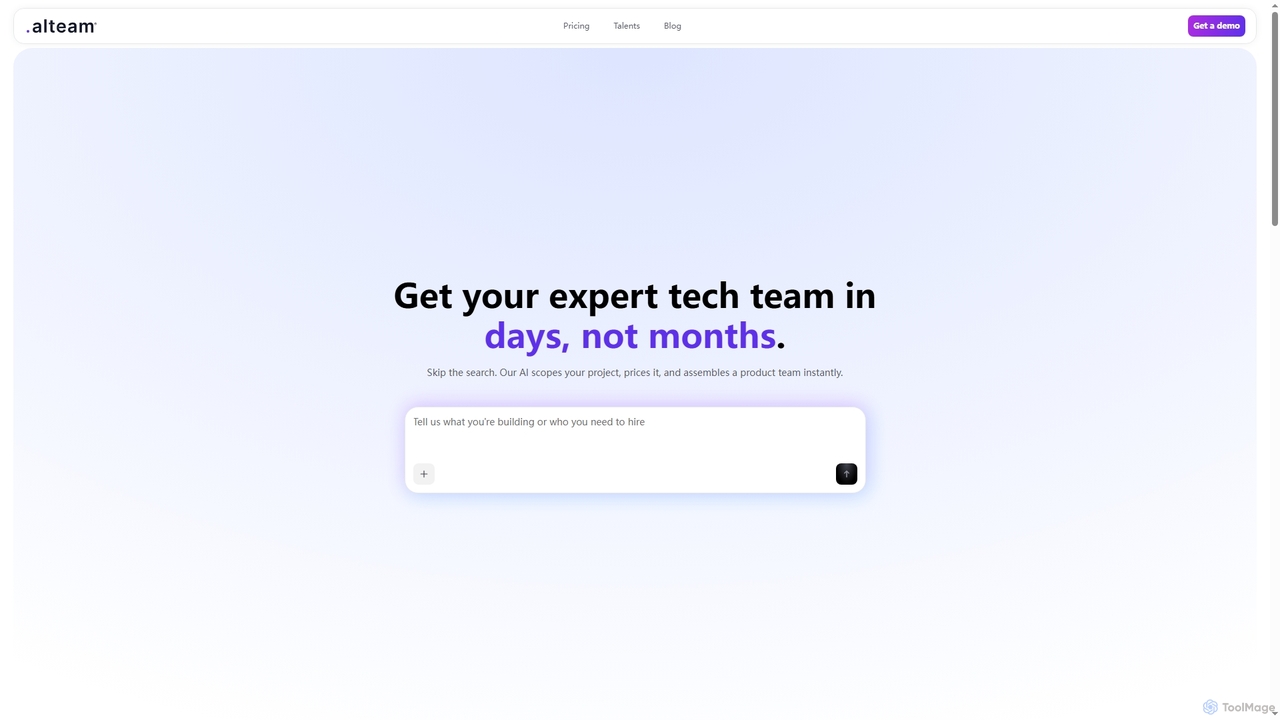
Alteam is an AI-powered talent platform that helps businesses hire vetted tech teams and individual experts in days, …
Alteam is an AI-powered talent platform that helps businesses hire vetted tech teams and individual experts in days, not months. It streamlines project scoping, pricing, and talent matching for rapid development and scaling.
About Recruitment
AI Recruitment tools are AI-powered solutions designed to streamline and enhance various stages of the hiring process. These tools leverage artificial intelligence and machine learning to automate repetitive tasks, analyze vast amounts of data, and provide data-driven insights. They significantly improve efficiency, reduce time-to-hire, and enhance the overall candidate experience by focusing on precision and speed.
Core Features
- Automated Candidate Sourcing: AI scans job boards, professional networks, and internal databases to identify and engage qualified candidates.
- Intelligent Resume Screening: AI analyzes resumes and applications for keywords, skills, and experience, ranking candidates based on job requirements.
- AI-Powered Interview Scheduling: Automates the coordination of interviews, sending invites, managing reschedules, and sending reminders to all parties.
- Candidate Engagement Chatbots: Provide instant answers to candidate queries, guide them through the application process, and offer real-time updates.
- Predictive Hiring Analytics: Uses historical data to forecast candidate success, retention rates, and cultural fit, informing better hiring decisions.
Applicable Scenarios
AI Recruitment tools are invaluable for organizations facing high-volume hiring needs, seeking specialized talent, or aiming to reduce bias in their selection process. They are widely adopted by large enterprises, fast-growing startups, and recruitment agencies to manage extensive applicant pools and optimize their talent acquisition strategies.
How to Choose
When selecting an AI Recruitment tool, consider its integration capabilities with existing ATS/HRIS systems, the accuracy and fairness of its AI algorithms in screening and matching, and its scalability to meet future hiring demands. Evaluate the user experience for both recruiters and candidates, and ensure it offers robust analytics and reporting features to track performance.
RecruitmentUse Cases
Automated Resume Screening for High-Volume Roles
HR teams and recruiters managing thousands of applications for entry-level or high-volume positions use AI tools to automatically screen resumes. The AI quickly identifies candidates matching specific keywords, skills, and experience, ranking them based on job requirements. This significantly reduces the manual review time, allowing recruiters to focus on engaging with the most promising candidates.
Proactive Sourcing of Passive Candidates
Recruiters seeking specialized or hard-to-find talent utilize AI tools to proactively search professional networks, social media, and public databases. The AI identifies passive candidates whose profiles align with specific skill sets and experience, even if they are not actively looking for a job. This expands the talent pool beyond active applicants and helps fill niche roles more effectively.
AI-Powered Interview Scheduling and Coordination
Hiring managers and recruitment coordinators leverage AI tools to automate the entire interview scheduling process. The AI integrates with calendars, sends personalized invitations, manages rescheduling requests, and sends timely reminders to both candidates and interviewers. This eliminates the administrative burden of manual coordination, reduces no-shows, and accelerates the interview pipeline.
Personalized Candidate Engagement via Chatbots
Companies use AI-powered chatbots on their career pages or during the application process to provide instant, personalized support to candidates. These chatbots answer frequently asked questions, guide applicants through complex forms, provide real-time updates on application status, and even pre-screen candidates with quick qualification questions. This improves candidate satisfaction and reduces the workload on recruitment teams.
Predictive Analytics for Reducing Turnover
HR analysts and talent strategists employ AI recruitment tools to analyze historical hiring data, candidate profiles, and performance metrics. The AI identifies patterns and correlations to predict which candidates are most likely to succeed in a role, integrate well with the company culture, and have a higher retention rate. This data-driven approach helps organizations make more informed hiring decisions, ultimately reducing employee turnover.
Bias Reduction in Candidate Shortlisting
Organizations committed to diversity and inclusion implement AI recruitment tools designed to mitigate unconscious bias. These tools can anonymize candidate data, focus solely on skills and experience, or use algorithms trained on diverse datasets to ensure fair evaluation. By reducing human bias in the initial stages of shortlisting, companies can create a more equitable and diverse talent pipeline.