Nurovant
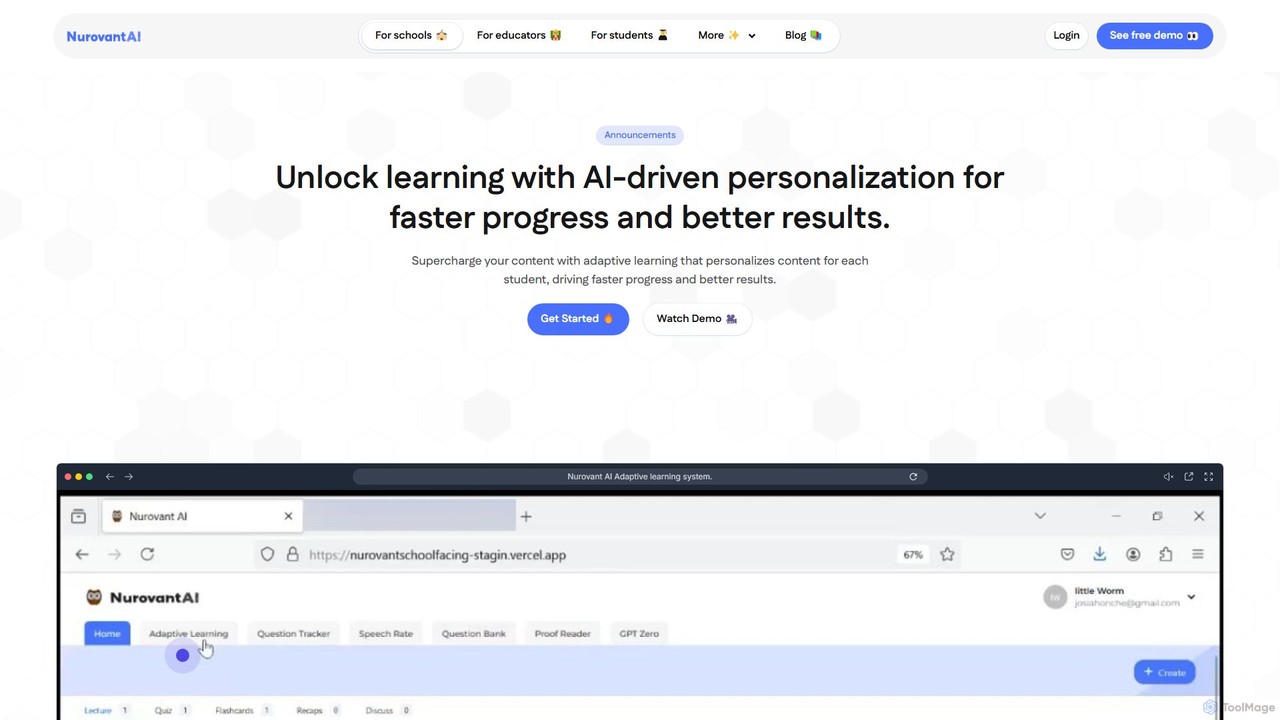
Nurovant is an AI-powered adaptive learning platform designed for students, educators, and schools. It personalizes educational content for …
Nurovant is an AI-powered adaptive learning platform designed for students, educators, and schools. It personalizes educational content for each user, identifies learning gaps, provides immediate feedback, and automates tedious tasks for teachers. By transforming dense materials into manageable study aids like summaries, quizzes, and flashcards, Nurovant accelerates learning, boosts engagement, and improves academic outcomes.
Quino
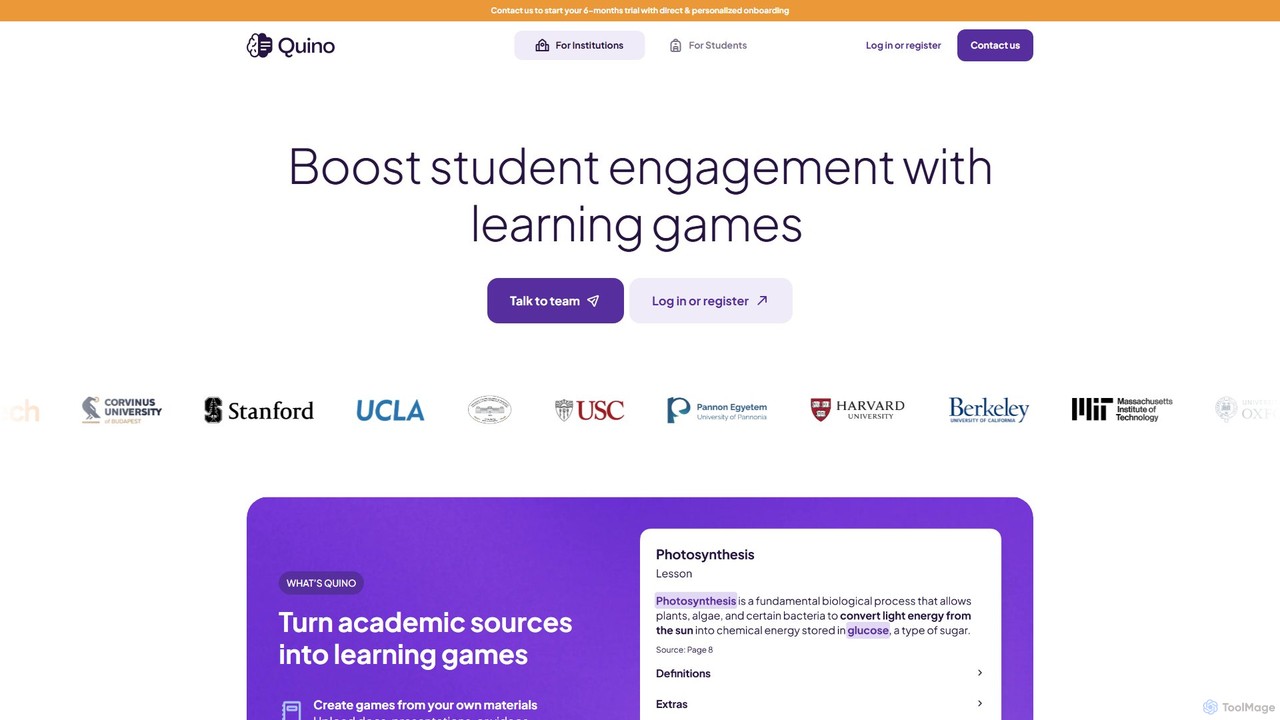
Quino is an AI-driven learning platform that transforms academic materials into engaging learning games and interactive study tools. …
Quino is an AI-driven learning platform that transforms academic materials into engaging learning games and interactive study tools. Designed for both educational institutions and students, it automates lesson creation, boosts student engagement, and provides powerful AI research tools like document summarization and Q&A to foster deeper understanding and academic integrity.
About Teacher
AI Teacher tools are specialized applications designed to assist educators in planning, teaching, and administrative tasks. These tools leverage artificial intelligence, particularly natural language processing and machine learning, to automate content creation, personalize learning, and streamline classroom management. By handling repetitive work like generating lesson plans, creating quizzes, and grading assignments, they free up valuable time for teachers to focus on direct student interaction and mentorship. This leads to more efficient workflows and tailored educational experiences for every student.
Core Features
- Lesson Plan Generation: Automatically create structured and curriculum-aligned lesson plans, activities, and presentations.
- Automated Assessment & Grading: Design quizzes and assignments, and receive instant grading and feedback for various question types.
- Personalized Learning Path Creation: Analyze student performance data to recommend customized resources and learning activities.
- Content Creation & Curation: Generate educational materials like worksheets, case studies, and summaries from various sources.
- Administrative Automation: Streamline tasks such as writing parent communications, generating progress reports, and managing schedules.
Use Cases
These tools are widely used by K-12 teachers, university professors, corporate trainers, and online course creators. For instance, a high school teacher can generate a full week's curriculum in minutes, while a corporate trainer can create interactive onboarding materials. They are particularly effective in environments with diverse student needs, enabling educators to provide differentiated instruction at scale.
How to Choose
When selecting an AI Teacher tool, consider its subject and grade level specialization. Evaluate the quality and customizability of the generated content. Check for integration with your existing Learning Management System (LMS) like Google Classroom or Canvas. Finally, assess the user interface's simplicity and the platform's data privacy policies to ensure it's a secure and practical fit for your educational setting.
TeacherUse Cases
Rapid Lesson Plan and Curriculum Development
A high school biology teacher needs to prepare a new unit on genetics. Instead of spending hours searching for resources, they use an AI Teacher tool. By inputting the topic, grade level, and learning objectives, the tool generates a complete weekly lesson plan, including daily activities, presentation slides, discussion prompts, and a list of key vocabulary. This process reduces planning time by over 70%, allowing the teacher to focus on adapting the materials for their specific students and preparing hands-on experiments.
Creating Differentiated Assessments
An English language teacher works with students at varying proficiency levels. To assess their reading comprehension, the teacher uses an AI tool to create a single quiz that adapts its difficulty. The tool generates questions based on a provided text, creating easier multiple-choice questions for struggling readers and more complex open-ended questions for advanced students. This ensures every student is appropriately challenged, providing the teacher with more accurate data on individual progress without having to create multiple versions of the test manually.
Automating Initial Essay Feedback
A university professor teaching a large introductory sociology class is overwhelmed by the volume of essays to grade. They use an AI grading assistant to provide initial, formative feedback. The tool scans each submission for grammatical errors, structural coherence, citation accuracy, and adherence to the rubric. It provides students with instant suggestions for improvement, allowing them to revise their work before final submission. This empowers students to learn from their mistakes while saving the professor significant time on preliminary checks.
Generating Personalized Student Progress Reports
A primary school teacher needs to write end-of-term progress reports for 25 students. Using an AI tool, the teacher inputs key data points and observations for each student, such as performance in math, reading participation, and social skills. The AI then drafts a comprehensive, well-structured, and positive narrative for each report. The teacher can quickly review and edit these drafts, adding personal anecdotes. This automates the repetitive writing process, ensuring consistency and saving dozens of hours.
Designing Interactive Classroom Activities
A history teacher wants to make a lesson on ancient Egypt more engaging. They use an AI tool to create an interactive role-playing scenario where students act as archaeologists discovering a tomb. The AI generates character profiles, clues, and historical puzzles for the students to solve. It can also act as a 'game master,' responding to student questions in the role of an ancient scribe. This transforms a standard lecture into a memorable, immersive learning experience that boosts student participation and retention.
Curating Supplementary Learning Materials
A corporate trainer is developing a course on digital marketing for employees with different backgrounds. They use an AI tool to support personalized learning. Based on an employee's pre-assessment score, the AI curates a custom playlist of learning materials. For a novice, it might recommend introductory articles and video tutorials. For an expert, it could suggest advanced case studies and research papers. This ensures each employee receives relevant content that matches their knowledge level, maximizing training effectiveness.