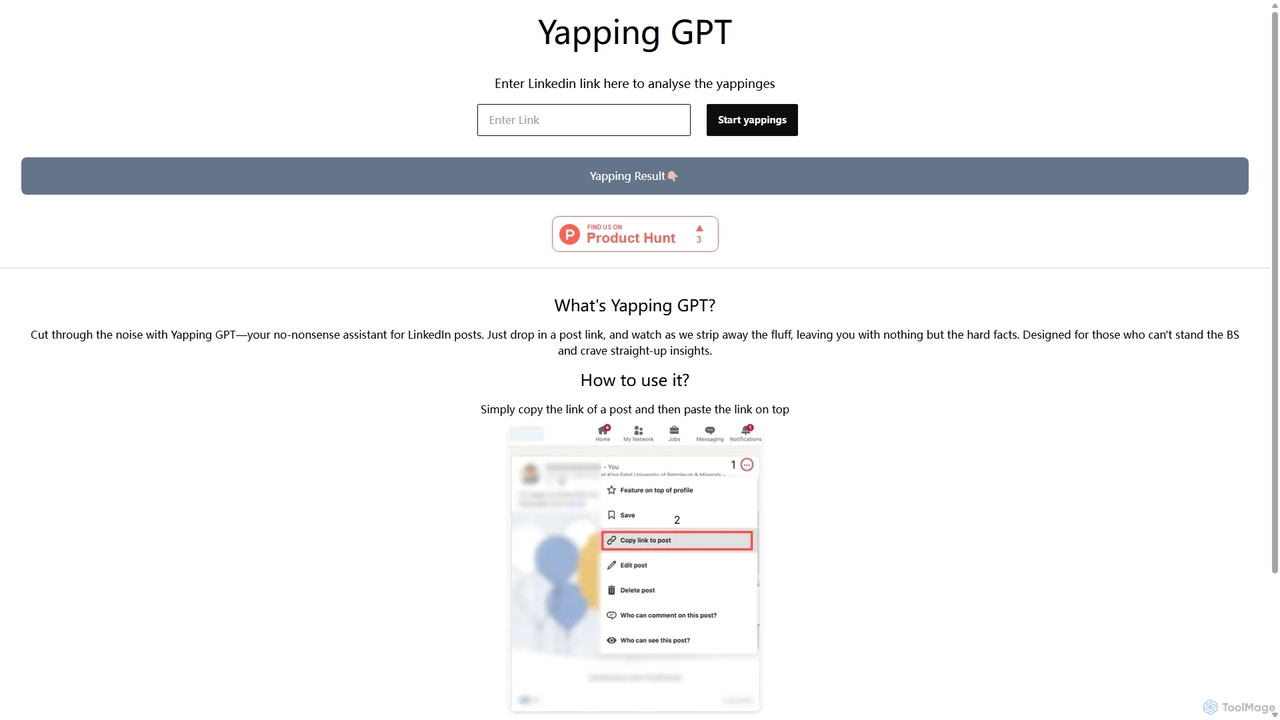
YappingGPT
YappingGPT is an AI-powered tool that instantly summarizes verbose LinkedIn posts. Simply paste a post's link to cut …
YappingGPT is an AI-powered tool that instantly summarizes verbose LinkedIn posts. Simply paste a post's link to cut through the fluff, jargon, and self-promotion. It extracts the core message and key insights, saving you time and helping you focus on what truly matters in your professional feed.
About Content Curation
Content Curation tools are AI-powered platforms designed to discover, filter, organize, and present relevant information from vast digital sources. Operating as a specialized segment within Text Analysis, these tools leverage natural language processing (NLP) and machine learning to intelligently identify, summarize, and categorize content. They enable users to efficiently manage information overload, extract valuable insights, and deliver targeted content experiences to specific audiences or for particular objectives.
Core Features
- Automated Content Discovery: Automatically scans and identifies relevant articles, news, social media posts, and research papers across diverse online sources.
- Intelligent Filtering & Scoring: Applies advanced NLP to filter content based on specified keywords, topics, sentiment, and quality metrics, often assigning relevance scores.
- Summarization & Keyphrase Extraction: Condenses lengthy texts into concise summaries and extracts essential keywords or entities, saving time for review.
- Categorization & Tagging: Automatically classifies and tags content into predefined or custom categories, enhancing organization and searchability.
- Personalized Content Delivery: Tailors content feeds, newsletters, or recommendations based on individual user preferences, historical interactions, or audience profiles.
Applicable Scenarios
Content curation AI is invaluable for professionals needing to stay informed and disseminate targeted information. Marketing teams use it to monitor industry trends and competitor news, while researchers leverage it to aggregate academic papers for literature reviews. Educators can create personalized learning resource lists, and internal communications teams can build dynamic knowledge bases for employees.
How to Choose
When selecting a content curation tool, evaluate its source compatibility with your desired platforms (web, social, databases). Consider the granularity of its filtering capabilities for precise topic and sentiment analysis. Assess the flexibility of its output formats, such as newsletters or API integrations, and its ability to customize content delivery for specific audiences. Finally, ensure it offers sufficient scalability to handle your content volume and growth.
Content CurationUse Cases
Curating Industry Newsletters
A marketing manager needs to send out a weekly industry newsletter to subscribers. The AI content curation tool automatically scans hundreds of news sources, blogs, and industry publications, filters them based on predefined topics and keywords, summarizes the most relevant articles, and even suggests a layout. This saves hours of manual research and writing, ensuring the newsletter is always fresh and highly relevant to the audience.
Academic Research & Literature Review
A university researcher is conducting a literature review on a specific scientific topic. The AI tool is configured to monitor academic databases, journals, and preprint servers. It identifies new publications, extracts key findings, categorizes them by methodology or sub-topic, and highlights conflicting results, significantly accelerating the research process and ensuring comprehensive coverage.
Social Media Trend Monitoring
A social media strategist aims to identify emerging trends and popular discussions related to their brand or industry. The content curation AI continuously monitors social platforms, forums, and blogs, identifying trending hashtags, topics, and influential voices. It provides real-time alerts and aggregated reports, allowing the strategist to quickly adapt content strategies and engage with relevant conversations.
Personalized Content Recommendations
An online learning platform wants to offer personalized course recommendations to its users. The AI tool analyzes user learning history, preferences, and engagement data, then curates relevant articles, videos, and courses from its vast library and external sources. This enhances user experience by providing highly tailored suggestions that match individual learning paths and interests.
Building an Internal Knowledge Base
A large enterprise needs to maintain an up-to-date internal knowledge base for its employees, drawing from various internal documents, external industry reports, and company news. The AI content curation system automatically ingests and processes these diverse sources, extracts key information, categorizes it, and makes it searchable, ensuring employees have easy access to the most current and relevant information.
Identifying Content Gaps for Creation
A content team is looking for new topics to cover that resonate with their audience and fill existing content gaps. The AI curation tool analyzes popular content within their niche, identifies frequently asked questions, trending keywords, and areas where competitors are lacking. This data-driven approach helps the team prioritize content creation efforts, ensuring they produce highly relevant and impactful material.