Formula Bot
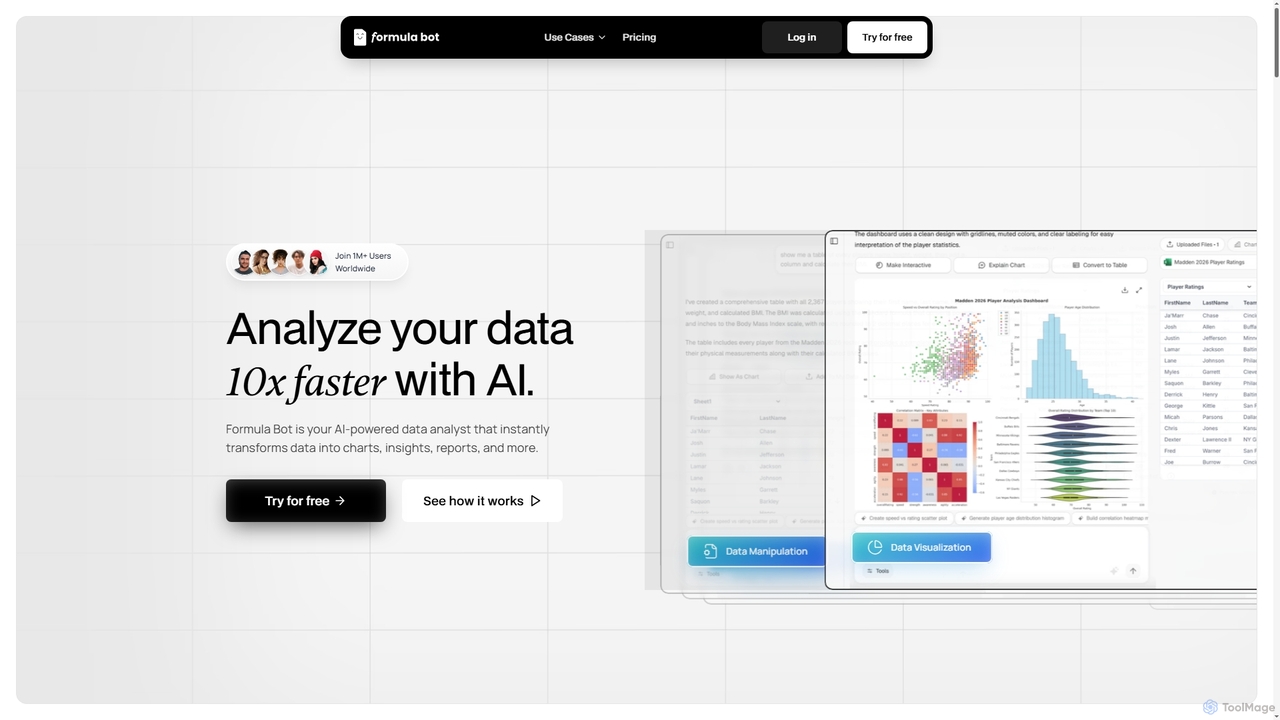
Formula Bot is an AI-powered data analyst that instantly transforms raw data into actionable insights, stunning charts, and …
Formula Bot is an AI-powered data analyst that instantly transforms raw data into actionable insights, stunning charts, and comprehensive reports. It also offers specialized AI tools for generating Excel formulas, converting PDFs to Excel, and providing step-by-step homework assistance across various subjects, streamlining data handling and learning processes for users worldwide.
About Natural Language Processing
Natural Language Processing (NLP) tools are AI-powered solutions designed to enable computers to understand, interpret, and generate human language. These tools leverage advanced machine learning models to process vast amounts of text and speech data, extracting meaning and facilitating human-computer interaction. They are crucial for automating language-related tasks, enhancing data analysis, and building intelligent communication systems within the broader field of text analysis.
Core Features
- Sentiment Analysis: Automatically identifies and extracts subjective information, such as opinions and emotions, from text.
- Named Entity Recognition (NER): Locates and classifies named entities in text into predefined categories like person names, organizations, locations, and dates.
- Text Summarization: Condenses long documents or articles into shorter, coherent summaries while retaining key information.
- Machine Translation: Automatically translates text or speech from one natural language to another, preserving context and meaning.
- Speech-to-Text & Text-to-Speech: Converts spoken language into written text and vice versa, enabling voice interfaces.
Use Cases
NLP tools are widely adopted across various sectors, from customer service to content creation and data analytics. They empower businesses to automate responses, gain insights from unstructured data, and bridge language barriers. For instance, marketing teams use NLP for brand monitoring, while legal professionals apply it for document review and e-discovery.
How to Choose
When selecting an NLP tool, consider its specific capabilities (e.g., sentiment, NER, translation), the languages it supports, and its integration potential with existing systems. Evaluate the accuracy and robustness of its underlying models, scalability for your data volume, and pricing structure. User-friendliness and customization options are also important for effective implementation.

Natural Language ProcessingUse Cases
Automate Customer Support with AI Chatbots
Customer service teams utilize NLP tools to power AI chatbots and virtual assistants. By understanding customer queries in natural language, these tools can automatically provide instant answers to frequently asked questions, route complex issues to human agents, and personalize interactions, significantly reducing response times and improving customer satisfaction.
Extract Insights from Unstructured Text Data
Data analysts and researchers employ NLP to process large volumes of unstructured text, such as social media posts, customer reviews, and news articles. Tools perform sentiment analysis to gauge public opinion, identify key topics through topic modeling, and extract named entities, transforming raw text into actionable business intelligence for strategic decision-making.
Facilitate Cross-Language Communication
Global businesses and international teams leverage NLP for real-time machine translation. This enables seamless communication across different languages in emails, chat platforms, and documents, breaking down language barriers. It also supports localization efforts for products and services, ensuring content is culturally and linguistically appropriate for diverse markets.
Efficiently Summarize and Extract Key Information
Professionals in legal, medical, and research fields use NLP to quickly digest lengthy documents. Tools can automatically summarize reports, contracts, or research papers, highlighting critical information and key clauses. This drastically reduces manual reading time, allowing users to focus on analysis and decision-making rather than extensive document review.
Build Intelligent Voice-Activated Applications
Developers integrate NLP's speech-to-text and text-to-speech capabilities to create sophisticated voice assistants and interactive voice response (IVR) systems. These applications can accurately transcribe spoken commands, understand user intent, and generate natural-sounding spoken responses, enhancing user experience in smart devices, call centers, and accessibility tools.
Generate Human-Like Text for Various Purposes
Content creators and marketers use advanced NLP models for automated text generation. These tools can assist in drafting articles, marketing copy, product descriptions, or social media updates based on prompts or existing data. This accelerates content production, helps overcome writer's block, and ensures consistent messaging across platforms.