ToolMage
Sign in

Best 1 Audiobook Creator AI tools for Text To Speech

Popular Audiobook Creator AI tools in Text To Speech include Serendpt AI, helping you work more efficiently.

Serendpt AI
Freemium

Serendpt AI

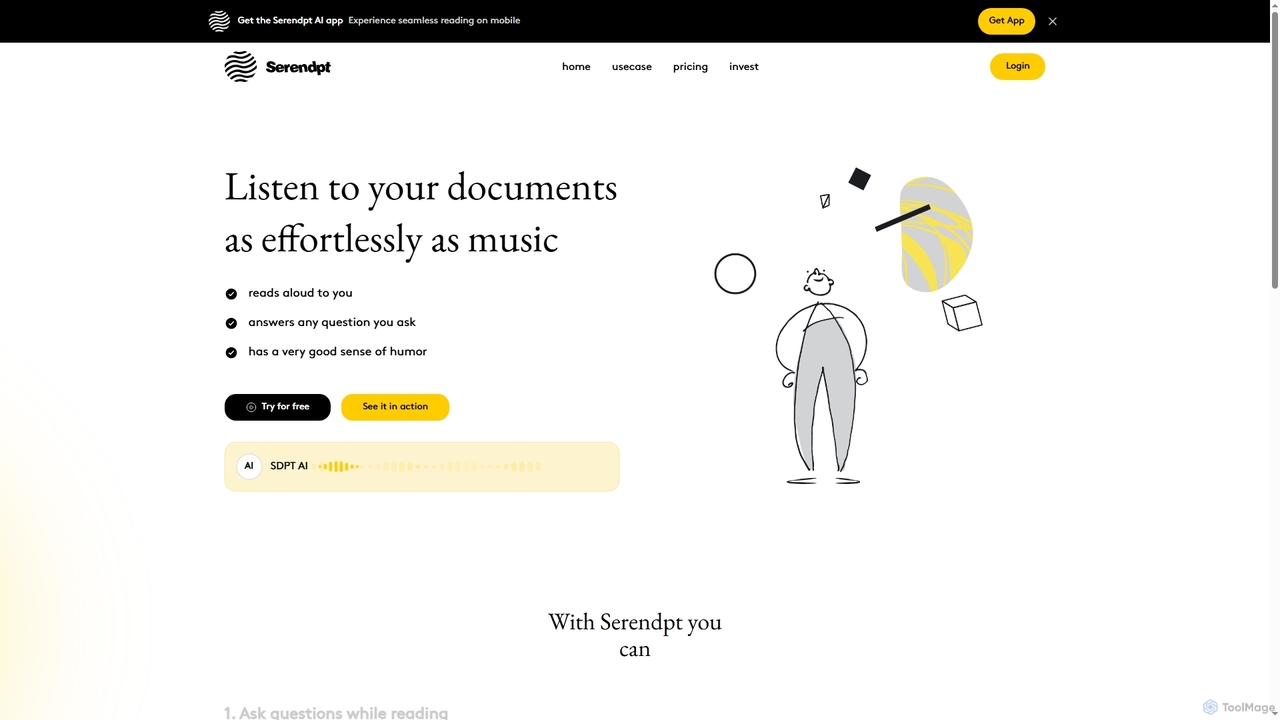
Serendpt AI is an intelligent reading companion that transforms documents and books into interactive experiences. It reads content aloud, answers questions instantly, and offers a personalized tutor mode, all accessible via a mobile app.

Conversational Ai
Visits 5.6KFavorites 132Likes 140

About Audiobook Creator

Audiobook Creator tools are specialized AI applications within the broader Text To Speech category, designed to transform written text into high-quality, natural-sounding audiobooks. These platforms leverage advanced voice synthesis and natural language processing to generate engaging narration from scripts, novels, or educational materials. They offer a cost-effective and efficient solution for authors, publishers, and content creators to produce audio versions of their works, expanding accessibility and reach. Many tools provide a range of customizable voices, emotional tones, and pronunciation controls to ensure a professional listening experience.

Core Features

  • Advanced Voice Synthesis: Converts text into lifelike speech with various voice styles and languages.
  • Emotional Nuance Control: Adjusts tone, pitch, and emphasis to convey specific emotions in narration.
  • Pronunciation Editor: Allows users to correct or customize the pronunciation of specific words or names.
  • Background Music & Sound Effects: Integrates ambient sounds or music to enhance the audiobook experience.
  • Multi-format Export: Exports audiobooks in standard formats like MP3, WAV, or AAC for wide compatibility.

Applicable Scenarios

Authors and independent publishers utilize these tools to convert their written manuscripts into audiobooks without the need for professional voice actors, significantly reducing production costs and time. Educators and e-learning platforms employ them to create accessible audio versions of textbooks and course materials, catering to diverse learning styles. Content creators and podcasters also use them to narrate long-form articles or scripts, expanding their content formats.

How to Choose

When selecting an Audiobook Creator, consider the quality and naturalness of the AI voices, especially for long-form content. Evaluate the range of customization options for voice styles, emotional expression, and pronunciation. Check for supported input and output formats, as well as integration capabilities with other publishing platforms. Finally, assess the pricing model based on your expected usage volume and the availability of features like background music or sound effects.

Audiobook Creator use cases

1

Independent Author Audiobook Production

An independent author can use an Audiobook Creator to convert their written novel into a professional-sounding audiobook. By assigning distinct AI voices to different characters and controlling emotional nuances, the author can bring their story to life without the high costs and time commitment of hiring human narrators. This expands their book's reach to audio listeners and generates new revenue streams.

2

Converting Novels for Self-Publishing

Independent authors can transform their written novels into audiobooks using AI voice synthesis. By uploading their manuscript, they select a suitable AI voice, adjust narration speed and tone, and generate an audio file ready for distribution on platforms like Audible, reaching a wider audience and increasing book sales without hiring voice talent.

3

Convert Novels to Engaging Audiobooks

Authors and independent publishers can utilize Audiobook Creator tools to transform their written novels into immersive audio experiences. By inputting the text, they can select diverse AI voices for narration and assign unique voices to different characters for dialogue. This process significantly reduces the time and cost associated with hiring voice actors and studio time, enabling them to quickly release audio versions of their books and reach a broader audience, including visually impaired readers or those who prefer listening.

4

Create Accessible Educational Audio Content

Educators and e-learning platforms can leverage Audiobook Creator tools to produce accessible audio versions of textbooks, lecture notes, and study guides. By converting written academic materials into audio, they cater to students with different learning styles, visual impairments, or those who prefer to learn on the go. This enhances inclusivity and flexibility in education, allowing students to absorb complex information through listening, improving comprehension and retention without the need for manual narration.

5

Educational Material Audio Conversion

Educators can transform textbooks, lecture notes, or study guides into accessible audio lessons using an Audiobook Creator. This benefits students with learning disabilities, those who prefer auditory learning, or individuals who want to study on the go. The tool ensures consistent narration quality and allows for easy updates to educational content.

6

Creating Educational Audio Content

Educators and e-learning developers utilize audiobook creators to convert textbooks, lecture notes, and study guides into accessible audio formats. This supports students with visual impairments or different learning preferences, allowing them to listen to course material on the go, enhancing learning flexibility and retention.

7

Corporate Training Module Narration

Businesses can utilize Audiobook Creators to generate engaging audio narrations for their e-learning modules, compliance training, or onboarding materials. This ensures a consistent voice and tone across all training content, making it more professional and accessible for employees. It also reduces the need for costly voice actors and studio time, streamlining the production process.

8

Producing Marketing & Promotional Audio

Marketing teams can generate short audio summaries or excerpts of their whitepapers, reports, or blog posts to use in social media campaigns or podcasts. This provides an engaging alternative to text, capturing audience attention and driving traffic to their full content, quickly producing multiple audio variations for A/B testing.

9

Produce Multi-Voice Fictional Narratives

Storytellers and game developers can use Audiobook Creator tools to bring fictional narratives to life with dynamic multi-voice dialogue. Instead of hiring multiple voice actors, they can assign distinct AI voices to each character, complete with emotional inflections and unique speaking styles. This capability is ideal for creating audio dramas, interactive stories, or character dialogue for video games, significantly cutting production costs and accelerating content creation while maintaining high-quality, engaging vocal performances.

10

Blog Post to Podcast/Audio Article

Content creators and marketers can quickly convert their written blog posts, articles, or news updates into audio versions using an Audiobook Creator. This allows them to repurpose content for a podcast format or offer audio articles, catering to audiences who prefer listening over reading. It expands content reach and engagement across different platforms.

11

Developing Corporate Training Modules

Companies use these tools to narrate internal training manuals, compliance documents, and onboarding materials. This ensures consistent voice and tone across all modules, making complex information more digestible and engaging for employees, streamlining the training process and reducing the need for human narrators.

12

Localize Audiobooks for Global Markets

Publishers and content owners can efficiently localize their existing audiobooks into multiple languages using Audiobook Creator tools. By feeding the translated text into the system, they can generate new audio versions with native-sounding AI voices, complete with appropriate accents and cultural nuances. This streamlines the process of expanding into international markets, making their content accessible to a global audience without the extensive costs and logistical challenges of hiring voice talent for each language.

13

Historical Document Audio Archiving

Archivists and historians can use Audiobook Creators to digitize and narrate historical texts, public domain books, or rare manuscripts into accessible audio formats. This preserves valuable written heritage in a new medium, making it available to a broader audience, including those with visual impairments, and ensures its longevity for future generations.

14

Localizing Content for Global Audiences

Publishers and content creators can translate their existing text into multiple languages and then use an audiobook creator to generate audio versions in each language. This enables them to quickly localize their content, making it accessible to a global audience and expanding market reach without significant investment in multilingual voice actors.

15

Transform Blog Posts into Audio Articles

Content marketers and bloggers can convert their long-form blog posts, articles, and whitepapers into engaging audio articles or podcast episodes using Audiobook Creator tools. This allows them to repurpose existing written content for a new consumption format, catering to users who prefer listening while commuting, exercising, or multitasking. By offering audio versions, they can increase content accessibility, extend engagement time, and potentially improve SEO by providing diverse content formats, all without manual recording.

16

Develop Audio Guides for Museums and Tours

Cultural institutions and tourism operators can create rich audio guides for museums, historical sites, or city tours using Audiobook Creator tools. By converting descriptive texts about exhibits or landmarks into engaging audio narration, they offer visitors an enhanced, self-paced touring experience. This eliminates the need for expensive human narrators or complex recording setups, allowing for quick updates and multilingual support, making cultural information more accessible and enjoyable for a diverse audience.

17

Enhancing Accessibility for Visually Impaired

Organizations and individuals can convert any written document, from personal notes to public information, into spoken audio. This provides a vital resource for visually impaired individuals, allowing them to access information independently and conveniently, promoting inclusivity and equal access to knowledge.

18

Marketing Content Audio Versioning

Marketing teams can leverage Audiobook Creators to produce audio versions of whitepapers, case studies, product descriptions, or even email newsletters. This multi-modal content strategy allows businesses to reach audiences who prefer consuming information audibly, enhancing engagement and accessibility. It provides a competitive edge by offering diverse content formats.

Audiobook Creator FAQ

What are Audiobook Creator tools?

Audiobook Creator tools are AI-powered platforms that convert written text into spoken audio, specifically optimized for long-form content like books and articles. They leverage advanced text-to-speech technology to generate natural-sounding narration, often with options for different voices, emotional tones, and pronunciation adjustments, making audiobook production accessible and efficient for various creators.

What are Audiobook Creator tools?

Audiobook Creator tools are AI-powered platforms that convert written text into full-fledged audiobooks. They go beyond basic text-to-speech by offering specialized features like multi-voice narration, emotional tone control, chapter management, and background music integration. These tools are designed to streamline the production of long-form audio content, making it accessible and engaging for listeners.

What are AI Audiobook Creators?

AI Audiobook Creators are advanced software tools that use artificial intelligence to convert written text into spoken audio, specifically optimized for long-form content like books and articles. They go beyond basic text-to-speech by offering features such as multiple character voices, emotional tone control, and pronunciation editing, making the generated audio sound natural and engaging. These tools are primarily used by authors, publishers, and educators to produce high-quality audio versions of their content efficiently.

How do Audiobook Creator tools differ from standard Text-to-Speech (TTS)?

While both convert text to speech, Audiobook Creator tools are specifically optimized for long-form narrative content. Standard TTS focuses on simple, direct conversion of text snippets. Audiobook Creators, however, offer advanced features like assigning different voices to characters, fine-tuning emotional delivery, managing chapter breaks, and integrating background music, all crucial for producing a cohesive and engaging audiobook experience.

How do AI Audiobook Creators differ from general Text-to-Speech (TTS) tools?

While both AI Audiobook Creators and general Text-to-Speech (TTS) tools convert text to audio, Audiobook Creators are specifically designed for long-form narrative content. They offer advanced features like multi-character voice assignment, fine-grained emotional tone control, and robust pronunciation editing, which are crucial for producing engaging and coherent audiobooks. General TTS tools typically provide a single voice for continuous text and lack the nuanced controls needed for complex storytelling, making them more suitable for short-form content or simple voiceovers.

How do Audiobook Creator tools differ from general Text To Speech (TTS) tools?

While both convert text to audio, Audiobook Creator tools are specialized for long-form content, offering features crucial for audiobook production. This includes advanced voice customization, emotional nuance control, chapter management, and often integration with background music or sound effects. General TTS tools typically focus on shorter text snippets and simpler voice output for immediate consumption, lacking the depth required for professional audiobook narration.

What features should I look for in an AI Audiobook Creator?

When choosing an AI Audiobook Creator, prioritize natural-sounding voices with a wide range of customization options for accents, styles, and emotional tones. Look for multi-character support to assign distinct voices for dialogue, a robust pronunciation editor for specific words or names, and the ability to add background music or sound effects. Other important considerations include the variety of supported languages, ease of use, integration capabilities with other platforms, and a clear, scalable pricing model that fits your production volume.

What features should I look for in an Audiobook Creator?

When choosing an Audiobook Creator, prioritize tools with high-quality, natural-sounding AI voices and extensive language support. Look for robust customization options, including emotional tone control, speaking pace adjustments, and a pronunciation editor. Multi-voice capabilities for character assignment, efficient chapter management, and the ability to integrate background music or sound effects are also key. Finally, ensure it supports common audiobook export formats like M4B.

Who can benefit from using an AI Audiobook Creator?

A wide range of users can benefit. Independent authors and publishers use them to produce audio versions of their books cost-effectively. Educators create accessible learning materials. Marketing professionals generate audio summaries for content promotion. Businesses develop engaging internal training modules. Essentially, anyone needing to convert extensive written content into high-quality, narrated audio can find value in these tools.

What features should I look for in an Audiobook Creator?

Key features to consider include the naturalness and variety of AI voices, support for multiple languages, and the ability to control emotional tone and pronunciation. Look for tools that offer chapter segmentation, background music integration, and export options to common audio formats (e.g., MP3, WAV). User-friendliness, editing capabilities, and a clear pricing structure based on usage are also important considerations.

Can AI-generated audiobooks sound natural and expressive?

Yes, significant advancements in AI and deep learning have enabled Audiobook Creators to produce highly natural and expressive voices. Modern tools can mimic human speech patterns, inflections, and even convey a range of emotions. While not always indistinguishable from human narration, the quality is often professional-grade, making AI-generated audiobooks a viable and compelling option for many creators.

Can AI Audiobook Creators produce natural-sounding voices with emotions?

Yes, modern AI Audiobook Creators are highly capable of producing natural-sounding voices and can often convey a range of emotions. Through advanced deep learning models and neural networks, these tools analyze text context to apply appropriate emotional inflections, such as joy, sadness, anger, or excitement. While the level of naturalness and emotional nuance can vary between tools, the best creators offer highly realistic and expressive voices that significantly enhance the listening experience, making the audio feel less robotic and more human-like.

Can AI-generated audiobooks sound truly natural and engaging?

Modern AI Audiobook Creators have made significant advancements, producing highly natural and engaging narration. While they may not perfectly replicate every nuance of a human voice actor, many tools offer a wide range of expressive voices, emotional controls, and custom pronunciation features that allow for compelling storytelling. The quality continues to improve rapidly, making them a viable and often indistinguishable option for many types of audio content.

Who can benefit most from using an Audiobook Creator?

Independent authors and small publishers benefit greatly by producing audiobooks affordably and quickly. Educators can create accessible learning materials for diverse student needs. Content marketers can repurpose written content into audio articles or podcasts, expanding their audience reach. Businesses can generate consistent, professional narrations for training modules and internal communications, saving time and resources.

Who benefits most from using AI Audiobook Creator tools?

A wide range of individuals and organizations benefit from AI Audiobook Creator tools. Authors and independent publishers gain a cost-effective way to produce audio versions of their books, expanding their reach. Educators can create accessible learning materials for students with diverse needs. Content marketers and bloggers can repurpose written content into engaging audio articles, increasing audience engagement. Additionally, businesses looking to localize content or create internal training materials in audio format find these tools invaluable for efficiency and scalability.