Avoidable Apps
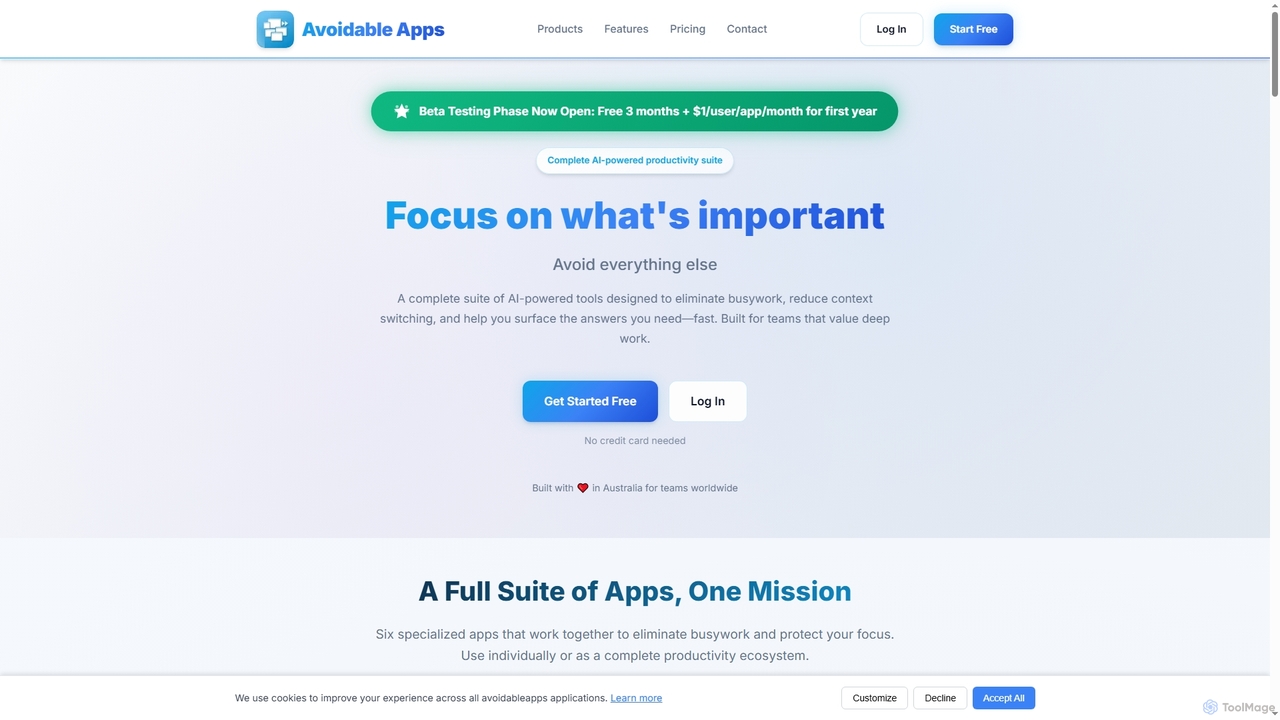
Avoidable Apps is an AI-powered productivity SaaS suite designed to eliminate busywork, reduce context switching, and help teams …
Avoidable Apps is an AI-powered productivity SaaS suite designed to eliminate busywork, reduce context switching, and help teams achieve deep work. It offers a comprehensive ecosystem of six specialized applications that can be used individually or together to streamline workflows and enhance focus.
About Time Tracking
Time Tracking tools are AI-powered solutions designed to automatically monitor and analyze how individuals and teams spend their working hours. Leveraging artificial intelligence, these tools go beyond simple logging, offering intelligent insights into productivity patterns, project progress, and resource allocation. They help users gain a precise understanding of time distribution, optimize workflows, ensure accurate client billing, and enhance overall operational efficiency.
Core Features
- Automated Time Capture: Automatically records time spent on applications, websites, and tasks without manual input.
- Project & Task Allocation: Links time entries directly to specific projects and tasks for granular tracking and reporting.
- Productivity Analysis: Provides insights into productive vs. non-productive activities, identifying areas for improvement.
- Billing & Payroll Integration: Facilitates accurate invoicing for clients and streamlines payroll processing based on recorded hours.
- Anomaly Detection: Uses AI to flag unusual time entries or deviations from typical work patterns.
Applicable Scenarios
These tools are invaluable for a wide range of professionals and organizations. Freelancers use them to ensure transparent and fair client billing. Project managers leverage them to monitor team progress, identify bottlenecks, and keep projects on schedule. Businesses utilize AI time tracking for precise payroll, resource optimization, and compliance with labor laws, ensuring every hour is accounted for efficiently.
How to Choose
When selecting an AI time tracking tool, prioritize accuracy in automated capture and the depth of productivity insights it offers. Consider its integration capabilities with existing project management, CRM, and accounting software. Evaluate the reporting features for clarity and customization, ensuring they meet your specific analytical needs. Finally, assess the user interface for ease of adoption and scalability to accommodate future team growth.
Time TrackingUse Cases
Accurate Client Billing for Freelancers and Agencies
Freelancers and agencies often struggle with accurately tracking billable hours across multiple projects and clients. AI Time Tracking tools automatically log time spent on specific tasks, applications, and client-related activities. This ensures precise billing, eliminates manual data entry errors, and provides transparent, detailed reports to clients, significantly improving revenue capture and client trust.
Accurate Client Billing for Freelancers
Freelance professionals, such as designers or consultants, utilize AI time tracking to automatically log every minute spent on client projects. This ensures that all billable hours, including research, communication, and actual work, are accurately captured. The tool then generates detailed, transparent reports, allowing freelancers to invoice clients precisely and confidently, eliminating disputes and maximizing earnings.
Freelancer Billing Accuracy
Freelancers often juggle multiple clients and projects, making manual time logging tedious and prone to errors. AI Time Tracking tools automatically record time spent on each task, application, and client, ensuring every billable minute is captured. This leads to highly accurate invoices, reduces administrative overhead, and builds client trust through transparent reporting.
Accurate Client Billing for Freelancers
Freelancers and consultants utilize AI-powered Time Tracking tools to meticulously log billable hours for various clients and projects. By automatically recording time spent on specific tasks, meetings, and communications, these tools ensure that every minute of work is accounted for, leading to transparent and fair invoicing. This eliminates manual logging errors and provides clients with detailed breakdowns of services rendered, fostering trust and streamlining payment processes.
Automating Client Billing for Freelancers
Freelance designers or consultants often struggle with accurately tracking billable hours across multiple clients and projects. An AI time tracking tool automatically logs time spent in design software, communication apps, and client meetings. It then categorizes these activities, generating precise timesheets that can be directly used for invoicing, ensuring fair compensation and reducing administrative overhead by up to 70%.
Accurate Client Billing for Freelancers
Freelance designers and consultants often struggle with manual time logging, leading to inaccurate invoices. AI time tracking tools automatically record hours spent on client projects, including specific tasks and applications used. This ensures precise billing, reduces administrative overhead, and provides clients with transparent work logs, improving trust and financial accuracy.
Accurate Client Billing for Freelancers
A freelance graphic designer uses an AI Time Tracking tool to automatically log hours spent on various client projects. The tool intelligently categorizes time spent in design software and communication platforms, providing a detailed breakdown of billable hours. This ensures transparent and accurate invoicing, reducing disputes and saving the freelancer significant administrative time each month.
Accurate Client Billing for Freelancers
A freelance graphic designer uses an AI time tracking tool to automatically log hours spent on different client projects. The tool identifies active design software usage and categorizes it by project, ensuring precise billing. This eliminates manual time logging errors and provides clients with transparent, detailed invoices, improving trust and payment accuracy.
Accurate Client Billing for Freelancers
Freelancers often juggle multiple client projects and need precise records for invoicing. An AI time tracking tool automatically logs time spent on specific applications, documents, and client-related tasks. This ensures every billable minute is captured, eliminating manual logging errors and providing transparent, detailed reports to clients, which can lead to a 15-20% increase in accurately billed hours.
Streamlining Client Billing for Freelancers
Freelance designers and consultants often struggle with accurately logging billable hours across multiple projects and clients. An AI Time Tracking tool automatically records time spent on specific design software, client calls, and document creation. This ensures every minute is captured, generating precise invoices and eliminating disputes, ultimately saving hours of manual logging and reconciliation each month.
Accurate Client Billing for Freelancers
Freelance designers and consultants often juggle multiple client projects, requiring precise time tracking for fair billing. AI time tracking tools automatically log hours spent on design software, client calls, and research, categorizing them by project. This ensures clients are billed accurately for actual work performed, reducing disputes and improving financial transparency, leading to stronger client relationships.
Automating Billable Hours for Freelancers
A freelance graphic designer needs to accurately track time for multiple client projects to ensure correct billing. An AI Time Tracking tool automatically logs time spent in design software, communication apps, and browser tabs, categorizing activities by client and project. This eliminates manual time entry, reduces billing errors, and ensures the designer is compensated fairly for all work, saving hours each month on administrative tasks.
Accurate Client Billing for Freelancers & Consultants
Freelancers and consultants often juggle multiple clients and projects, making manual time logging prone to errors. AI time tracking tools automatically record all work activities, from meetings to development tasks, intelligently categorizing them and assigning them to the correct client or project. This ensures precise, verifiable time sheets for billing, eliminating missed billable hours and enhancing client trust through transparent reporting.
Precise Client Billing for Freelancers
Freelancers often juggle multiple client projects, making accurate time tracking crucial for fair billing. An AI time tracking tool automatically logs hours spent on specific client tasks, applications, and documents. This ensures that every billable minute is captured and categorized correctly, generating transparent reports that justify invoices and build client trust, ultimately maximizing earnings and minimizing administrative overhead.
Accurate Client Billing for Freelancers
Freelance designers and consultants often struggle with accurately tracking billable hours across multiple client projects. AI Time Tracking tools automatically log time spent on specific applications, documents, and client meetings. This ensures precise billing, eliminates manual time-sheet errors, and provides transparent work logs for clients, leading to improved trust and streamlined invoicing processes.
Accurate Client Billing for Freelancers
Freelancers often struggle with accurately tracking billable hours across multiple clients and projects. An AI time tracking tool automatically logs time spent on specific applications, documents, and client communications. This ensures precise invoicing, eliminates manual errors, and provides detailed activity logs for client transparency, ultimately maximizing earnings and building trust.
Freelancer Client Billing & Transparency
Freelancers often struggle with accurately logging billable hours across multiple projects and clients. AI time tracking tools automatically record time spent on specific applications, documents, and client-related tasks. This ensures precise invoicing, eliminates manual errors, and provides clients with transparent, detailed reports of work performed, fostering trust and improving payment cycles.
Optimizing Team Productivity and Resource Allocation
Team managers need clear insights into how their team's time is utilized to optimize workflows and allocate resources effectively. AI Time Tracking provides real-time data on task duration, project progress, and potential bottlenecks. It helps identify areas for improvement, balance workloads among team members, and make data-driven decisions to enhance overall team efficiency and project delivery timelines.
Optimizing Team Productivity in Agencies
Marketing and creative agencies employ AI time tracking to gain insights into how their teams allocate time across various campaigns and client accounts. Project managers can identify which tasks consume the most time, pinpoint bottlenecks, and understand individual and team productivity trends. This data-driven approach enables better resource planning, more realistic project timelines, and improved overall team efficiency.
Optimizing Team Project Allocation
Project managers can struggle to understand how their team's time is truly distributed across various project phases and tasks. AI-powered time trackers provide objective data on actual time spent, highlighting bottlenecks, identifying over-allocated resources, and revealing areas where efficiency can be improved. This enables better resource planning and more realistic project timelines.
Optimizing Project Budgets for Agencies
Project managers in creative agencies or consulting firms deploy Time Tracking solutions to monitor the actual time invested in each project phase and task. This allows them to compare real-time data against initial budget estimates, quickly identify potential cost overruns, and reallocate resources proactively. The insights gained help in refining future project proposals, improving profitability, and ensuring projects are delivered within financial constraints.
Optimizing Team Productivity in Software Development
Software development teams need to understand how much time is spent on coding, debugging, meetings, and administrative tasks. AI time tracking monitors application usage and categorizes activities, providing project managers with real-time insights into team productivity. This data helps identify bottlenecks, reallocate resources, and make informed decisions to keep development cycles on track and within budget.
Optimizing Team Productivity in Agencies
Marketing and creative agencies need to understand how their teams allocate time across multiple client projects. AI time trackers provide detailed insights into time distribution, highlighting bottlenecks or over-allocation. Project managers can identify underutilized resources or areas requiring more focus, enabling better resource planning and improving overall project delivery efficiency by up to 20%.
Optimizing Team Productivity for Project Managers
A project manager in a software development company deploys AI Time Tracking across their team. The tool provides real-time insights into how much time is spent on coding, meetings, and bug fixes for each project. By analyzing these patterns, the manager can identify bottlenecks, reallocate resources more effectively, and ensure projects stay on schedule and within budget, improving overall team efficiency by 15%.
Optimizing Team Productivity in Marketing Agencies
A marketing agency implements time tracking to monitor how its team allocates time across various client campaigns. The AI analyzes activity data to highlight time spent on productive tasks versus distractions. This allows project managers to identify workflow inefficiencies, reallocate resources effectively, and ensure projects stay within budget and deadlines, ultimately boosting overall team output.
Optimizing Team Productivity for Project Managers
Project managers need to understand how their team's time is distributed across various tasks to ensure project milestones are met. AI time tracking tools provide automated insights into task duration, identify bottlenecks, and highlight areas where team members might be over- or under-utilized. This enables data-driven decisions for resource reallocation, potentially improving project delivery times by up to 10% and reducing overtime costs.
Optimizing Team Productivity in Remote Work
For remote teams, understanding how time is allocated and identifying productivity bottlenecks can be challenging. AI Time Tracking tools provide managers with real-time insights into application usage, task focus, and project progress for each team member. This data helps in reallocating resources, identifying training needs, and fostering a more efficient and accountable remote work environment without micromanagement.
Optimizing Team Productivity in Agencies
Marketing and creative agencies need to understand how their teams allocate time across various campaigns and client deliverables. AI time tracking tools provide detailed insights into individual and team productivity, highlighting time sinks or inefficient processes. Project managers can then reallocate resources, identify training needs, and ensure projects stay on budget and schedule, improving overall operational efficiency by up to 20%.
Optimizing Team Productivity in Remote Work
A remote software development team struggles with understanding how time is distributed across different features and bug fixes. Implementing an AI Time Tracking solution allows team leads to monitor application usage and task duration without micromanagement. The tool provides insights into peak productivity times, identifies potential distractions, and helps reallocate resources more effectively, leading to faster project delivery and improved team efficiency.
Optimizing Team Productivity & Project Workflows
Project managers and team leads utilize AI time tracking to gain insights into how their teams spend time across various tasks and projects. By analyzing data on task duration, interruptions, and productive hours, they can identify bottlenecks, reallocate resources more effectively, and streamline workflows. This leads to improved project delivery timelines, better resource utilization, and a boost in overall team efficiency.
Optimizing Team Productivity and Workflows
For project managers and team leads, understanding how teams spend their time is vital for efficiency. AI time tracking provides detailed insights into individual and team activity patterns, highlighting bottlenecks or areas of over-commitment. By analyzing this data, managers can reallocate resources, refine project timelines, and implement more effective workflows, leading to improved project delivery and overall team performance.
Optimizing Project Resource Allocation for Teams
Project managers in agencies or development firms need to understand how team members spend their time to optimize resource allocation. These tools provide real-time data on task completion rates and time spent per project. This allows managers to identify bottlenecks, reassign resources effectively, and make data-driven decisions to keep projects on track and within budget, improving overall project profitability.
Enhancing Team Productivity & Workflow Optimization
For project managers and team leads, understanding how team members spend their time is crucial for efficiency. AI time tracking tools provide insights into individual and team productivity by categorizing activities as productive or distracting. This data helps identify bottlenecks, reallocate resources effectively, and implement workflow improvements, leading to better project outcomes and reduced operational costs.
Optimizing Project Team Productivity
Project managers can utilize AI time tracking to gain real-time visibility into how their teams allocate time across various project phases and tasks. The tools identify time sinks, highlight over-allocated resources, and provide data-driven insights to reallocate efforts more effectively. This leads to improved project timelines, better resource utilization, and enhanced team efficiency.
Boosting Individual Focus and Time Management
Individuals aiming to improve personal productivity and reduce distractions can leverage AI Time Tracking. These tools automatically monitor application and website usage, categorizing activities as productive or distracting. Users gain a clear, objective overview of their daily time allocation, identify time-wasting habits, and develop better strategies for focused work, leading to improved personal output and work-life balance.
Enhancing Personal Productivity & Focus
Individuals aiming to improve their personal productivity use these tools to monitor their daily digital activities. The AI automatically categorizes time spent on different applications and websites, highlighting distractions and unproductive habits. Users can then review their time usage patterns, set focused work blocks, and make informed adjustments to their routines to allocate more time to high-priority tasks and deep work.
Ensuring Project Budget Adherence
For businesses managing client projects, staying within budget is critical. AI Time Tracking allows project leads to continuously monitor the actual time invested in tasks against the budgeted hours. By identifying potential overruns early, teams can adjust strategies, communicate proactively with clients, and ensure projects remain profitable and delivered on schedule.
Enhancing Remote Team Productivity
For companies managing distributed or remote teams, Time Tracking tools provide valuable insights into employee engagement and productivity. Managers can track work patterns, identify peak performance times, and understand how time is allocated across different tasks without resorting to intrusive monitoring. This data supports performance reviews, helps in workload balancing, and ensures team members remain focused and accountable, fostering a productive remote work environment.
Enhancing Project Profitability for Marketing Agencies
Marketing agencies manage numerous client projects simultaneously, each with specific budgets and deadlines. AI time tracking automatically captures time spent on campaign creation, content writing, and client communication. By linking time data directly to project budgets, agencies can accurately assess project profitability, identify scope creep, and optimize future project planning and pricing strategies.
Enhancing Employee Accountability in Remote Teams
Managing remote teams requires clear visibility into work engagement and task progress. Time tracking tools offer a non-intrusive way to monitor activity levels, showing time spent on specific tasks or applications. This helps team leads ensure accountability, identify potential distractions, and provide targeted support, fostering a more productive remote work environment without micromanagement.
Automated Payroll and Compliance Reporting
A small business owner uses an AI Time Tracking solution to automate employee payroll processing. The tool accurately records employee work hours, including breaks and overtime, and generates compliance reports for labor laws. This reduces manual errors in payroll calculations by 90% and ensures the business adheres to all regulatory requirements, saving time and avoiding potential fines.
Enhancing Project Profitability for Consulting Firms
A consulting firm utilizes time tracking to gain deep insights into project costs and profitability. By automatically capturing consultant hours against specific project phases and tasks, the tool provides real-time data on resource consumption. This enables firm leaders to make informed decisions on pricing strategies, identify underperforming projects, and optimize future project planning for maximum profitability.
Enhancing Client Reporting for Consulting Firms
Consulting firms require meticulous time tracking to justify invoices and demonstrate value to clients. AI time tracking solutions automatically capture all client-facing and internal project work, categorizing it accurately. This allows consultants to generate comprehensive, transparent reports detailing hours spent on specific deliverables, fostering trust and reducing billing disputes by up to 25% through clear accountability.
Enhancing Project Management and Budget Adherence
Project managers need to keep projects on track and within budget. By using AI Time Tracking, they can automatically monitor the actual time spent on different project phases and tasks. The tool flags potential overruns by comparing tracked hours against estimated budgets, allowing for proactive adjustments, better resource allocation, and improved project profitability.
Project Cost Analysis for Software Development
Software development teams work on complex projects with varying modules and phases. AI time tracking helps track developer hours spent on coding, debugging, meetings, and testing for each project component. This data is crucial for accurate project cost analysis, future project estimation, and identifying areas for process improvement in the development lifecycle, potentially reducing project overruns by 15%.
Enhancing Project Profitability for Agencies
A marketing agency manages numerous campaigns for various clients, needing to ensure each project remains profitable. An AI Time Tracking system automatically links employee activities to specific client projects, tracking both billable and non-billable hours. This provides detailed cost analysis per project, highlights areas of overspending or inefficiency, and enables the agency to adjust pricing strategies and resource allocation for better financial outcomes.
Enhancing Software Development Sprint Analysis
Software development teams, especially those following Agile methodologies, benefit from AI time tracking by accurately monitoring time spent on coding, testing, debugging, and code reviews within each sprint. These tools integrate with platforms like Jira, providing detailed time distribution reports per task. This data helps teams refine future sprint estimations, identify areas for process improvement, and ensure projects stay on track.
Managing Project Budgets and Costs
Businesses undertaking fixed-price or time-and-materials projects need stringent budget control. AI time tracking integrates with project management platforms to monitor actual hours against estimated budgets in real-time. This allows project managers to proactively identify potential cost overruns, adjust resource allocation, and ensure projects remain within financial constraints, providing stakeholders with clear financial oversight.
Enhancing Remote Team Productivity and Accountability
Managing remote teams requires clear visibility into individual and collective productivity. AI Time Tracking solutions automatically monitor work activities, providing insights into active work hours and task engagement. This helps team leads identify potential distractions, support team members effectively, and ensure accountability without intrusive surveillance, fostering a productive and transparent remote work environment.
Streamlining Project Cost Estimation & Budgeting
Businesses frequently face challenges in accurately estimating project costs and staying within budget. By tracking historical time data for similar projects, AI time tracking tools can provide data-driven insights for future estimations. This allows for more realistic budgeting, better resource planning, and proactive adjustments to avoid cost overruns, ensuring projects are delivered profitably.
Enhancing Remote Work Accountability
For remote teams, maintaining accountability and understanding work patterns can be challenging. AI time tracking solutions offer non-intrusive monitoring of activity levels, application usage, and task focus. This helps managers ensure team members are engaged and productive, while also providing individuals with data to manage their own work-life balance and identify distractions.
Ensuring Compliance and Generating Audit Trails
Businesses in regulated industries or those with strict labor laws require meticulous records of employee work hours for compliance and audit purposes. AI Time Tracking systems automatically capture and log work activities, providing an immutable and accurate record of time spent on specific tasks or projects. This simplifies compliance reporting, reduces audit risks, and ensures adherence to legal and industry standards.
Precise Project Cost Estimation & Budgeting
Software development or engineering teams leverage AI time tracking to collect granular data on the effort required for different project phases and tasks. By analyzing historical time data from similar projects, project leads can generate more accurate cost estimates and create realistic budgets for future endeavors. This leads to better financial planning, reduced project overruns, and improved profitability.
Enhancing Remote Work Accountability
In remote or hybrid work environments, maintaining visibility into employee engagement and workload can be challenging. AI Time Tracking tools offer a transparent way to track activity, ensuring fair workload distribution and accountability. They provide insights into focus times and potential distractions, helping foster a productive and trusting remote work culture.
Streamlining Payroll for Service Businesses
Service-based businesses, such as law firms, accounting practices, or IT support companies, use Time Tracking to automate the collection of employee work hours. This automation significantly simplifies the payroll process, reducing the administrative burden and minimizing errors associated with manual timesheets. Accurate time logs ensure employees are paid correctly for their hours, while also providing clear data for client billing based on service delivery.
Ensuring Compliance and Payroll Accuracy for Enterprises
Large enterprises require meticulous time records for compliance, labor laws, and accurate payroll processing. AI time tracking systems provide an unbiased, automated record of employee work hours, including breaks and overtime. This ensures adherence to regulations, minimizes payroll errors, and provides verifiable data for audits, streamlining HR and finance operations significantly.
Project Cost Estimation and Budget Adherence
Project managers in software development or construction need accurate data for future project estimations and budget control. By tracking actual time spent on similar past projects, AI tools provide historical data for more precise cost projections. This helps in setting realistic budgets, identifying scope creep early, and ensuring projects stay within financial limits, reducing cost overruns by 15-25%.
Improving Personal Focus and Productivity
An individual knowledge worker uses an AI Time Tracking tool to understand their daily work habits. The tool identifies periods of deep work versus distractions from social media or non-work-related browsing. Based on this data, the AI suggests optimal focus blocks and provides personalized recommendations to minimize interruptions, helping the user increase their productive time by 20%.
Streamlining Payroll for Small Businesses
A small business owner employs an AI time tracking system to automate employee work hour calculations for payroll. The tool accurately records clock-in/out times, breaks, and overtime, reducing the administrative burden of manual timesheet processing. This ensures employees are paid correctly and on time, minimizing payroll errors and compliance risks.
Analyzing Employee Productivity for Small Businesses
Small business owners often need to monitor employee productivity to ensure efficient operations without micromanaging. AI time tracking tools provide objective data on how employees spend their work hours, identifying patterns of focus and distraction. This allows managers to offer targeted support or training, leading to a measurable improvement in overall team efficiency and better allocation of resources, potentially boosting output by 5-10%.
Analyzing Personal Work Habits for Self-Improvement
Individuals looking to improve personal productivity can leverage AI Time Tracking to gain objective insights into their daily routines. The tool identifies time sinks, frequently used applications, and periods of high focus versus distraction. This data empowers users to make informed decisions about their work habits, set realistic goals, and develop strategies for better time management and work-life balance.
Employee Attendance and Compliance for Enterprises
Large enterprises require robust systems for employee attendance, payroll, and compliance with labor laws. Automated time tracking solutions record employee clock-ins, clock-outs, and breaks, ensuring accurate payroll processing. They also provide audit trails for regulatory compliance, minimizing legal risks and administrative overhead associated with manual time cards, leading to a 30% reduction in payroll errors.
Personal Productivity Improvement for Individuals
An individual professional aims to improve focus and reduce procrastination during their workday. An AI Time Tracking tool silently monitors computer activity, categorizing time spent on productive applications versus distracting websites. By reviewing daily and weekly reports, the individual gains objective insights into their work habits, identifies time sinks, and can consciously adjust their routine to maximize deep work and achieve personal goals.
Managing Billable Hours in Legal & Professional Services
Law firms and consulting agencies require meticulous records of billable hours for client invoicing. AI time tracking tools automatically capture time spent on calls, document drafting, research, and client meetings, categorizing them by client case or project. This automation significantly reduces the administrative burden of manual logging, minimizes errors, and ensures that all services rendered are accurately accounted for and billed.
Improving Personal Time Management Skills
Individuals seeking to boost personal productivity and develop better work habits can leverage AI time tracking. The tool passively records daily activities, revealing how much time is truly spent on focused work versus distractions. Users can then analyze their own data to identify time sinks, set realistic goals, and make conscious adjustments to their routines, fostering greater self-awareness and efficiency.
Streamlining Payroll and Expense Management for SMBs
Small and medium-sized businesses (SMBs) can significantly reduce administrative overhead by automating time tracking for payroll and expense management. These tools accurately record employee work hours, including breaks and overtime, and can integrate with payroll systems. This automates salary calculations, simplifies expense allocation to projects, and ensures compliance with labor laws, saving valuable HR time.
Employee Monitoring & Compliance for Remote Teams
Managing remote teams requires robust tools to ensure accountability and compliance. AI time tracking solutions offer non-intrusive monitoring of work activities, ensuring employees are engaged during working hours. This helps maintain productivity standards, supports compliance with labor laws (e.g., break times), and provides objective data for performance reviews, fostering a fair and transparent remote work environment.
Accurate Payroll & Compliance Reporting
Businesses, especially those with hourly employees or complex labor laws, require meticulous time records for payroll and compliance. AI time tracking automates the collection of work hours, including breaks and overtime, minimizing human error. It generates comprehensive reports that simplify payroll processing, ensure adherence to regulations, and provide clear audit trails for legal requirements.
Precise Project Cost Analysis and Budgeting
Project managers and finance teams need accurate data on labor costs to budget effectively and analyze project profitability. AI Time Tracking automatically links time spent by team members to specific projects and tasks, allowing for precise calculation of labor expenses. This data supports better budget forecasting, identifies potential cost overruns early, and helps in making informed decisions for future project bids and resource planning.
Ensuring Compliance and Streamlining Payroll
Large enterprises and organizations with hourly employees use AI time tracking for automated attendance and work hour logging. The tools accurately record start/end times, breaks, and overtime, ensuring compliance with labor laws and company policies. This automation significantly reduces manual data entry errors, simplifies payroll processing, and provides an auditable trail of employee work hours.
Boosting Personal Productivity
Individuals aiming to improve their personal time management can leverage AI Time Tracking to gain a clear picture of their daily habits. The tools automatically categorize activities, revealing how much time is spent on deep work versus administrative tasks or distractions. This data empowers users to identify time sinks, set better priorities, and cultivate more focused work routines.
Personal Productivity Improvement
Individuals seeking to boost their personal efficiency and time management skills leverage Time Tracking tools to gain a clear understanding of their daily activities. By tracking time spent on different applications, websites, and tasks, users can identify distractions, pinpoint time-consuming habits, and analyze their focus levels. This self-awareness enables them to make informed adjustments to their routines, prioritize effectively, and ultimately achieve higher levels of personal productivity.
Personal Productivity Improvement for Remote Workers
Remote workers often find it challenging to maintain focus and accurately gauge their productive hours. An AI time tracking tool can help by passively monitoring computer activity and categorizing tasks. This allows individuals to review their daily time allocation, identify distractions, and adjust their work habits to improve focus and overall personal productivity without manual logging.
Personal Productivity Improvement for Individuals
Individuals aiming to improve their personal productivity often find it hard to identify time sinks. AI time trackers passively monitor daily activities, categorizing time spent on productive vs. unproductive tasks. Users gain a clear picture of their work habits, allowing them to consciously reallocate time, minimize distractions, and focus on high-priority tasks, potentially boosting personal output by 10-15%.
Cost Analysis for Research & Development
A research and development team uses AI Time Tracking to accurately allocate engineering hours to specific R&D projects. The tool automatically tracks time spent on different software modules, experiments, and documentation. This data enables precise cost analysis for each project, helping management make informed decisions about future investments and resource allocation, leading to a 10% reduction in project overruns.
Improving Software Development Sprint Planning
A software development team integrates time tracking into their agile workflow to analyze time spent on coding, debugging, and meetings during sprints. The AI helps identify patterns in task completion times and potential bottlenecks. This data is crucial for refining future sprint estimations, improving resource allocation, and ensuring more realistic and efficient project delivery cycles.
Ensuring Compliance in Legal and Professional Services
Industries like legal and accounting have strict requirements for logging billable hours and demonstrating compliance. AI time tracking tools offer an automated, tamper-proof record of all activities, ensuring that time entries are accurate and auditable. This reduces the risk of non-compliance fines and provides robust documentation for regulatory bodies, saving firms significant administrative time and potential legal costs.
Ensuring Compliance and Audit Trails in Regulated Industries
In industries requiring strict compliance and detailed record-keeping, such as legal or finance, accurate time tracking is crucial for audits. AI Time Tracking tools provide an immutable, automated log of all work activities, including document access and communication. This creates a robust audit trail, demonstrating due diligence and simplifying compliance reporting, reducing legal risks.
Personal Productivity Improvement for Remote Workers
Remote workers often struggle with maintaining focus and understanding their own work patterns without office structure. AI time trackers passively monitor application usage, helping individuals identify distractions and unproductive habits. Users can then set personal goals, block distracting websites, and gain a clearer picture of their most productive hours, enhancing self-management and boosting focus by up to 25%.
Streamlining Client Invoicing for Consultants
A consulting firm needs to generate precise and transparent invoices for clients based on hours worked. An AI Time Tracking system automatically captures all client-related activities, meetings, and research, linking them to specific client accounts. At the end of the billing cycle, the system generates detailed reports that itemize services and hours, ensuring accuracy, reducing disputes, and accelerating the invoicing process.
Improving Personal Productivity & Focus
Individuals aiming to better manage their work-life balance and enhance focus can leverage AI time tracking. Running silently in the background, these tools record time spent on applications and websites. Daily or weekly reports offer a clear overview of time allocation, helping users identify time-wasting habits and distractions. This self-awareness enables them to adjust routines, improve concentration, and achieve personal productivity goals.
Ensuring Remote Work Accountability & Transparency
In remote work environments, maintaining transparency and accountability can be challenging. AI time tracking provides objective data on employee activity during work hours, without intrusive monitoring. It helps managers understand workload distribution, identify who is working on what, and ensure fair contributions across the team, fostering trust and providing a basis for performance discussions.
Personal Productivity Analysis and Habit Improvement
Individual professionals, from students to executives, can use AI Time Tracking to gain insights into their personal work habits. The tools track time spent on different applications and tasks, highlighting distractions and focus periods. This data empowers users to identify time sinks, optimize their daily schedules, and cultivate better work habits, ultimately boosting personal efficiency and achieving goals faster.
Personal Productivity Improvement & Habit Formation
Individuals seeking to improve personal productivity can leverage AI time tracking to understand their own work habits. The tools automatically log time spent on tasks, highlighting distractions and peak productivity periods. This self-awareness enables users to identify time sinks, set realistic goals, and cultivate better focus and time management habits, leading to increased personal output and reduced burnout.
Personal Productivity & Habit Improvement
Individuals seeking to improve their personal productivity can benefit greatly. AI time trackers analyze daily routines, categorizing time spent on different activities (e.g., deep work, meetings, distractions). Users receive personalized reports and suggestions to identify unproductive habits, set realistic goals, and consciously reallocate time towards high-value tasks, leading to better focus and output.
Monitoring Remote Work Engagement and Output
Managing remote teams effectively requires understanding work patterns and ensuring engagement without resorting to micromanagement. AI Time Tracking offers insights into active work time, task focus, and project contributions across distributed teams. It helps managers identify periods of high productivity, potential burnout, and ensures equitable workload distribution, fostering a transparent and productive remote work environment.
Strategic Resource Allocation in Consulting Firms
Consulting firms utilize AI time tracking to analyze how their consultants' time is distributed across various client engagements and internal initiatives. By understanding the actual time investment per project and client, firm leaders can optimize resource deployment, identify underutilized talent, and strategically allocate consultants to maximize billable hours and client satisfaction, leading to higher firm profitability.
Generating Detailed Client Reports
Agencies and service providers need to demonstrate the value of their work to clients. AI Time Tracking simplifies the creation of comprehensive, data-driven reports detailing the exact hours spent on various client-specific tasks and deliverables. These reports enhance transparency, justify service costs, and strengthen client relationships by providing undeniable proof of effort.
Compliance and Audit Trails
Organizations operating in regulated industries or those requiring strict adherence to labor laws utilize Time Tracking tools to maintain comprehensive and verifiable records of employee work hours. These tools provide an indisputable audit trail for compliance purposes, demonstrating adherence to working hour regulations, overtime policies, and project-specific mandates. This ensures legal compliance, mitigates risks, and supports internal and external audits with accurate, timestamped data.
Resource Allocation and Forecasting for Consulting Firms
Consulting firms need to efficiently allocate consultants to projects and forecast future resource needs. AI time tracking provides detailed historical data on how long specific types of tasks and projects typically take. This information enables firm leaders to make data-driven decisions on staffing, project timelines, and client commitments, leading to better resource utilization and client satisfaction.
Compliance and Audit Trails for Regulated Industries
Businesses in regulated sectors, such as legal or finance, require meticulous records of work performed for compliance and auditing purposes. AI time tracking tools provide an immutable log of activities, detailing who worked on what, when, and for how long. This ensures adherence to regulatory requirements, simplifies audit processes, and provides verifiable proof of work for legal or financial scrutiny.
Streamlining Time-Off Requests and Approvals
An HR department integrates an AI Time Tracking system with their leave management platform. Employees submit time-off requests through the system, which automatically checks for adequate accrued leave and potential staffing conflicts using AI. Managers receive intelligent notifications for approval, streamlining the entire process and reducing manual HR workload by 30%, ensuring fair and efficient leave management.
Personal Productivity Monitoring for Remote Workers
A remote employee uses a personal AI time tracker to understand their daily work habits and identify peak productivity hours. The tool passively monitors application usage and provides a breakdown of time spent on different tasks. This self-awareness helps the individual optimize their work schedule, minimize distractions, and maintain focus, leading to improved personal output and work-life balance.
Improving Project Budget Management for Creative Agencies
Creative agencies often struggle with managing project budgets and ensuring profitability due to fluctuating workloads. AI time tracking tools provide real-time data on time spent per project phase and task, automatically flagging when a project is nearing its budget limit or exceeding estimated hours. This proactive insight allows agency managers to adjust resources or communicate with clients promptly, improving project profitability by 10-15%.
Automating Payroll and Expense Allocation for Businesses
Businesses with hourly employees or project-based expenses face complexities in payroll processing and cost allocation. AI Time Tracking integrates with payroll systems to automatically calculate wages based on verified work hours. It also helps allocate time-based expenses to specific projects or clients, simplifying accounting, reducing administrative overhead, and ensuring fair compensation.
Resource Allocation for Cross-Functional Teams
Cross-functional teams in product development or R&D need to efficiently allocate their diverse skill sets across various tasks. Time tracking data reveals how much time is spent on specific tasks by different team members. This allows team leads to make informed decisions about resource allocation, balance workloads, and ensure critical path activities receive adequate attention, preventing project delays by up to 10%.
Resource Allocation and Planning for Startups
A growing startup needs to understand how its limited resources are being utilized across different product development phases and operational tasks. An AI Time Tracking solution provides a comprehensive overview of where employee time is invested. This data helps leadership make informed decisions about future hiring, project prioritization, and budget allocation, ensuring the company's growth is supported by efficient resource management.
Transparent Remote Work Monitoring & Accountability
For managers of remote teams, AI time tracking provides a non-intrusive way to understand work engagement. Instead of screenshots, these tools offer activity summaries, showing how time is distributed across projects. This fosters accountability among remote employees, provides objective data for performance reviews, and builds trust by offering transparency into work contributions without micromanagement, supporting effective remote collaboration.
Streamlining Billable Hours for Professional Services
Law firms, consulting agencies, and other professional service providers rely heavily on accurate billable hour tracking. AI time tracking automates the logging of client-specific activities, meetings, and research, ensuring no billable time is missed. This reduces manual entry errors, accelerates the billing cycle, and provides comprehensive audit trails for compliance, significantly improving revenue capture and operational efficiency.
Improving Project Profitability for Consulting Firms
Consulting firms rely on accurate time tracking to understand the true cost and profitability of each client engagement. AI-powered tools provide detailed breakdowns of time spent by consultants on various project phases, client communications, and administrative tasks. This enables firms to analyze project margins, identify areas for efficiency improvement, and make informed decisions on pricing strategies and future project bids.
Detailed Project Reporting for Stakeholders
Presenting clear and comprehensive project reports to stakeholders is essential for transparency and decision-making. AI time tracking tools generate automated reports detailing time spent per task, project phase, and team member. These reports offer granular insights into resource utilization, project progress, and potential delays, facilitating informed discussions and strategic planning with clients and internal stakeholders.
Resource Allocation & Capacity Planning
For organizations managing multiple projects and a shared pool of resources, AI time tracking provides critical data for strategic planning. By analyzing historical time spent on similar tasks, managers can accurately forecast future project durations and resource needs. This enables more informed decisions on staffing, project prioritization, and overall capacity planning, preventing burnout and maximizing production.