ToolMage
Sign in

Best 1 Product Visualization AI tools for Visual Effects

Popular Product Visualization AI tools in Visual Effects include Seed3D, helping you work more efficiently.

Seed3D
Paid

Seed3D

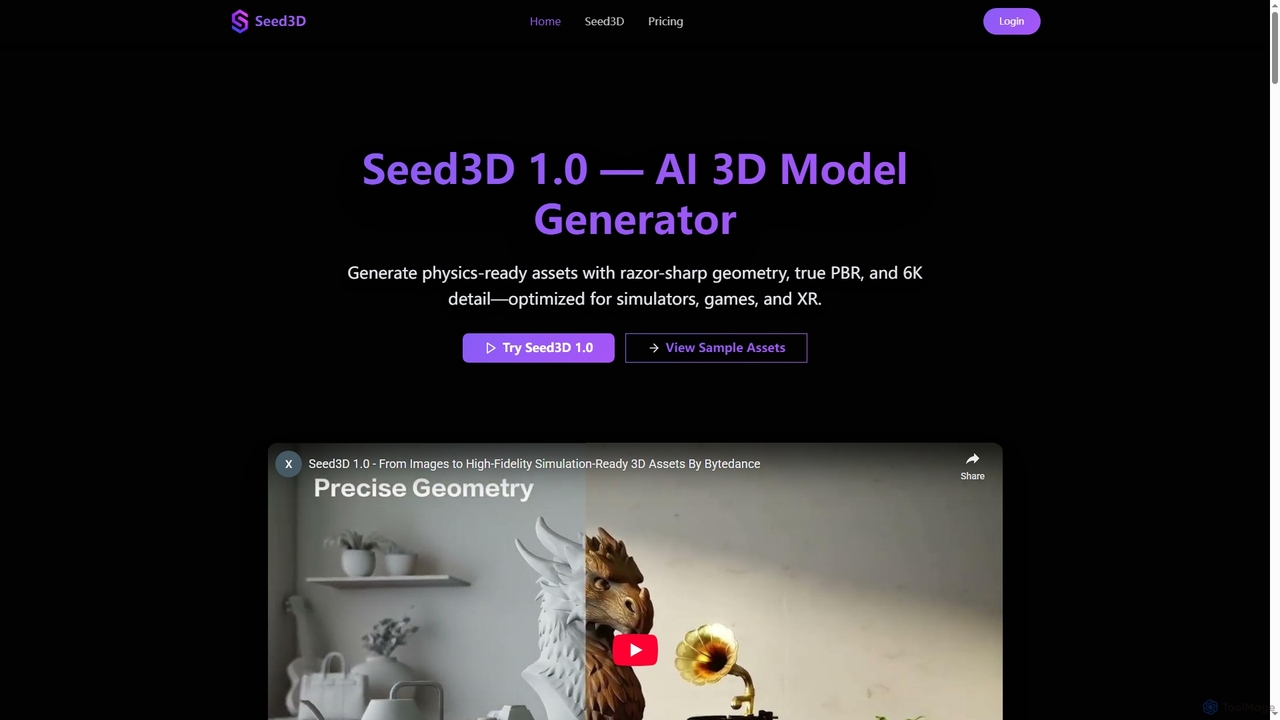
Seed3D is an AI-powered 3D model generator that creates high-fidelity, physics-ready 3D assets from a single image. It delivers razor-sharp geometry, true PBR materials, and 6K textures, optimized for simulators, games, and XR applications.

3D Modeling
Visits 3.7KFavorites 98Likes 97

About Product Visualization

Product Visualization tools are AI-powered solutions that generate realistic 2D and 3D visual representations of products. These tools leverage advanced generative AI and rendering technologies to transform text descriptions, CAD models, or existing product data into high-quality images, videos, or interactive 3D models. They are invaluable for showcasing products in various contexts, from e-commerce listings to marketing campaigns, significantly reducing the need for traditional photography and physical prototypes. As a specialized segment within Visual Effects, AI Product Visualization focuses specifically on creating compelling commercial product imagery with unprecedented speed and flexibility.

Core Features

  • AI-Powered Rendering: Automatically generates photorealistic product images and videos from minimal input, such often text prompts or basic 3D models.
  • Virtual Environment Creation: Places products into diverse virtual scenes and backdrops, allowing for contextual visualization without physical setups.
  • Material & Texture Generation: Applies realistic materials, textures, and lighting effects to products, enhancing visual fidelity and perceived quality.
  • 3D Model Generation: Creates or refines 3D product models from 2D images or specifications, enabling interactive exploration and diverse angle views.
  • Batch Processing & Customization: Generates multiple product variations, colors, or configurations efficiently, supporting extensive customization for marketing.

Use Cases

Product Visualization tools are widely adopted by e-commerce businesses, marketing agencies, and product designers. They enable the rapid creation of diverse product visuals for online stores, social media campaigns, and advertising. Designers use them for quick iteration and concept validation, while sales teams leverage interactive 3D models to engage potential customers with detailed product views.

How to Choose

When selecting an AI Product Visualization tool, consider its rendering quality and realism, the range of supported input formats (e.g., text, CAD, 2D images), and the ease of customizing environments and materials. Evaluate its integration capabilities with existing design or e-commerce platforms, pricing structure, and the scalability for handling large volumes of product variations. User-friendliness and the learning curve are also crucial for efficient adoption.

Featured tool rankings

Product Visualization use cases

1

Generate E-commerce Product Images

E-commerce managers can input basic product photos or descriptions to instantly generate high-quality, consistent product images with various backgrounds and lighting for online listings, saving time and photography costs.

2

Rapid Product Concept Iteration

Product designers use AI visualization to quickly render multiple design variations, material options, and color schemes from initial sketches or CAD models, accelerating the design review and decision-making process.

3

Create Immersive Marketing Campaigns

Marketing teams leverage these tools to produce engaging 3D product animations, interactive virtual showrooms, or lifestyle imagery for social media, advertisements, and virtual reality experiences, enhancing customer engagement.

4

Virtual Staging for Real Estate Products

Real estate developers or interior designers can visualize furniture and decor products within virtual room settings, allowing clients to see how items would look in a specific space before purchase or physical staging.

5

Personalized Product Configuration

Retailers offer customers the ability to customize products (e.g., cars, furniture) in real-time through an interactive configurator, instantly rendering the chosen options and showing the final personalized product.

6

Automated Catalog & Brochure Production

Manufacturers and brands can automate the creation of extensive product catalogs and brochures by feeding product data into AI visualization tools, which then generate all necessary visuals consistently and at scale.

Product Visualization FAQ

What are AI Product Visualization tools?

AI Product Visualization tools are software applications that use artificial intelligence, particularly generative AI and advanced rendering algorithms, to create realistic 2D images, videos, or interactive 3D models of products. They aim to replace or augment traditional photography and 3D modeling processes by automating the generation of high-quality visual assets from minimal input, such as text descriptions, 2D images, or CAD files.

How do AI Product Visualization tools differ from general Visual Effects (VFX) tools?

While both fall under the broader Visual Effects category, AI Product Visualization tools are highly specialized. General VFX tools are designed for a wide range of visual effects in film, gaming, and animation, focusing on complex simulations and artistic expression. Product Visualization, however, specifically targets commercial products, emphasizing photorealism, material accuracy, and efficient generation for marketing, e-commerce, and design purposes, often with features like batch processing and virtual staging tailored for product display.

What are the key benefits of using AI for product visualization?

The primary benefits include significant cost reduction by minimizing the need for physical prototypes and photoshoots, accelerated time-to-market due to faster visual asset creation, and enhanced design flexibility for rapid iteration. These tools also enable greater customization and personalization options for customers, improve visual consistency across marketing channels, and allow for the creation of diverse product scenarios without logistical constraints.

What input formats do AI Product Visualization tools typically support?

Most AI Product Visualization tools support a variety of input formats. Common inputs include 2D product images (for upscaling, background removal, or style transfer), 3D CAD models (e.g., .obj, .fbx, .step) for rendering, and text descriptions or prompts (for generative AI to create visuals from scratch or modify existing ones). Some advanced tools can even work with basic sketches or material specifications.

Can AI Product Visualization tools create interactive 3D models for websites?

Yes, many advanced AI Product Visualization tools are capable of generating interactive 3D models that can be embedded directly into e-commerce websites or used in augmented reality (AR) applications. These models allow customers to rotate, zoom, and even customize products in real-time, providing a highly engaging and immersive shopping experience that can significantly boost conversion rates and reduce returns.
