SnowdayAICalculator
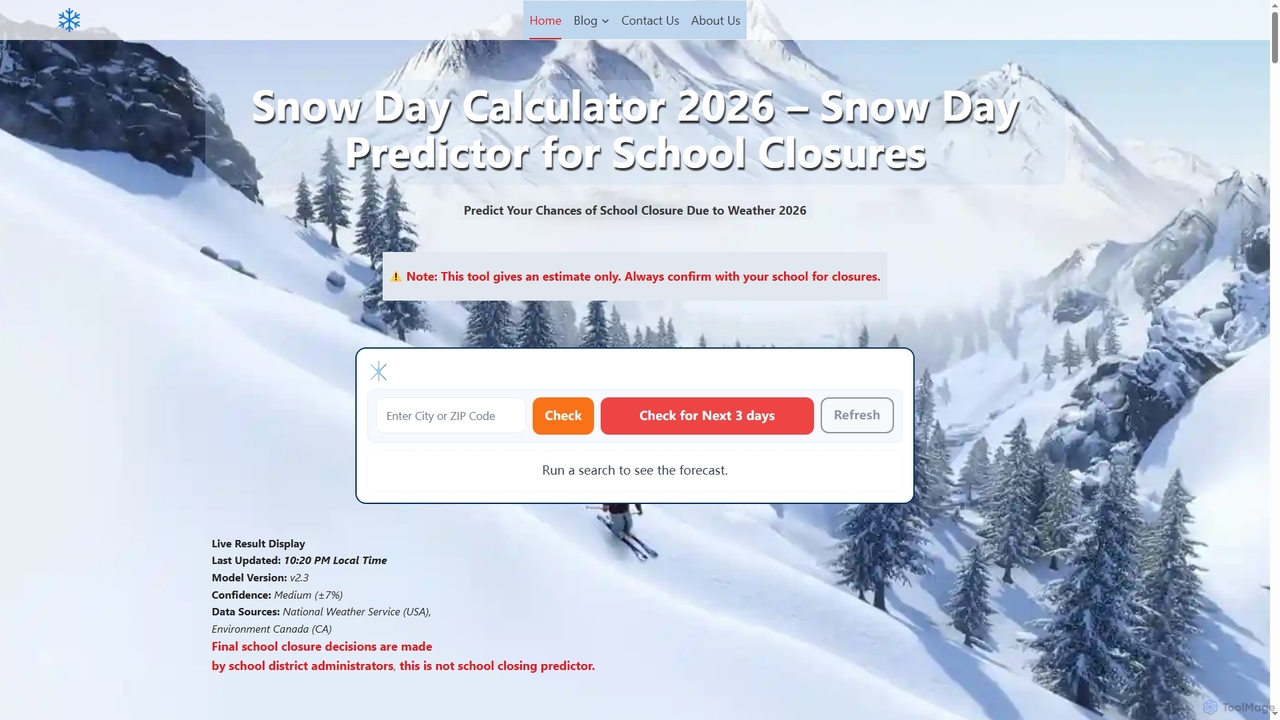
SnowdayAICalculator is an AI-powered online tool that predicts the probability of school closures due to winter weather. By …
SnowdayAICalculator is an AI-powered online tool that predicts the probability of school closures due to winter weather. By analyzing real-time weather data, historical closure patterns, and local school policies, it provides a percentage-based estimate for snow days, helping students, parents, and teachers plan ahead. It supports locations in the US, Canada, and worldwide.
Samudra Sahayak
An AI-powered smart fishing assistant for Indian fishermen. It provides AI-predicted potential fishing zones, real-time weather alerts, GPS …
An AI-powered smart fishing assistant for Indian fishermen. It provides AI-predicted potential fishing zones, real-time weather alerts, GPS navigation, emergency SOS, and a catch logging system to enhance safety, efficiency, and profitability at sea.
About Forecasting
Forecasting tools are AI-powered applications designed to predict future trends, events, or conditions by analyzing historical data and identifying patterns. Within the broader context of weather, these tools specifically leverage meteorological data, satellite imagery, and sensor readings to generate highly accurate predictions for atmospheric phenomena. They provide critical insights for proactive planning and risk management across various sectors.
Core Features
- Time-Series Analysis: Analyzes sequential data points over time to identify trends and seasonality for future projections.
- Model Selection & Optimization: Automatically chooses and fine-tunes the most suitable predictive models (e.g., ARIMA, Prophet, neural networks) for specific datasets.
- Scenario Planning: Allows users to simulate different future conditions and assess their potential impact on predictions.
- Anomaly Detection: Identifies unusual data points or deviations from expected patterns that could affect forecast accuracy.
- Real-time Data Integration: Continuously ingests and processes live data streams to update forecasts dynamically.
Applicable Scenarios
These tools are vital for industries where future conditions significantly impact operations and safety. For instance, in agriculture, farmers use AI forecasting to predict crop yields, pest outbreaks, and optimal irrigation schedules based on weather patterns. Energy companies rely on these tools to forecast demand and supply fluctuations, especially for renewable energy sources like solar and wind, which are highly dependent on weather. Furthermore, logistics and transportation leverage forecasting for route optimization and managing delays caused by adverse weather.
How to Choose
When selecting an AI forecasting tool, consider its data integration capabilities to ensure compatibility with your existing data sources (e.g., weather APIs, IoT sensors). Evaluate the accuracy and interpretability of its models, as transparent models are crucial for understanding predictions. Look for customization options that allow tailoring models to specific business needs and the ability to perform scenario analysis for robust planning. Finally, assess its scalability to handle growing data volumes and complexity.

ForecastingUse Cases
Optimizing Agricultural Operations
Farmers use AI forecasting tools to predict rainfall, temperature, and soil moisture levels with high precision. This enables them to schedule irrigation, planting, and harvesting at optimal times, minimizing water waste and maximizing crop yields. Early warnings for frost or pest outbreaks also allow for proactive protective measures, significantly reducing losses and improving farm efficiency.
Demand Forecasting for Retail Inventory
Retail operations managers use AI forecasting to predict future product demand with high precision, optimizing inventory levels, reducing stockouts, and minimizing carrying costs and waste. This allows for more efficient supply chain management and improved customer satisfaction.
Optimizing Agricultural Operations
Farmers use AI forecasting to predict rainfall, temperature, and humidity, enabling precise irrigation scheduling, optimal planting and harvesting times, and proactive disease management. This significantly reduces crop loss, optimizes resource use, and enhances overall farm productivity by making data-driven decisions.
Predicting Agricultural Yields
Farmers and agricultural businesses utilize AI forecasting tools to predict crop yields and potential harvest times. By integrating historical weather data, soil conditions, and satellite imagery, these tools can forecast the impact of climate variations on specific crops, enabling optimized planting schedules, resource allocation, and market planning to maximize output and minimize waste.
Enhancing Renewable Energy Management
Energy grid operators and renewable power producers leverage AI forecasting tools to predict wind speeds for turbine output or solar irradiance for panel efficiency. This allows for better grid balancing, optimizing energy storage, and making proactive adjustments to meet demand. Accurate forecasts help prevent energy waste and ensure a stable power supply from intermittent sources.
Energy Grid Load Prediction
Utility companies deploy AI forecasting to anticipate electricity and gas consumption peaks and troughs, enabling efficient power generation scheduling, grid balancing, and proactive prevention of outages. This ensures stable energy supply and optimizes operational costs.
Enhancing Renewable Energy Management
Energy companies leverage forecasting tools to predict solar irradiance and wind speeds, optimizing the output of solar farms and wind turbines. This allows for better grid integration, balancing supply and demand, and minimizing energy waste, crucial for stable and efficient renewable energy operations.
Optimizing Energy Grid Management
Energy providers, particularly those managing renewable sources like wind and solar, employ forecasting AI to predict energy generation and demand. These tools analyze weather patterns, historical consumption, and grid load to forecast supply-demand imbalances, allowing for proactive adjustments in energy distribution, storage, and trading, ensuring grid stability and efficiency.
Improving Logistics and Supply Chain Planning
Transportation and logistics companies utilize AI weather forecasts to predict severe weather events along shipping routes, such as heavy snow, storms, or floods. This helps in rerouting vehicles, adjusting delivery schedules, and preventing delays or damage to goods. By proactively managing weather risks, businesses can ensure timely and safe deliveries, reducing operational costs and improving customer satisfaction.
Financial Market Trend Analysis
Investment analysts and traders leverage AI forecasting to predict stock price movements, currency exchange rate fluctuations, and commodity price trends, informing strategic trading and portfolio management decisions. This helps in identifying opportunities and managing risks in volatile markets.
Improving Logistics and Supply Chain Planning
Transportation and logistics firms utilize weather forecasts to plan optimal shipping routes, avoid adverse conditions, and predict delivery delays. This ensures timely delivery, reduces fuel consumption, and enhances safety for goods and personnel, leading to more resilient and cost-effective supply chains.
Enhancing Supply Chain Resilience
Logistics and supply chain managers use AI forecasting to anticipate disruptions caused by extreme weather events or seasonal changes. By predicting potential delays in shipping routes, port closures, or inventory fluctuations, businesses can reroute shipments, adjust stock levels, and communicate proactively with customers, minimizing financial losses and maintaining service levels.
Supporting Disaster Preparedness and Response
Government agencies and emergency services employ AI forecasting to predict the trajectory and intensity of natural disasters like hurricanes, floods, or wildfires. This enables timely evacuations, strategic resource allocation, and efficient deployment of emergency personnel. Accurate, early warnings are crucial for saving lives, minimizing property damage, and coordinating effective disaster response efforts.
Agricultural Yield & Climate Impact Forecasting
Farmers and agricultural scientists utilize AI to predict crop yields based on historical data, soil conditions, and advanced weather forecasts, optimizing planting schedules and resource allocation. This enables better planning for harvests and mitigation of climate-related risks.
Supporting Disaster Preparedness and Response
Emergency services and government agencies employ AI forecasting to predict the trajectory and intensity of severe weather events like hurricanes or floods. This enables early warnings, efficient resource deployment, and evacuation planning, significantly saving lives and mitigating property damage during critical situations.
Forecasting Retail Demand for Seasonal Products
Retailers leverage AI forecasting to predict consumer demand for seasonal products, especially those influenced by weather, such as apparel, outdoor gear, or beverages. By analyzing past sales data, local weather forecasts, and promotional activities, these tools help optimize inventory levels, prevent stockouts or overstocking, and inform marketing strategies for maximum sales.
Informing Urban Planning and Infrastructure Resilience
City planners and urban developers use long-term climate forecasts generated by AI tools to design resilient infrastructure. This includes planning for drainage systems capable of handling increased rainfall, constructing buildings resistant to extreme temperatures, or assessing flood risks for new developments. Such foresight ensures sustainable urban development and protects public assets against future climate challenges.
Customer Churn Prevention
Telecommunication or subscription service providers use AI forecasting to identify customers at high risk of churning, allowing for targeted retention campaigns and personalized offers to improve customer loyalty and reduce revenue loss. This proactive approach enhances customer lifetime value.
Informing Urban Planning and Infrastructure Development
City planners use long-term climate predictions to design resilient infrastructure, manage water resources, and develop strategies for heat island mitigation. This helps cities adapt to climate change, protect urban populations from environmental risks, and ensure sustainable urban development for the future.
Supporting Disaster Preparedness and Response
Government agencies and emergency services utilize AI forecasting for predicting the trajectory and intensity of natural disasters like hurricanes, floods, or wildfires. These tools integrate real-time meteorological data, topographical information, and historical event patterns to provide early warnings, facilitate evacuation planning, and optimize resource deployment for effective disaster response.
Personalized Weather Alerts for Outdoor Activities
Individuals and businesses involved in outdoor recreation, such as event organizers, hikers, or construction crews, use personalized AI forecasts to receive hyper-local, real-time alerts for sudden weather changes. This enables safer planning and decision-making for activities, preventing potential hazards, optimizing resource deployment, and ensuring the safety and success of outdoor operations or events.
Project Timeline & Resource Forecasting
Project managers predict task completion times and resource requirements (e.g., personnel, budget, materials) using AI forecasting to ensure projects stay on schedule and within budget. This minimizes delays, optimizes resource allocation, and improves overall project success rates.
Personalized Outdoor Activity Planning
Individuals and businesses in tourism or outdoor sports use hyper-local forecasts to plan activities, ensuring safety and maximizing enjoyment. This includes predicting conditions for hiking, skiing, or event management, allowing for informed decisions that enhance user experience and minimize risks associated with weather changes.
Personalized Health Risk Prediction (Weather-related)
Healthcare providers and public health organizations can use AI forecasting to predict the incidence of weather-sensitive health issues, such as asthma attacks or flu outbreaks. By correlating local weather forecasts with historical health data and air quality metrics, these tools can issue personalized alerts or public health advisories, enabling individuals to take preventive measures and healthcare systems to prepare for increased demand.