Amp
Code Assistant
AI TOOL COMPARISON
What is the difference, and which fits your workflow? Compare features, usage, pricing models and traffic side by side.
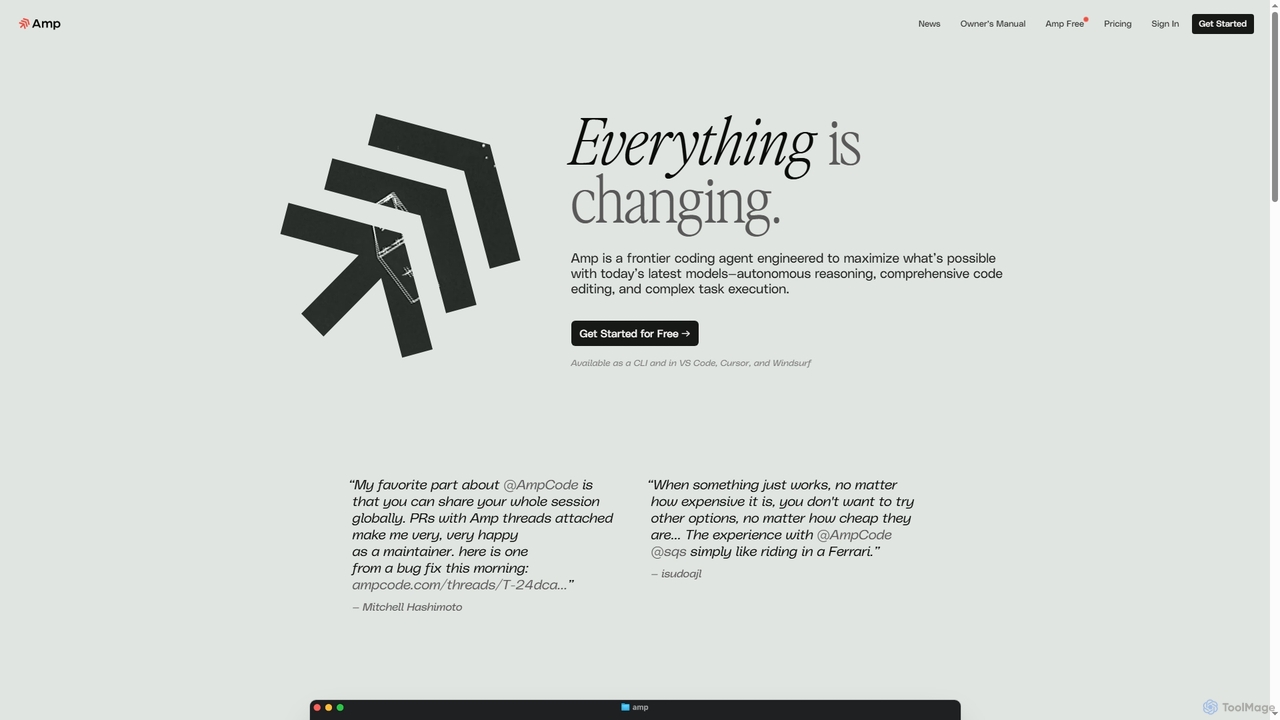
Amp is a frontier AI coding agent designed for developers. It operates as a CLI and within IDEs like VS Code, automating complex tasks such as code editing, debugging, and refactoring. Amp leverages the latest AI models to provide autonomous reasoning and execution, enhancing developer productivity through features like subagents, an Oracle for complex analysis, and deep IDE integration.
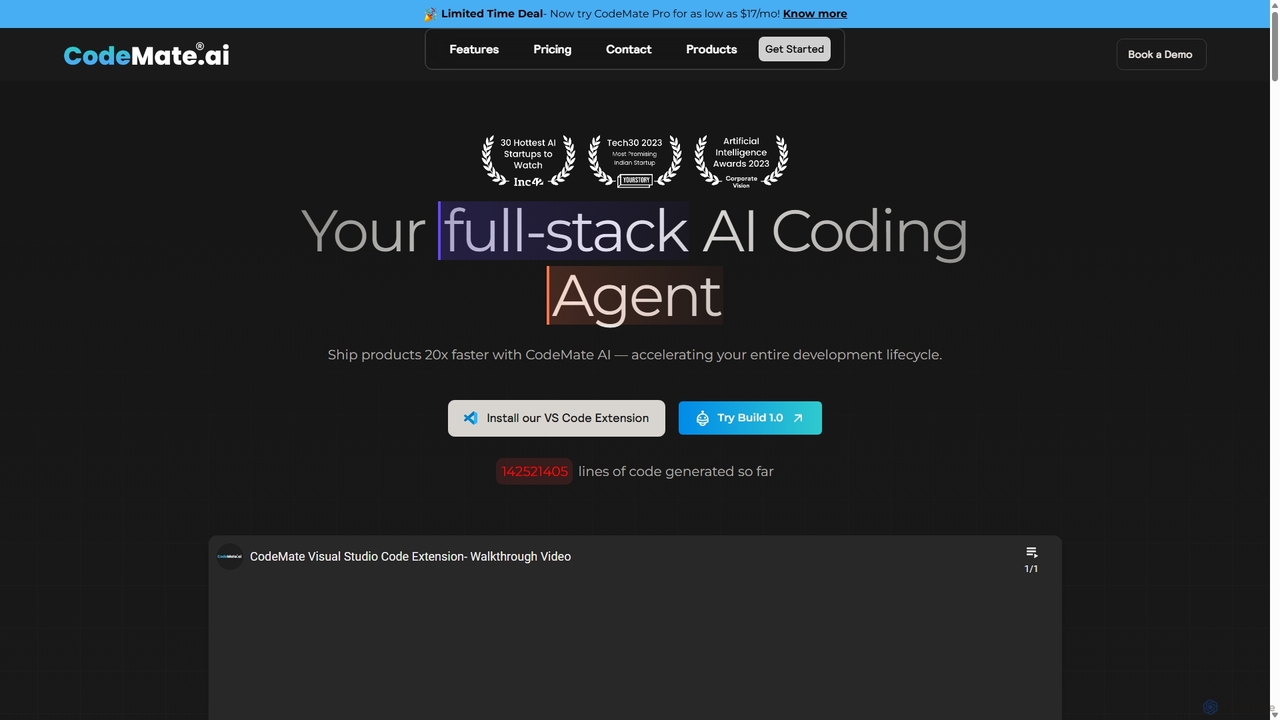
CodeMate is a secure, personalized AI pair programmer designed to enhance developer productivity. It assists with debugging, reviewing, and optimizing code, offering context-aware chat and seamless integration with IDEs like VS Code to help developers build software up to 20x faster.
Compare product focus, pricing models and audiences. Highlighted rows indicate different listed information; unknown pricing does not mean free.
| Quick facts | Amp | CodeMate |
|---|---|---|
| Pricing model | Freemium | Paid |
| Product type | Web | Web |
| Primary focus | Code Assistant | Code Assistant |
| Audience and roles | Data Scientist · DevOps Engineer · Software Developer · Software Engineer | Backend Engineer · DevOps Engineer · Engineering Manager · Full-Stack Developer · Software Developer · Software Engineer · Student · Teacher |
| Categories | Code Assistant · Developer Tools | Code Assistant · Learning · Developer Tools |
| Added | Oct 22, 2025 | Sep 7, 2025 |
| Updated | Nov 19, 2026 | Nov 19, 2026 |
Explore the listed product descriptions, features and workflows. Taxonomy labels alone are not feature evaluations.
Amp is a sophisticated, frontier coding agent developed by Sourcegraph to maximize developer capabilities using the latest AI models. It functions as both a command-line interface (CLI) and an extension for popular code editors like VS Code, Cursor, and Windsurf. Amp is engineered for autonomous reasoning, comprehensive code editing, and executing complex programming tasks. It aims to act as a powerful pair programmer, capable of understanding codebase context, fixing errors, implementing features, and refactoring code with minimal guidance. By always using the best available models and providing unconstrained token usage, Amp delivers raw AI power directly into the developer's workflow.
To get started with Amp, users first sign in on the official website and install the tool, either as a VS Code extension or a CLI for macOS, Linux, and Windows (via WSL). Once authenticated, you can interact with Amp using natural language prompts. For example, you can ask it to "Fix all the TypeScript errors in this file" or "Add a dark mode toggle to this React component." Amp can be guided using `AGENTS.md` files for project-specific instructions, and users can mention files with `@` to provide context. The CLI allows for both interactive sessions and non-interactive execution of commands for scripting and automation.
Amp is ideal for a wide range of software development tasks. Developers can use it for rapid debugging by asking it to identify and fix errors in files or entire projects. It excels at code refactoring, such as converting CSS to Tailwind or improving code structure. It can also be used to implement new features from high-level descriptions, like adding a UI component or setting up an API endpoint. For codebase exploration, Amp can quickly find where specific logic is handled or explain the relationship between different parts of the code. It's also a valuable tool for automating tests, writing documentation, and reviewing API designs.
Amp's primary advantage is its focus on providing raw, unconstrained AI power to developers. Its principle of always using the best models ensures users benefit from cutting-edge AI without manual configuration. The ability to use subagents, the Oracle, and the Librarian allows it to tackle highly complex problems that are beyond the scope of typical AI assistants. Its deep integration into the developer's existing workflow via CLI and IDE extensions minimizes friction. Furthermore, its collaborative features and extensibility with custom tools make it a powerful asset for both individual developers and entire engineering teams.
Amp offers a freemium pricing model with three main tiers:
CodeMate is an advanced AI-powered pair programmer designed to revolutionize the software development lifecycle. It acts as a personal and secure co-developer, empowering engineers to transition from idea to deployment in record time. By integrating directly into the developer's workflow, CodeMate helps eliminate context switching and overloading browser tabs, allowing for a deep focus on problem-solving rather than tedious debugging and code maintenance. Trusted by engineers at major tech companies, it aims to make developers 20x more productive by automating repetitive tasks and providing intelligent assistance.
Getting started with CodeMate is straightforward and designed for seamless integration. Users can incorporate its powerful features directly into their existing development environment. The primary method is by installing the CodeMate extension for Visual Studio Code (VS Code). Once installed, developers can connect their codebases, documentation, and Git repositories. This allows the AI to gain context and provide highly relevant assistance. With the extension active, you can use simple commands to debug code, request code reviews, refactor complex functions, or generate documentation. Alternatively, for those who prefer a dedicated space, CodeMate also offers its own web-based IDE where you can write, test, and fix your code with all the AI features built-in.
CodeMate is versatile and benefits various users. Individual developers and freelancers can use it to accelerate their personal projects, quickly debug issues, and learn best practices. For smaller development teams and startups, it facilitates collaboration through a shared knowledge base and ensures code consistency and quality with automated PR reviews. Large organizations and enterprises can leverage on-premises deployment for maximum security, custom fine-tuned models for proprietary codebases, and dedicated support to streamline their development processes. In educational settings, CodeMate serves as an AI-powered coding companion for students, offering personalized learning paths and instant feedback, while providing teachers with tools to manage assignments and track student progress.
The primary advantage of CodeMate is the massive boost in productivity, enabling developers to focus on high-level problem-solving. Its context-aware nature provides more accurate and relevant suggestions than generic AI models. Security is a cornerstone, with features like on-premises deployment and a commitment to keeping user code private. The tool's extensive language support makes it adaptable to virtually any project. Furthermore, its educational features bridge the gap between learning and professional development, making it a valuable tool for both students and seasoned engineers.
CodeMate offers several pricing plans tailored to different needs:
Their taxonomy shows where the products overlap and where each one has a more distinct focus. Unknown fields are shown explicitly and are never filled with assumptions.
Traffic is shown on the same scale so differences in market visibility are not visually understated.
Both charts share the same months and vertical scale. Each tool identifies its latest reporting month; missing months are left blank, not counted as zero. Regional and source visit counts are estimates calculated from the reported shares.
| Country/region | Percentage | Estimated visits |
|---|---|---|
| 🇺🇸United States | 40.72% | 122.6K |
| 🇨🇳China | 27.13% | 81.7K |
| 🇹🇼Taiwan | 12.58% | 37.9K |
| 🇭🇰Hong Kong | 11.4% | 34.3K |
| 🇻🇳Vietnam | 8.17% | 24.6K |
| Source type | Percentage | Estimated visits |
|---|---|---|
| Direct | 82.01% | 247K |
| Referral | 16.72% | 50.4K |
| 1.27% | 3.8K |
| Country/region | Percentage | Estimated visits |
|---|---|---|
| 🇮🇳India | 67.51% | 14.1K |
| 🇺🇸United States | 28.17% | 5.9K |
| 🇬🇧United Kingdom | 3.79% | 794 |
| 🇻🇳Vietnam | 0.53% | 111 |
| Source type | Percentage | Estimated visits |
|---|---|---|
| Direct | 92.95% | 19.5K |
| Referral | 6.05% | 1.3K |
| 1% | 209 |
Ratings, comments, favorites, and likes are community signals—not a substitute for product fit.
Amp is a frontier coding agent built by Sourcegraph, designed for software developers. It functions as a command-line tool (CLI) and an extension for code editors like VS Code, Cursor, and Windsurf. Its purpose is to assist with complex coding tasks through autonomous reasoning, code editing, and task execution.
Amp has a multi-tiered pricing structure:
Amp follows the principle of always using the best models available for the task, rather than letting users choose. Currently, it uses Claude Sonnet 4.5 for most tasks. For more complex reasoning and analysis, it utilizes a tool called 'Oracle,' which is powered by GPT-5.
Amp is available as a command-line interface (CLI) for macOS, Linux, and Windows (via WSL). It also has an editor extension for VS Code and compatible forks like Cursor, Windsurf, and VSCodium. Additionally, the Amp CLI can integrate directly with Neovim and JetBrains IDEs (like IntelliJ and WebStorm) to access file context and perform edits.
You can guide Amp by creating `AGENTS.md` files in your project's repository. Amp looks for these files in the current directory, parent directories, and subtrees to get guidance on codebase structure, build/test commands, and other conventions. You can also @-mention specific files in your prompts to include them as context.
This page is assembled from ToolMage product listings, taxonomy, traffic statistics and on-site user feedback. It is not a hands-on test or an independent review.