ToolMage
Sign in

AI TOOL COMPARISON

AskCodi vs Zencoder

What is the difference, and which fits your workflow? Compare features, usage, pricing models and traffic side by side.

Jump to key differences

Product overview

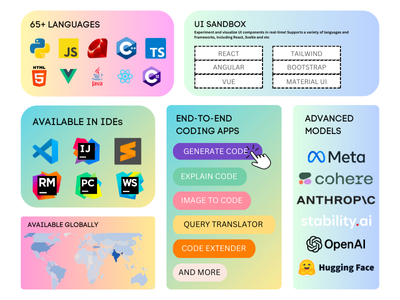
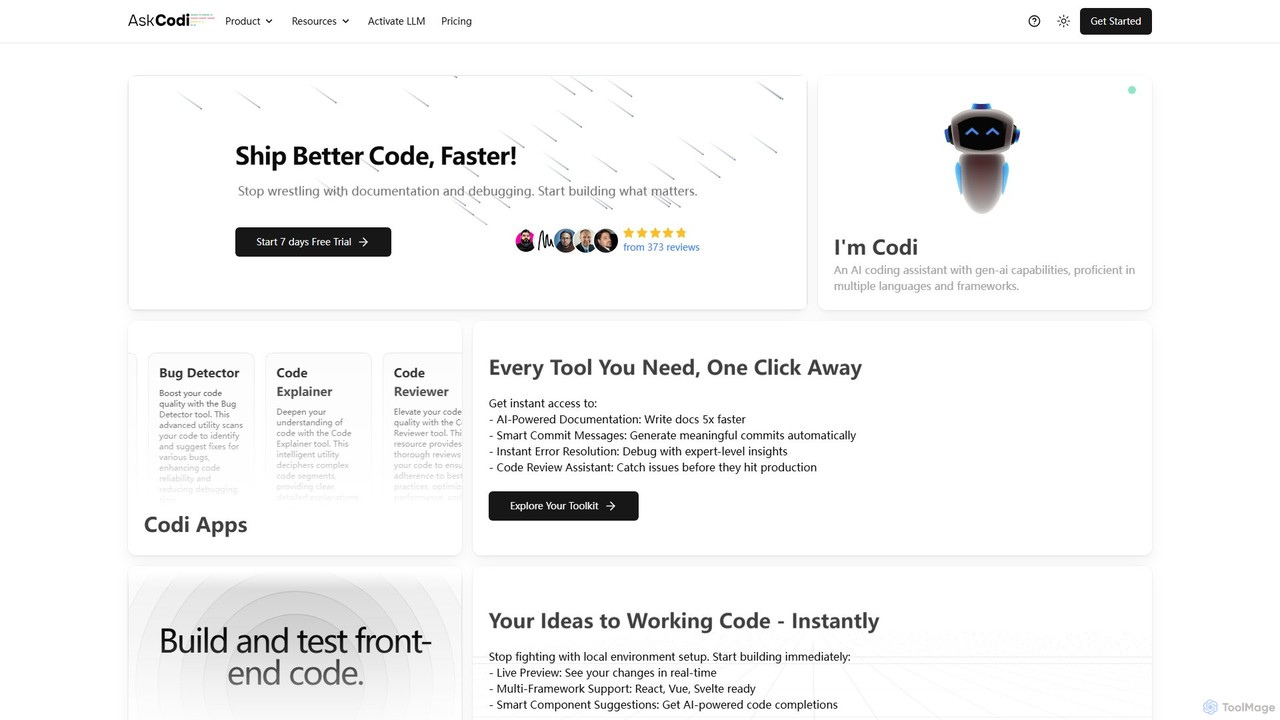
AskCodi Product overview

AskCodi is a comprehensive AI-powered code assistant designed to streamline the entire software development lifecycle. It offers a suite of over 20 tools for code generation, refactoring, debugging, testing, and documentation. With integrations for popular IDEs like VSCode and JetBrains, AskCodi helps developers of all skill levels to write better code, faster, and focus on building what matters.

Preview

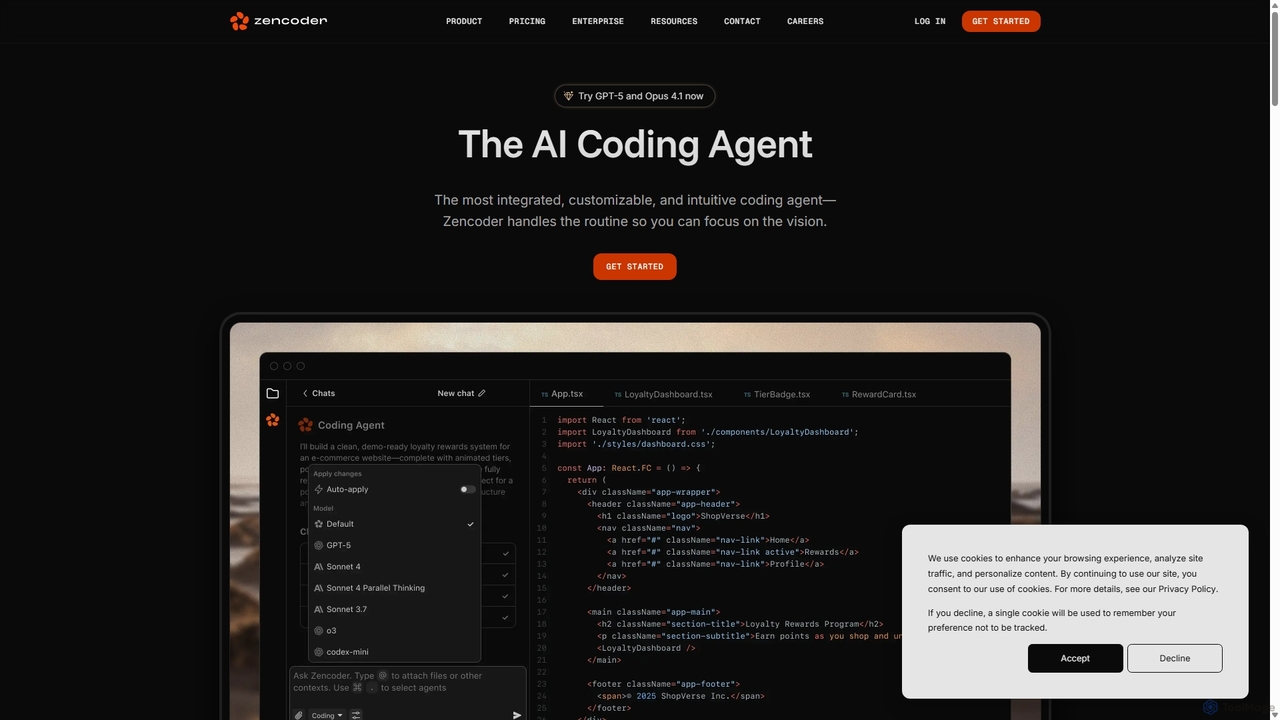
Zencoder Product overview

Zencoder is an advanced AI coding agent designed to automate routine development tasks. It deeply integrates into your workflow, understanding your entire codebase to implement features, write tests, fix bugs, and refactor code autonomously. With customizable 'Zen Agents' and seamless integration with VS Code, JetBrains, and over 100 developer tools, Zencoder empowers engineering teams to focus on innovation and ship products faster.

Preview

Quick facts

Compare product focus, pricing models and audiences. Highlighted rows indicate different listed information; unknown pricing does not mean free.

AskCodi VS Zencoder — Quick facts
Quick factsAskCodiZencoder
Pricing modelFreemiumFreemium
Product typeWebWeb
Primary focusCode AssistantCode Assistant
Audience and rolesNo data availableDevOps Engineer · Engineering Manager · Machine Learning Engineer · Product Manager · Quality Assurance Engineer · Software Developer
CategoriesCode Assistant · Documentation · Testing · Developer ToolsCode Assistant · Debugging · Testing · Automation
AddedAug 13, 2025Sep 9, 2025
UpdatedNov 19, 2026Nov 19, 2026

Features, usage and use cases

Explore the listed product descriptions, features and workflows. Taxonomy labels alone are not feature evaluations.

AskCodi

AskCodi is an advanced AI-powered development platform designed to serve as a comprehensive assistant for software developers. It goes beyond simple code completion, offering a robust suite of over 20 specialized applications that cover the entire development lifecycle—from initial ideation and code generation to testing, debugging, documentation, and deployment. By integrating powerful AI models from providers like OpenAI, Anthropic, and Meta, AskCodi helps developers streamline repetitive tasks, improve code quality, and significantly accelerate their workflow. Whether you're a beginner learning to code or a seasoned professional building complex systems, AskCodi provides the tools you need to ship better code, faster.

How to use AskCodi

Getting started with AskCodi is straightforward and designed to integrate seamlessly into your existing workflow:

  1. Sign Up & Choose a Plan: Visit the AskCodi website to sign up. You can start with the free plan or opt for a paid plan like Premium or Ultimate, which come with a 7-day free trial to explore all features.
  2. Use the Web Application: The web app provides access to the full suite of "Codi Apps." Here you can generate code snippets, refactor existing functions, write unit tests, create Dockerfiles, generate SQL queries, and much more by simply providing a description of your needs.
  3. Prototype with Codi Sandbox: For front-end development, the Codi Sandbox offers an interactive environment. You can start a project from scratch, use a template, import a GitHub repository, or even describe your idea to the AI and have it generate a starting point. It supports frameworks like React, Vue, and Svelte with a live preview.
  4. Integrate with Your IDE: For maximum productivity, install the AskCodi extension for your favorite IDE (VSCode, JetBrains, Sublime Text). This brings AI-powered assistance directly into your coding environment, providing context-aware suggestions, code generation, and error analysis without switching windows.
  5. Chat with Your Codebase: Use the AI chat feature to interact with your project. You can ask for a summary of a complex file, get an explanation for an error, or request modifications, making it easier to navigate and understand large codebases.

Core Features of AskCodi

  • Comprehensive Code Toolkit: Access over 20 specialized apps including a Code Generator, Code Refactor, Code Fixer, and Language Translator to handle various coding tasks.
  • Automated Testing and Quality Assurance: Generate unit tests automatically with the Unit-Tests Writer, detect bugs with the Bug Detector, get performance insights with the Big-O Analyzer, and ensure best practices with the Code Reviewer.
  • Intelligent Documentation and Explanation: Automatically generate clear code documentation, create meaningful commit messages with the Commit Generator, and understand complex code or error messages with the Code Explainer and Error Explainer.
  • DevOps and Infrastructure Automation: Simplify your deployment pipeline by generating Makefiles, Dockerfiles, Kubernetes configurations, and CI/CD pipeline scripts.
  • Database Management: Effortlessly write complex SQL and NoSQL queries with the Query Writer and manage database structures with the Schema Resolver.
  • Interactive Development Environments: Utilize the Codi Sandbox for live front-end prototyping and the beta Codespaces for a complete, AI-enhanced cloud development environment.
  • Seamless IDE Integration: Native extensions for popular IDEs like VSCode, JetBrains, and Sublime Text provide AI assistance directly within your workflow.
  • Multi-LLM Support: Choose from a wide range of cutting-edge Large Language Models (LLMs) from providers like OpenAI, Anthropic, Meta, and Google to best suit your task.

Use Cases for AskCodi

  • Accelerated Development: Developers can use the Code Generator to quickly create boilerplate code, functions, and classes, significantly reducing development time.
  • Legacy Code Modernization: The Code Refactor and Language Translator tools are perfect for updating old codebases to modern standards and languages, improving maintainability and performance.
  • Enhanced Learning and Onboarding: Junior developers or those new to a project can use the Code Explainer to quickly understand complex algorithms and existing code structures.
  • Streamlined Debugging: Instead of spending hours on cryptic error messages, developers can use the Error Explainer and Bug Detector to identify issues and get suggested fixes instantly.
  • Automated DevOps Processes: DevOps engineers can automate the creation of configuration files for containerization (Dockerfile Writer) and orchestration (Kubernetes Writer), ensuring consistency and reducing manual errors.
  • Improved Code Quality: Teams can enforce coding standards and catch potential issues before production by integrating the Code Reviewer and Unit-Tests Writer into their workflow.

Advantages of AskCodi

  • All-in-One Platform: It consolidates dozens of development tools into a single, cohesive platform, eliminating the need to switch between multiple services.
  • Increased Productivity: By automating mundane and time-consuming tasks like writing tests, documentation, and commit messages, developers can focus on high-impact problem-solving.
  • Context-Aware Assistance: The IDE integrations understand your project's context, providing more relevant and accurate suggestions than generic AI chatbots.
  • Accessible for All: The intuitive interface and clear explanations make it a valuable tool for beginners, while the advanced features and integrations empower professional developers.
  • Flexible and Powerful: The ability to switch between different state-of-the-art LLMs gives users the flexibility to choose the best model for performance, cost, or specific capabilities.

Pricing and Plans

AskCodi offers a freemium model with plans tailored to different needs, all available with a 7-day free trial for paid tiers.

  • Free Plan: Provides access to base AI models (e.g., GPT 4.1 nano, Claude 3.5 Haiku) for fundamental coding tasks.
  • Premium Plan: Priced at $149.99/year, this plan is designed for professionals. It includes 500 AI credits monthly, 10 LLM credits, access to 3 codespaces, all extensions, the autocomplete plugin, and a wider range of advanced AI models.
  • Ultimate Plan: Priced at $349.99/year, this is the comprehensive solution for power users and teams. It offers 1500 AI credits monthly, 25 LLM credits, access to 5 codespaces, and access to the most powerful and latest LLMs available on the platform (e.g., Llama 4 Maverick, Gemini 2.5 Pro).

Zencoder

Zencoder is a sophisticated AI Coding Agent built to revolutionize the software development lifecycle. It goes beyond simple code completion by acting as an autonomous partner for engineering teams. By deeply understanding the entire codebase, including complex architectures and cross-repository dependencies, Zencoder handles the mundane and repetitive tasks, allowing developers to concentrate on high-level design and innovation. It is trusted by engineers from startups to Fortune 500 companies and is designed for enterprise-scale development, prioritizing security, compliance, and scalability.

The core of Zencoder's power lies in its 'Zen Agents'—customizable AI agents that can be tailored to your team's specific workflows and best practices. These agents can be created, configured, and deployed to automate everything from generating unit tests to fixing production bugs overnight. This transforms team knowledge into scalable, automated processes, ensuring consistency and quality across all projects.

How to use Zencoder

Getting started with Zencoder is designed to be seamless and intuitive, integrating directly into existing developer environments. First, install the Zencoder extension for your preferred IDE, such as VS Code or any JetBrains IDE (like IntelliJ IDEA, PyCharm). Once installed, connect Zencoder to your development stack. It offers native integrations with over 100 tools including GitHub, GitLab, Jira, Linear, Sentry, and Datadog. You can authorize access to your repositories to give the agent full context of your codebase. For specific tasks, you can interact with Zencoder through its 'Agentic Chat' interface, where you can issue commands in natural language, ask technical questions, or request code generation. For example, you can ask it to 'implement the feature described in JIRA-123' or 'write unit tests for the new checkout service'. To automate workflows, you can configure Zen Agents to trigger on specific events, such as a new Jira ticket or a failing CI/CD build, enabling a 24/7 autonomous engineering workforce.

Core Features of Zencoder

  • Autonomous Zen Agents: Create, customize, and deploy AI agents that understand your code, automate workflows, and scale team knowledge. These agents can operate 24/7 to fix bugs, update dependencies, and clean up tech debt.
  • Deep Codebase Understanding: Zencoder analyzes your entire codebase, including large monorepos and multi-repo architectures, to understand structure, conventions, and dependencies, ensuring context-aware and accurate code generation.
  • Zentester: An AI-powered testing agent that generates comprehensive end-to-end and unit tests, following your existing patterns to ensure high test coverage and code quality.
  • Seamless IDE Integration: Native extensions for VS Code and JetBrains IDEs, allowing developers to use Zencoder without leaving their familiar coding environment.
  • Extensive Stack Integration: Connects with over 100 developer tools like GitHub, Jira, Sentry, and CircleCI, enabling powerful workflow automation across your entire toolchain.
  • Agentic Chat: An intelligent chat assistant with full codebase context that can answer technical questions, provide guidance, and act as an AI pair programmer.
  • Enterprise-Ready Security: The only AI coding agent with SOC 2 Type II, ISO 27001, and ISO 42001 certifications. It offers SSO, audit logs, role-based access, and flexible deployment options (cloud, on-premise).
  • High Performance: Achieved a 70% success rate on the SWE-Bench benchmark, demonstrating industry-leading performance on real-world engineering tasks.

Use Cases for Zencoder

Zencoder is versatile and can be applied across the development process. Teams use it for automated feature implementation, where an agent takes a Jira ticket description and generates the necessary code across multiple files. For quality assurance, it's used for autonomous testing, with Zentester creating complete test suites for new features. Another key use case is 24/7 bug fixing; an agent can be triggered by a Sentry alert, identify the root cause, write a fix, and open a pull request for review by the time the team starts their day. It also excels at large-scale code refactoring, a task that can take a human developer hours or days. Furthermore, by creating custom Zen Agents, teams can codify and enforce best practices, ensuring standardized code quality and architectural consistency across the organization.

Advantages of Zencoder

The primary advantage of Zencoder is its ability to act as a force multiplier for engineering teams, significantly boosting productivity and accelerating development cycles. It automates tedious, time-consuming tasks, freeing developers to focus on creative problem-solving. Its deep codebase understanding leads to higher quality, contextually-aware code suggestions compared to simple autocomplete tools. The platform's customizability through Zen Agents allows teams to build a bespoke AI workforce tailored to their unique needs. Finally, its strong emphasis on enterprise-grade security, compliance, and privacy ensures that it can be safely adopted in organizations of any size, protecting sensitive code and data.

Pricing and Plans

Zencoder offers a tiered pricing model to suit individuals, teams, and large enterprises. All plans include core features like the Coding Agent, 100+ integrations, and Zen Agents.

  • Free Plan: A 7-day trial plan perfect for testing and experimentation, offering 25 Premium LLM Calls per day.
  • Starter Plan ($19/user/month): Designed for light personal use and side projects, providing 200 Premium LLM Calls per day.
  • Core Plan ($49/user/month): Ideal for professional developers and teams, with 550 Premium LLM Calls per day, multi-repository indexing, SSO, and audit logs.
  • Advanced Plan ($119/user/month): For automation-heavy workflows, this plan includes access to premium models like Claude Opus 4.1.
  • Max Plan ($250/user/month): Built for high-performing developers with maximum usage limits.

After daily limits are reached on paid plans, service continues in a 'slow mode'. Users can also use their own API keys (BYOK) to bypass daily limits. A 'Premium LLM Call' is counted each time the agent interacts with a large language model to complete a task.

Positioning

Their taxonomy shows where the products overlap and where each one has a more distinct focus. Unknown fields are shown explicitly and are never filled with assumptions.

Categories

Shared
Code AssistantTesting
Only AskCodi
DocumentationDeveloper Tools
Only Zencoder
DebuggingAutomation

Tags

Shared
code generationcode reviewdebuggingunit testing
Only AskCodi
ai pair programmercode explanationcode refactoringdevopsdockerdocumentationide extensionkubernetesSQL
Only Zencoder
ai coding assistantautomationautonomous agentsCI/CDdeveloper toolsjetbrainsrefactoringVS Code

Audience and roles

Shared
No listed items
Only AskCodi
No listed items
Only Zencoder
DevOps EngineerEngineering ManagerMachine Learning EngineerProduct ManagerQuality Assurance EngineerSoftware Developer

Traffic comparison

Traffic is shown on the same scale so differences in market visibility are not visually understated.

How to interpret the traffic data

Both charts share the same months and vertical scale. Each tool identifies its latest reporting month; missing months are left blank, not counted as zero. Regional and source visit counts are estimates calculated from the reported shares.

AskCodi monthly traffic:

Latest traffic · 2026-05

Monthly visits
54.6K
Avg. visit duration
0:25
Pages per visit
2.94
Bounce rate
36.99%
Data updated 2026-06-15

Monthly traffic trend

  • 2025-09: 58K
  • 2026-01: 48.9K
  • 2026-02: 45.2K
  • 2026-03: 37.7K
  • 2026-04: 40.3K
  • 2026-05: 54.6K

Top regions

Top 5 countries/regions
Country/regionPercentageEstimated visits
🇷🇺Russia37.69%20.6K
🇮🇳India21.91%12K
🇺🇸United States14.02%7.7K
🇳🇬Nigeria13.56%7.4K
🇮🇩Indonesia12.82%7K

Search keywords

ask code aiaskcodicontinue devcontinue dev add codexsakcodi

Zencoder monthly traffic:

Latest traffic · 2026-05

Monthly visits
217.9K
Avg. visit duration
1:52
Pages per visit
3.76
Bounce rate
40.98%
Data updated 2026-06-15

Monthly traffic trend

  • 2025-09: 297.6K
  • 2026-01: 475.8K
  • 2026-02: 344.7K
  • 2026-03: 258.4K
  • 2026-04: 227.2K
  • 2026-05: 217.9K

Top regions

Top 5 countries/regions
Country/regionPercentageEstimated visits
🇺🇸United States41.97%91.5K
🇮🇳India25%54.5K
🇮🇹Italy16.16%35.2K
🇨🇱Chile9.94%21.7K
🇩🇪Germany6.93%15.1K

Traffic sources

Source typePercentageEstimated visits
Direct83.12%181.1K
Referral13.94%30.4K
Email2.94%6.4K

Search keywords

cursor aigithub copilotwindsurf aizencoderzenflow

Community signals

Ratings, comments, favorites, and likes are community signals—not a substitute for product fit.

AskCodi

Rating
No data available
Comments
0
Favorites
203
Likes
213

Zencoder

Rating
No data available
Comments
0
Favorites
166
Likes
160

AskCodi vs Zencoder · Comparison FAQ

What do AskCodi and Zencoder have in common?
Both tools are listed under Code Assistant、Testing. These categories indicate overlapping use cases; compare their detailed descriptions for workflows, capabilities and limitations.
Are AskCodi and Zencoder free?
Listed pricing models: AskCodi — Freemium; Zencoder — Freemium. Missing pricing is not proof of a free plan, and freemium does not mean every feature is free. Check official sites for current plans, limits and trials.
How should I choose between AskCodi and Zencoder?
The primary listed category is Code Assistant for AskCodi, and Code Assistant for Zencoder. Compare features, steps and use cases, then verify pricing, data permissions and deployment needs. This page does not include hands-on testing and does not declare a winner from traffic or tags.

Sources and comparison methodology

This page is assembled from ToolMage product listings, taxonomy, traffic statistics and on-site user feedback. It is not a hands-on test or an independent review.

  • Feature and plan descriptions reflect information in the listings, not real-time guarantees. Verify pricing, quotas, availability and privacy terms on the official sites.
  • Traffic uses the reporting months shown. Missing statistics do not mean zero visits, and different periods do not establish growth or superiority. Regional and source visit counts are estimates based on shares.
  • Different tags indicate differences in the listings, not proof that the other product lacks a capability. Ratings, favorites and visits are not used to declare a winner.

Related comparisons