
ToolMage
Sign in

AI TOOL COMPARISON

BasicAI vs Prodigy

What is the difference, and which fits your workflow? Compare features, usage, pricing models and traffic side by side.

Jump to key differences

Product overview

BasicAI Product overview

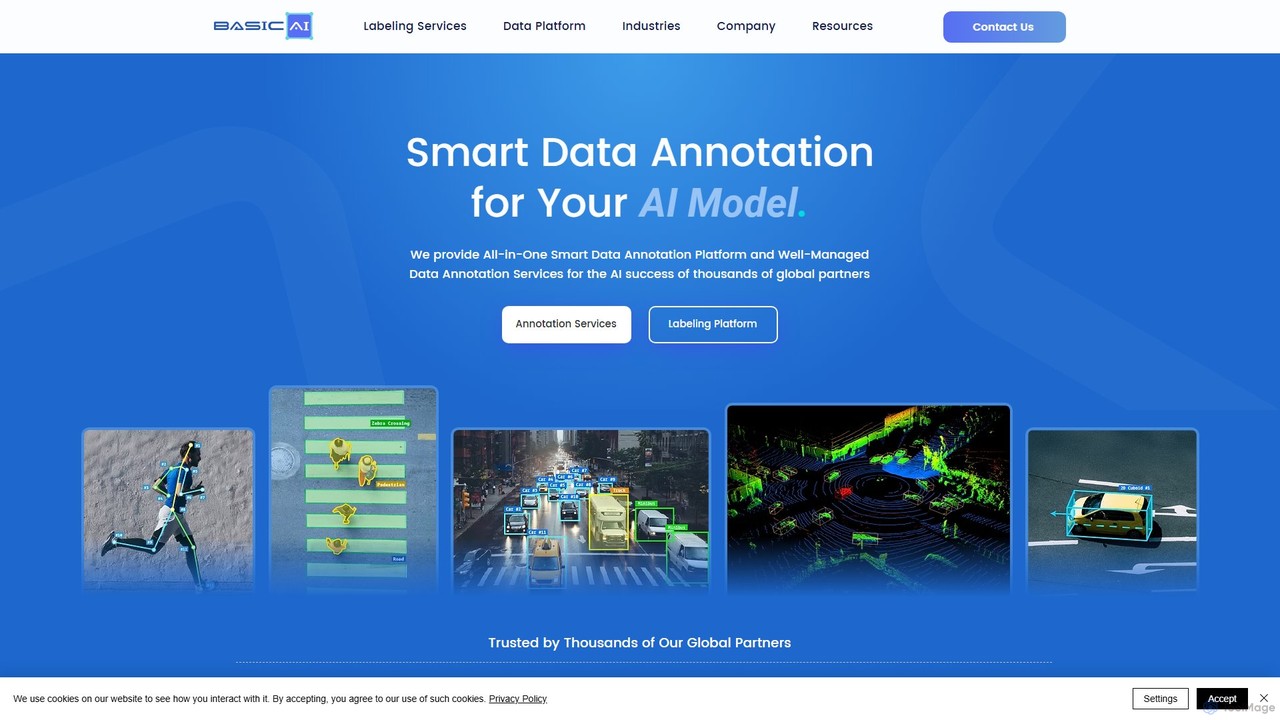
BasicAI offers a comprehensive data annotation platform and managed services to create high-quality training data for AI models. It specializes in 3D LiDAR, image, video, and NLP data, providing AI-assisted tools, scalable workflows, and enterprise-grade security to accelerate AI development.

Preview

Prodigy Product overview

Prodigy is a scriptable annotation tool for AI, Machine Learning, and NLP, designed for developers. It enables rapid creation of high-quality training and evaluation data through model-assisted, human-in-the-loop workflows. It runs on your own infrastructure, ensuring complete data privacy and control.

Preview

Quick facts

Compare product focus, pricing models and audiences. Highlighted rows indicate different listed information; unknown pricing does not mean free.

BasicAI VS Prodigy — Quick facts
Quick factsBasicAIProdigy
Pricing modelPaidPaid
Product typeWebWeb
Primary focusData LabelingAnnotation
Audience and rolesNo data availableAI Researcher · Data Analyst · Data Scientist · Machine Learning Engineer · NLP Engineer · Software Developer
CategoriesData Labeling · Annotation · Machine LearningAnnotation · Machine Learning · Automation
AddedAug 12, 2025Sep 12, 2025
UpdatedNov 19, 2026Nov 19, 2026

Features, usage and use cases

Explore the listed product descriptions, features and workflows. Taxonomy labels alone are not feature evaluations.

BasicAI

BasicAI is a leading provider of data annotation solutions, offering both a sophisticated, all-in-one smart data annotation platform and fully managed data labeling services. With a mission to build human-centered AI training data infrastructure, BasicAI empowers thousands of global partners to transform promising ideas into high-performance AI models that solve real-world problems. The company has over seven years of experience in the data labeling industry, having successfully built over 300,000 datasets.

The platform and services are designed to handle a wide variety of data types, ensuring that AI models can truly understand their environment. By converting raw data into precise, ground-truth datasets, BasicAI significantly elevates machine learning performance across numerous applications, from autonomous driving to geographic information systems (GIS).

How to use BasicAI

Engaging with BasicAI can be done through two primary models: Managed Services or the self-serve Platform.

For Managed Annotation Services:

  1. Free Consultation: Start by contacting BasicAI for a free consultation to discuss your project's specific needs, data types, and quality requirements.
  2. Project Scoping: BasicAI's experts work with you to define annotation guidelines, quality metrics, and project timelines.
  3. Data Transfer: Securely upload your raw data to the BasicAI platform.
  4. Annotation by Experts: One of BasicAI's 160+ specialized global teams, with industry-specific knowledge, performs the annotation. They do not use crowdsourcing, ensuring context-aware and high-quality results.
  5. Quality Assurance: The annotated data undergoes multi-level inspections and validations to ensure it meets the 99%+ quality standard.
  6. Dataset Delivery: Receive the high-quality, validated training dataset ready for your AI model development.

For the Data Annotation Platform (Private Deployment):

  1. Request a Demo: Contact BasicAI to request a demonstration of their platform and discuss private deployment options.
  2. Installation: The platform is installed within your own environment, giving you direct control over data processing and security.
  3. Workflow Customization: Set up and customize project management workflows to match your team's structure and needs.
  4. Data Annotation: Your team uses the platform's advanced tools, including AI-assisted features, to annotate data efficiently.
  5. Quality Control: Utilize the built-in smart quality check system, which combines real-time feedback and customizable rules to catch issues early.
  6. Export Data: Export the finished datasets for use in your machine learning pipelines.

Core Features of BasicAI

  • Comprehensive Data Type Support: Specializes in complex annotation tasks, including 3D LiDAR point clouds, 2D images (bounding boxes, semantic segmentation), audio/video tagging, and Natural Language Processing (NLP) data.
  • RLHF & SFT Dataset Creation: Provides services for creating Reinforcement Learning from Human Feedback (RLHF) and Supervised Fine-Tuning (SFT) datasets, crucial for training large language models.
  • AI-Assisted Annotation: The platform includes automated and AI-assisted tools that accelerate the annotation process for images, point clouds, and audio, reducing manual labor while maintaining high accuracy.
  • Scalable Workflow and Project Management: Enterprise-ready tools allow for customizable workflows, comprehensive project tracking, and detailed performance reporting, adapting to any team size.
  • Smart Quality Check: An integrated quality inspection system with real-time feedback and customizable batch QA rules ensures high-quality output and enables targeted human review.
  • Private Deployment: For enterprises with strict data security requirements, the platform can be deployed privately within their own infrastructure.
  • Open-Source Contribution: BasicAI is the creator of Xtreme1, the world's first open-source multi-sensory training data platform, demonstrating a commitment to the AI community.

Use Cases for BasicAI

BasicAI's solutions are applicable across various industries:

  • Autonomous Driving: Annotating 3D LiDAR point clouds and camera imagery for object detection, tracking, and semantic segmentation to train self-driving vehicles.
  • GIS & Remote Sensing: As demonstrated in a property tax assessment use case, performing semantic segmentation on satellite or aerial imagery to identify land features, buildings, and other elements.
  • Smart Cities: Using bounding box annotation on city-wide camera feeds to monitor traffic, detect pedestrians, and manage urban infrastructure.
  • Healthcare: Annotating medical images (X-rays, MRIs) for disease detection and diagnosis.
  • Retail & E-commerce: Labeling product images for visual search, automated tagging, and inventory management.
  • Robotics: Creating training data for robots to perceive and interact with their environment.

Advantages of BasicAI

  • 99%+ Quality Assurance: A rigorous, multi-level inspection and validation process guarantees that training datasets meet precise requirements, minimizing rework.
  • Specialized Annotation Teams: Instead of relying on anonymous crowdsourcing, BasicAI utilizes over 160 specialist teams with deep, industry-specific knowledge, ensuring a better understanding of data context.
  • Competitive Pricing: Efficiency gains from purpose-built tools and refined project management allow BasicAI to offer its high-quality services at competitive rates.
  • Enterprise-Grade Security: The option for private, on-premise deployment gives organizations full control over their data, meeting the highest security and compliance standards.
  • All-in-One Solution: BasicAI provides a unified solution with both a powerful platform and expert services, offering flexibility for different project needs and scales.

Pricing and Plans

BasicAI operates on a custom pricing model tailored to the specific needs of each project. Pricing is determined by factors such as the volume and complexity of the data, the type of annotation required, and whether the client opts for managed services or a private platform deployment. Interested parties are encouraged to request a Free Consultation for the annotation services or a Request Demo for the platform to receive a detailed quote.

Prodigy

Prodigy is a modern, highly extensible annotation tool designed for data scientists, machine learning engineers, and developers to create training and evaluation data for AI models efficiently. Unlike traditional annotation software, Prodigy is a downloadable Python library that integrates seamlessly into your development workflow. It emphasizes a scriptable, developer-centric approach, allowing you to build fully custom data annotation pipelines that are over 10 times more efficient than manual labeling.

The core philosophy behind Prodigy is 'human-in-the-loop' machine learning, where a model actively participates in the annotation process. This is achieved through active learning, where the model suggests annotations for the tasks it's most uncertain about, allowing human annotators to focus their efforts on the most valuable decisions. This significantly speeds up the creation of high-quality, gold-standard datasets for a wide range of tasks.

How to use Prodigy

Prodigy is operated primarily through the command line. The workflow is iterative and designed to be integrated into your existing Python environment.

  1. Installation: As a Python package, you install Prodigy into your environment using pip.
  2. Launch a Recipe: You start an annotation session by running a 'recipe' from your terminal. A recipe is a Python function that defines the entire workflow, including loading data, the annotation interface, and how annotations are saved. Prodigy comes with many built-in recipes for common tasks like Named Entity Recognition (NER), text classification, and image annotation (e.g., `Prodigy ner.manual my_dataset blank:en ./my_data.jsonl --label PERSON,ORG`).
  3. Annotate in the Browser: Once a recipe is running, Prodigy starts a local web server. You can then access the intuitive web application in your browser to perform the annotation tasks. The UI is optimized for speed with keyboard shortcuts and a clean, focused design.
  4. Train a Model: After collecting a sufficient number of annotations, you can use Prodigy's built-in `train` command to train a model (often a spaCy model) directly from your annotated datasets.
  5. Iterate: The process is cyclical. You can use your newly trained model to assist in annotating more data, perform error analysis, and continuously improve your model's performance.

Core Features of Prodigy

  • Scriptable & Extensible: Define fully custom workflows, data feeds, and annotation interfaces using Python, HTML, and JavaScript.
  • Model-Assisted Annotation: Leverage active learning by having models (including spaCy, Hugging Face Transformers, and LLMs) suggest annotations, dramatically increasing efficiency.
  • Multi-Modal Annotation: Supports a wide range of data types, including text (NER, text classification, span categorization, relations), images (bounding boxes, polygons), audio, and video.
  • Complete Data Privacy: Prodigy is a downloadable tool that runs entirely on your own machines (local or private cloud). No data ever leaves your servers, ensuring full compliance with strict privacy requirements.
  • Developer-Centric: Integrates tightly with popular ML libraries like spaCy, PyTorch, and TensorFlow. It's designed to be a part of a developer's toolkit, not a separate, restrictive platform.
  • Review & Collaboration: Includes workflows for reviewing annotations from multiple users, resolving conflicts, and creating a unified, high-quality dataset.
  • No Lock-In: You own your data and the models you create. Annotations can be easily exported in a simple JSONL format for use with any other tool or framework.

Use Cases for Prodigy

Prodigy is trusted by leading organizations for critical AI applications:

  • Financial Services: S&P Global uses Prodigy in a high-security environment to extract information and make markets more transparent.
  • Media & Journalism: The Guardian employs Prodigy to build systems for quote extraction from news articles, improving content analysis.
  • Economic Research: Nesta processed 7 million job ads to analyze the UK’s labor market, using Prodigy's flexible recipes to incorporate LLMs in the labeling process.
  • Legal Tech: Law firms use Prodigy to build NLP models that help recover millions by analyzing legal documents and communications.
  • Conversational AI: Companies like Posh deploy customized Prodigy services to build sophisticated financial chatbots for banking conversations.

Advantages of Prodigy

Prodigy stands out from other annotation solutions by being a developer tool, not just a labeling interface. Its main advantages include unparalleled efficiency through automation, complete control and privacy over your data and infrastructure, and extreme customizability that allows it to adapt to any specific machine learning project, no matter how complex. The pay-once lifetime license model also provides excellent long-term value without recurring subscription fees.

Pricing and Plans

Prodigy offers a lifetime license model, meaning you pay once and can use the software forever. It provides flexible licensing options for both individuals and teams. This model ensures full privacy as no data ever leaves your servers and there is absolutely no vendor lock-in. Specific pricing details are available on the official Prodigy website.

Positioning

Their taxonomy shows where the products overlap and where each one has a more distinct focus. Unknown fields are shown explicitly and are never filled with assumptions.

Categories

Shared
AnnotationMachine Learning
Only BasicAI
Data Labeling
Only Prodigy
Automation

Tags

Shared
computer visiondata annotationdata labelingmachine learningNLP
Only BasicAI
AI training dataautonomous drivingimage annotationLiDAR annotationRLHFSFT
Only Prodigy
active learningAI trainingdeveloper toolhuman-in-the-loopnatural language processingpythonspacy

Audience and roles

Shared
No listed items
Only BasicAI
No listed items
Only Prodigy
AI ResearcherData AnalystData ScientistMachine Learning EngineerNLP EngineerSoftware Developer

Traffic comparison

Traffic is shown on the same scale so differences in market visibility are not visually understated.

How to interpret the traffic data

Both charts share the same months and vertical scale. Each tool identifies its latest reporting month; missing months are left blank, not counted as zero. Regional and source visit counts are estimates calculated from the reported shares.

BasicAI monthly traffic:

Latest traffic · 2026-05

Monthly visits
21.5K
Avg. visit duration
0:15
Pages per visit
1.92
Bounce rate
38.67%
Data updated 2026-06-11

Monthly traffic trend

  • 2025-09: 26.6K
  • 2026-01: 41.9K
  • 2026-02: 36K
  • 2026-03: 30.5K
  • 2026-04: 22.5K
  • 2026-05: 21.5K

Top regions

Top 5 countries/regions
Country/regionPercentageEstimated visits
🇺🇸United States31.2%6.7K
🇮🇳India21.65%4.7K
🇻🇳Vietnam18.02%3.9K
🇳🇬Nigeria17.51%3.8K
🇮🇩Indonesia11.62%2.5K

Search keywords

basicaibasic.ai docsbasick.aisigmentation imagevideo recognition

Prodigy monthly traffic:

Latest traffic · 2026-05

Monthly visits
44.4K
Avg. visit duration
0:16
Pages per visit
1.79
Bounce rate
37.48%
Data updated 2026-06-15

Monthly traffic trend

  • 2025-09: 62K
  • 2026-01: 53.8K
  • 2026-02: 48.4K
  • 2026-03: 50.5K
  • 2026-04: 43.9K
  • 2026-05: 44.4K

Top regions

Top 5 countries/regions
Country/regionPercentageEstimated visits
🇺🇸United States50.4%22.4K
🇮🇳India16.77%7.4K
🇻🇳Vietnam11.88%5.3K
🇨🇦Canada11%4.9K
🇩🇪Germany9.95%4.4K

Search keywords

ner model for us addressprodigyprodigy softwareprodigy sshprodygy

Community signals

Ratings, comments, favorites, and likes are community signals—not a substitute for product fit.

BasicAI

Rating
No data available
Comments
0
Favorites
176
Likes
177

Prodigy

Rating
No data available
Comments
0
Favorites
177
Likes
174

BasicAI vs Prodigy · Comparison FAQ

What do BasicAI and Prodigy have in common?
Both tools are listed under Annotation、Machine Learning. These categories indicate overlapping use cases; compare their detailed descriptions for workflows, capabilities and limitations.
Are BasicAI and Prodigy free?
Listed pricing models: BasicAI — Paid; Prodigy — Paid. Missing pricing is not proof of a free plan, and freemium does not mean every feature is free. Check official sites for current plans, limits and trials.
How should I choose between BasicAI and Prodigy?
The primary listed category is Data Labeling for BasicAI, and Annotation for Prodigy. Compare features, steps and use cases, then verify pricing, data permissions and deployment needs. This page does not include hands-on testing and does not declare a winner from traffic or tags.

Sources and comparison methodology

This page is assembled from ToolMage product listings, taxonomy, traffic statistics and on-site user feedback. It is not a hands-on test or an independent review.

  • Feature and plan descriptions reflect information in the listings, not real-time guarantees. Verify pricing, quotas, availability and privacy terms on the official sites.
  • Traffic uses the reporting months shown. Missing statistics do not mean zero visits, and different periods do not establish growth or superiority. Regional and source visit counts are estimates based on shares.
  • Different tags indicate differences in the listings, not proof that the other product lacks a capability. Ratings, favorites and visits are not used to declare a winner.

Related comparisons