ToolMage
Sign in

AI TOOL COMPARISON

Bright Data vs Crawly

What is the difference, and which fits your workflow? Compare features, usage, pricing models and traffic side by side.

Jump to key differences

Product overview

Bright Data Product overview

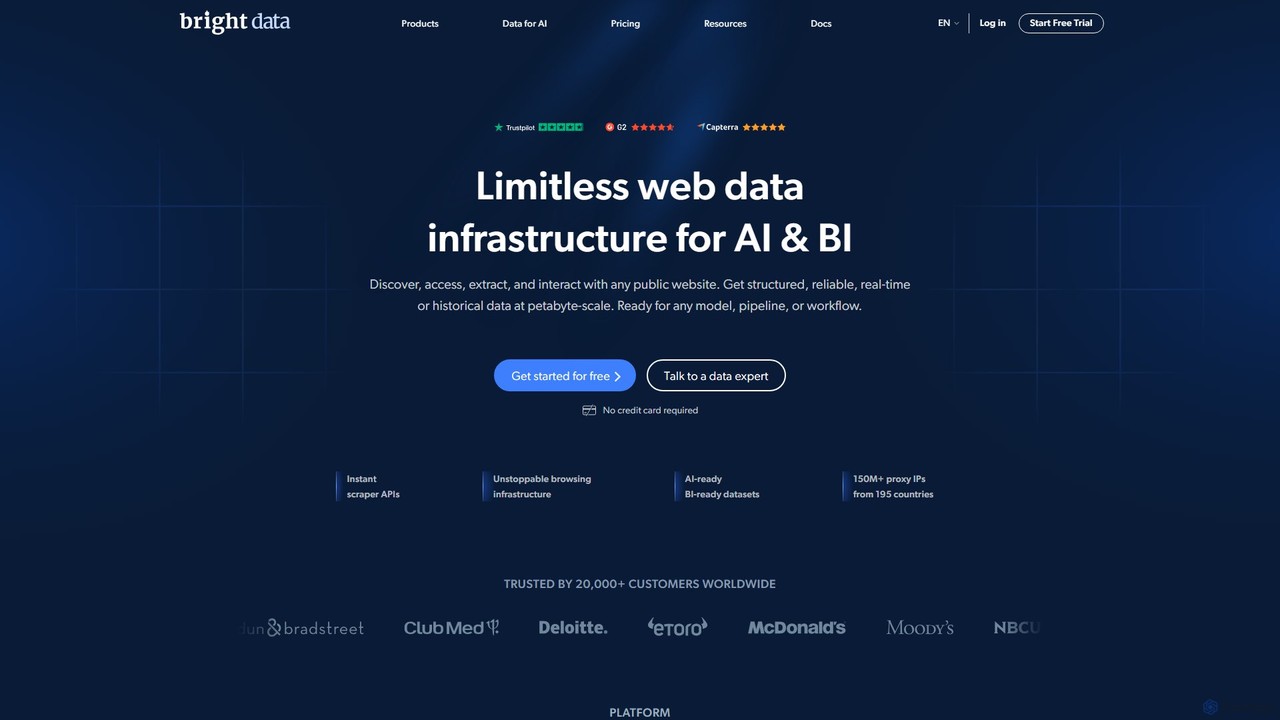
Bright Data is the world's leading web data platform, offering a comprehensive suite of tools including proxy networks, AI-powered web scrapers, and ready-to-use datasets. It enables businesses to collect vast amounts of public web data for AI training, market research, and competitive intelligence.

Preview

Crawly Product overview

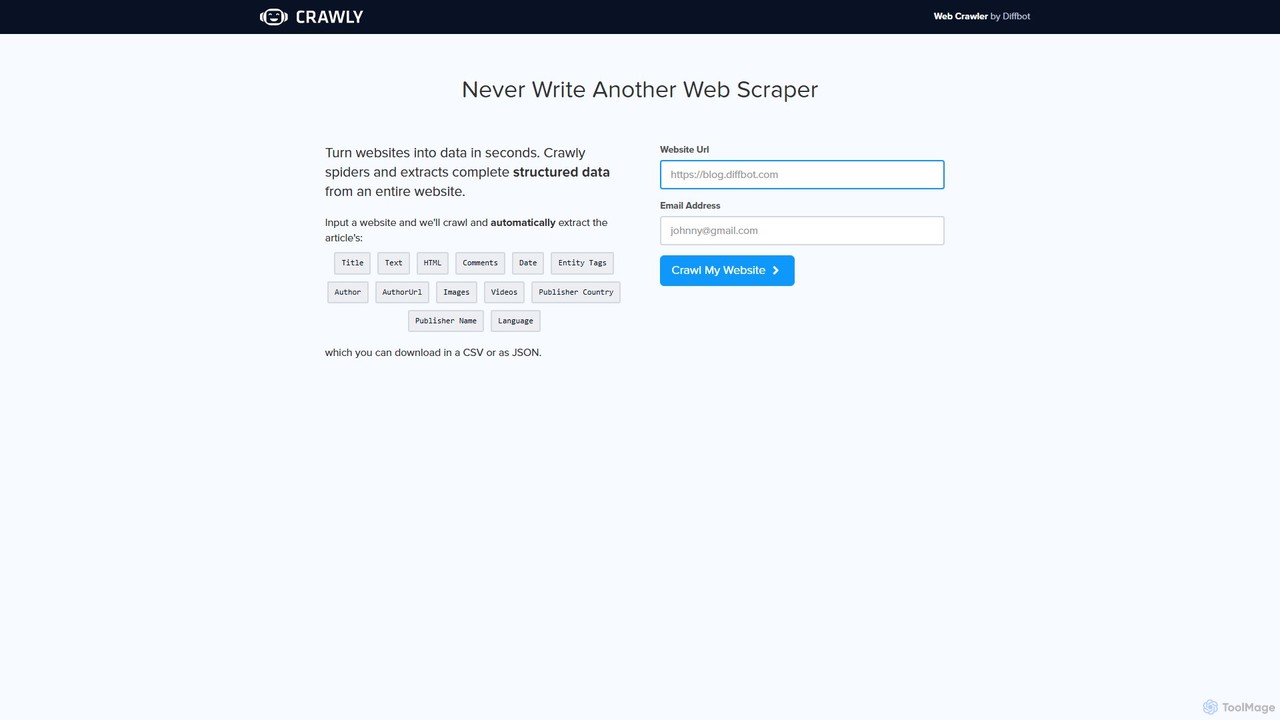
Crawly is an AI-powered web crawler by Diffbot that automatically extracts structured data from entire websites. Simply input a URL, and Crawly spiders the site to pull key information like articles, products, and discussions, converting it into clean JSON or CSV data without any coding required.

Preview

Quick facts

Compare product focus, pricing models and audiences. Highlighted rows indicate different listed information; unknown pricing does not mean free.

Bright Data VS Crawly — Quick facts
Quick factsBright DataCrawly
Pricing modelPaidFreemium
Product typeWebWeb
Primary focusBusiness IntelligenceWeb Scraping
Audience and rolesNo data availableNo data available
CategoriesBusiness Intelligence · Web Scraping · Api · Market ResearchWeb Scraping · Api · Market Research · Automation
AddedAug 12, 2025Aug 10, 2025
UpdatedNov 19, 2026Nov 19, 2026

Features, usage and use cases

Explore the listed product descriptions, features and workflows. Taxonomy labels alone are not feature evaluations.

Bright Data

Bright Data stands as the world's #1 web data platform, trusted by over 20,000 organizations across nearly every industry. It provides a robust, all-in-one solution for discovering, accessing, and extracting public web data at any scale. Whether you need real-time or historical data, Bright Data's infrastructure is built to deliver structured, reliable information ready for any model, pipeline, or workflow. The platform is designed to fuel AI development, power market research, monitor online assets, and enable data-driven decision-making.

How to use Bright Data

Bright Data offers a flexible platform that can be utilized in several ways depending on your needs:

  1. Proxy Networks: Integrate Bright Data's award-winning proxy networks (Residential, ISP, Datacenter, and Mobile) into your existing data collection scripts or applications. This allows you to route your requests through millions of real-user IPs, bypassing geo-restrictions and avoiding blocks to access any public website anonymously and successfully.
  2. Web Scraper IDE: For those who want to build custom scrapers, the Web Scraper IDE provides a powerful environment with pre-built functions and templates. You can develop, run, and manage your web scrapers without handling the underlying proxy infrastructure, scaling, or blockades.
  3. Dataset Marketplace: The easiest way to get started is by accessing the Dataset Marketplace. You can purchase ready-to-use, structured datasets from hundreds of popular websites like Amazon, LinkedIn, Zillow, and Instagram. Data can be downloaded as a one-time purchase or through a subscription for regular updates.
  4. Dataset API: For programmatic access, the Dataset API allows you to define, request, and retrieve custom data collections. The workflow typically involves: 1) Requesting a collection by defining your target sites and data points. 2) Checking the status of the collection job. 3) Initiating the collection to receive the data in your preferred format (JSON, CSV, Parquet).

Core Features of Bright Data

  • Comprehensive Proxy Networks: Access to over 72 million+ IPs across Residential, Datacenter, ISP, and Mobile networks in 195 countries.
  • AI-Powered Web Scraping: Advanced web scrapers and a Scraper IDE that can handle complex JavaScript-heavy websites, solve CAPTCHAs, and manage browser fingerprints automatically.
  • Vast Dataset Marketplace: A massive catalog of pre-collected and validated datasets from major e-commerce, social media, real estate, and business intelligence websites.
  • Scalability and Performance: Infrastructure built to handle petabytes of data, ensuring high success rates and uptime for large-scale data collection projects.
  • Data Compliance and Ethics: Industry-leading compliance with data protection laws like GDPR and CCPA, ensuring ethical and responsible data collection.
  • Flexible Data Delivery: Delivers clean, structured data in various formats, including JSON, CSV, and Parquet, ready for immediate analysis or model training.
  • Managed Services: For businesses that prefer a hands-off approach, Bright Data offers fully managed data services where their experts handle the entire data collection process for you.

Use Cases for Bright Data

Bright Data's solutions are versatile and cater to a wide range of applications:

  • AI & Machine Learning: Gather high-quality, large-scale datasets from across the web to train and validate machine learning models.
  • E-commerce & Retail Intelligence: Monitor competitor pricing, track product availability, aggregate product data, and analyze customer reviews to optimize strategy.
  • Market Research: Analyze market trends, track brand sentiment, and perform comprehensive competitor analysis by collecting data from news sites, forums, and social media.
  • Financial Services: Collect alternative data from public sources for investment analysis, risk assessment, and financial modeling.
  • Brand Protection: Scan the web for intellectual property infringement, counterfeit products, and unauthorized use of brand assets.

Advantages of Bright Data

Choosing Bright Data provides a significant competitive edge. Its all-in-one platform consolidates the need for multiple vendors by offering proxies, scrapers, and datasets under one roof. The quality and reliability of the data are unparalleled, thanks to robust validation processes. The platform's immense scale and global reach mean no target is out of reach. Crucially, Bright Data's strong commitment to ethical and compliant data collection provides peace of mind for businesses operating in a complex regulatory landscape. Its developer-friendly tools and dedicated support ensure a smooth experience from onboarding to production.

Pricing and Plans

Bright Data offers a flexible, pay-as-you-go pricing model as well as monthly and annual subscription plans tailored to different needs and scales.

  • Proxy Networks: Pricing is typically based on traffic (per GB) or per IP, with different rates for Datacenter, Residential, ISP, and Mobile proxies. Plans range from starter packages to large enterprise commitments.
  • Web Scraper IDE: Priced based on usage, often calculated by the number of successful requests (CPM).
  • Dataset Marketplace: Datasets can be acquired through a one-time purchase or a subscription model (monthly, quarterly, biannual) which offers significant discounts. The price is calculated per record (e.g., starting from $2.5 per 1,000 records), with costs varying based on the complexity and refresh rate of the data.
  • Support Plans: A Standard support plan is included for all customers. For enhanced service, Premium and Enterprise plans are available, offering 24/7 support, dedicated account managers, and prioritized responses. The Premium plan costs 8% of the monthly invoice (min $500/month), while the Enterprise plan is $10,000/month.

For detailed and customized pricing, it is recommended to contact the Bright Data sales team or visit their official pricing page.

Crawly

Crawly is a powerful and intelligent web crawler developed by Diffbot, a leader in AI-powered data extraction. It is designed to completely eliminate the manual and technical challenges of web scraping. Instead of writing complex code or using fragile selectors that break with website updates, Crawly leverages advanced artificial intelligence, including computer vision and natural language processing, to understand and interpret web pages like a human. This allows it to automatically identify and extract complete, structured data from an entire website with just a single URL as input.

The core promise of Crawly is to 'turn websites into data in seconds.' It navigates through a website, following links and analyzing the structure of each page to differentiate between various content types such as articles, products, discussions, and image galleries. The extracted data is then organized into a clean, structured format, ready for immediate use in applications, data analysis, or machine learning models.

How to use Crawly

Using Crawly is designed to be incredibly simple and accessible to everyone, regardless of technical skill. The process involves just a few steps:

  1. Input URL: Navigate to the Crawly website. In the provided input field, enter the full URL of the website you wish to crawl.
  2. Provide Email: Enter your email address. This is used to notify you and deliver the results once the crawl is complete.
  3. Initiate Crawl: Click the 'Crawl My Website' button. Crawly's AI engine will then begin to spider the entire site, analyzing pages and extracting information.
  4. Download Data: Once the process is finished, you will receive the extracted data. You can download it in convenient, structured formats like JSON or CSV, making it easy to import into databases, spreadsheets, or other software.

Core Features of Crawly

  • AI-Powered Automatic Extraction: Utilizes Diffbot's advanced AI to automatically recognize and extract data from articles, products, discussions, and more without any manual configuration.
  • Comprehensive Data Fields: Extracts a rich set of data points, including Title, Text, HTML, Comments, Date, Author, Author URL, Images, Videos, Publisher Information (Country, Name), and Language.
  • Entity Recognition: Automatically identifies and tags entities within the text, such as people, organizations, and locations, adding another layer of valuable metadata.
  • Full Site Crawling: Unlike single-page scrapers, Crawly navigates an entire website to gather data comprehensively.
  • Structured Data Output: Delivers clean, well-structured data in JSON or CSV formats, eliminating the need for post-processing and data cleaning.
  • No-Code Solution: Requires no programming skills or knowledge of web scraping technologies, making it accessible to marketers, researchers, and business analysts.
  • Robust and Resilient: Because it understands the content's semantic structure, it is not easily broken by website layout changes, a common problem with traditional scrapers.

Use Cases for Crawly

Crawly is a versatile tool suitable for a wide range of applications:

  • Market Research: Automatically gather competitor product information, pricing, customer reviews, and news mentions to gain a competitive edge.
  • Lead Generation: Extract contact details, company information, and key personnel from corporate websites and online directories.
  • Content Aggregation: Build a custom news feed or content platform by aggregating articles, blog posts, and videos from multiple sources.
  • Data for Machine Learning: Create large, high-quality datasets for training machine learning models, such as sentiment analysis on product reviews or trend analysis from news articles.
  • Brand Monitoring: Keep track of how your brand, products, or executives are mentioned across the web in real-time.

Advantages of Crawly

The primary advantage of Crawly is its simplicity and power. It democratizes web data extraction, allowing non-developers to perform tasks that would typically require a team of engineers. It saves immense amounts of time and resources by automating the entire scraping process. Furthermore, its AI-driven approach ensures higher accuracy and greater resilience than traditional methods, providing a reliable stream of high-quality data. By being a product of Diffbot, it is backed by enterprise-grade technology trusted by major corporations worldwide.

Pricing and Plans

Crawly offers a free trial crawl directly from its homepage, allowing users to test its capabilities by entering a URL and an email address. This is designed to provide a sample of the structured data that the tool can produce. For more extensive needs, such as large-scale crawling, frequent data extraction, or API access for programmatic use, users would typically subscribe to the full suite of tools offered by its parent company, Diffbot. Diffbot's pricing is tiered, with plans available for startups, businesses, and large enterprises, offering different levels of API calls and features.

Positioning

Their taxonomy shows where the products overlap and where each one has a more distinct focus. Unknown fields are shown explicitly and are never filled with assumptions.

Categories

Shared
Web ScrapingApiMarket Research
Only Bright Data
Business Intelligence
Only Crawly
Automation

Tags

Shared
APIdata extractionmarket researchstructured dataweb scraping
Only Bright Data
AI training dataalternative datadata collectione-commerce dataproxy
Only Crawly
automationDiffbotJSONlead generationno-codeweb crawler

Audience and roles

Shared
No listed items
Only Bright Data
No listed items
Only Crawly
No listed items

Traffic comparison

Traffic is shown on the same scale so differences in market visibility are not visually understated.

How to interpret the traffic data

Both charts share the same months and vertical scale. Each tool identifies its latest reporting month; missing months are left blank, not counted as zero. Regional and source visit counts are estimates calculated from the reported shares.

Bright Data monthly traffic:

Latest traffic · 2026-05

Monthly visits
810.9K
Avg. visit duration
3:21
Pages per visit
4.77
Bounce rate
42.51%
Data updated 2026-06-15

Monthly traffic trend

  • 2025-09: 771K
  • 2026-01: 735.5K
  • 2026-02: 714.5K
  • 2026-03: 830.2K
  • 2026-04: 833K
  • 2026-05: 810.9K

Top regions

Top 5 countries/regions
Country/regionPercentageEstimated visits
🇺🇸United States46.92%380.5K
🇨🇳China21.71%176.1K
🇮🇳India13.14%106.6K
🇬🇧United Kingdom10.78%87.4K
🇻🇳Vietnam7.45%60.4K

Traffic sources

Source typePercentageEstimated visits
Direct86.27%699.6K
Referral10.39%84.3K
Email3.34%27.1K

Search keywords

apifybright databrightdatasnapchatwayback machine

Crawly monthly traffic:

Latest traffic · 2026-05

Monthly visits
1.8K
Avg. visit duration
0:31
Pages per visit
1.15
Bounce rate
93.85%
Data updated 2026-06-15

Monthly traffic trend

  • 2025-09: 2.6K
  • 2026-01: 784
  • 2026-02: 640
  • 2026-03: 1K
  • 2026-04: 475
  • 2026-05: 1.8K

Top regions

Top 5 countries/regions
Country/regionPercentageEstimated visits
🇳🇬Nigeria82.43%1.5K
🇩🇪Germany9.9%177
🇨🇦Canada7.67%137

Search keywords

crawl urlcrawlyonline web crawlerwebsite crawlerwebsite crawler online

Community signals

Ratings, comments, favorites, and likes are community signals—not a substitute for product fit.

Bright Data

Rating
No data available
Comments
0
Favorites
140
Likes
156

Crawly

Rating
No data available
Comments
0
Favorites
162
Likes
160

Bright Data vs Crawly · Comparison FAQ

What do Bright Data and Crawly have in common?
Both tools are listed under Web Scraping、Api、Market Research. These categories indicate overlapping use cases; compare their detailed descriptions for workflows, capabilities and limitations.
Are Bright Data and Crawly free?
Listed pricing models: Bright Data — Paid; Crawly — Freemium. Missing pricing is not proof of a free plan, and freemium does not mean every feature is free. Check official sites for current plans, limits and trials.
How should I choose between Bright Data and Crawly?
The primary listed category is Business Intelligence for Bright Data, and Web Scraping for Crawly. Compare features, steps and use cases, then verify pricing, data permissions and deployment needs. This page does not include hands-on testing and does not declare a winner from traffic or tags.

Sources and comparison methodology

This page is assembled from ToolMage product listings, taxonomy, traffic statistics and on-site user feedback. It is not a hands-on test or an independent review.

  • Feature and plan descriptions reflect information in the listings, not real-time guarantees. Verify pricing, quotas, availability and privacy terms on the official sites.
  • Traffic uses the reporting months shown. Missing statistics do not mean zero visits, and different periods do not establish growth or superiority. Regional and source visit counts are estimates based on shares.
  • Different tags indicate differences in the listings, not proof that the other product lacks a capability. Ratings, favorites and visits are not used to declare a winner.

Related comparisons