ToolMage
Sign in

AI TOOL COMPARISON

CopilotKit vs Refine

What is the difference, and which fits your workflow? Compare features, usage, pricing models and traffic side by side.

Jump to key differences

Product overview

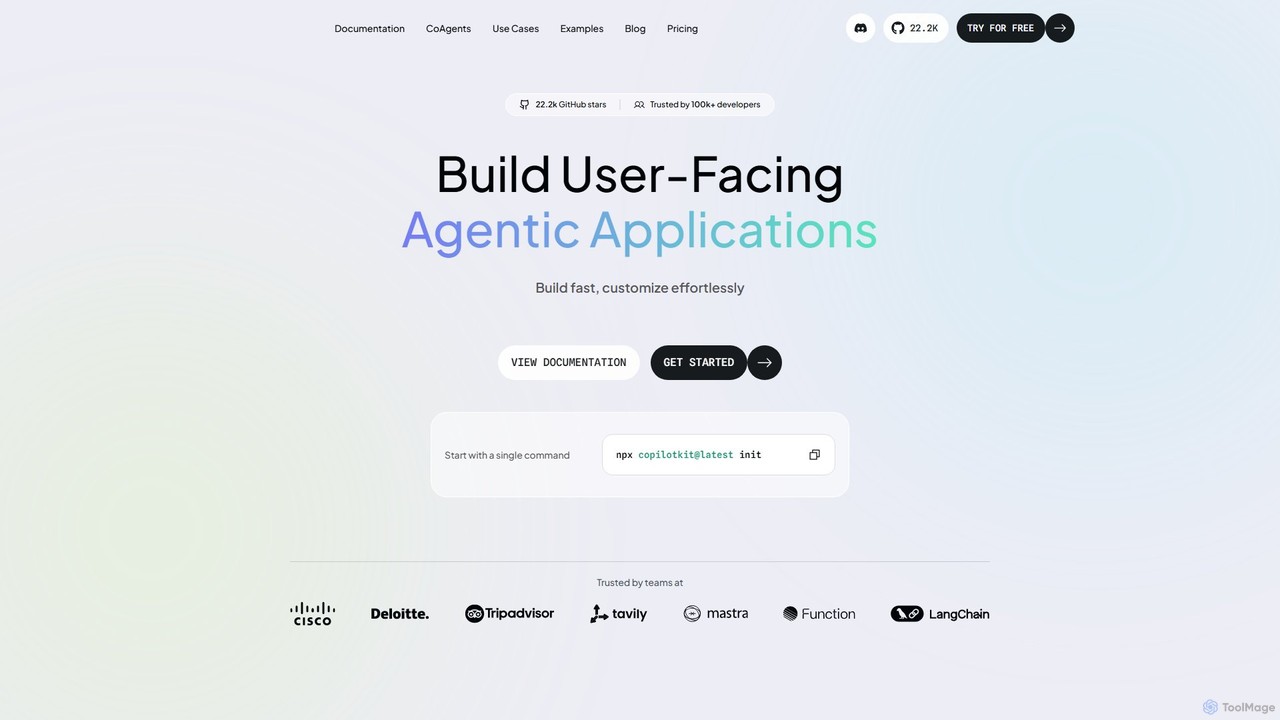
CopilotKit Product overview

CopilotKit is an open-source, full-stack framework for developers to build, deploy, and customize in-app AI copilots and agentic applications. It provides front-end components, back-end logic, and seamless integrations with any LLM or agent framework, enabling the creation of powerful, user-facing AI assistants.

Preview

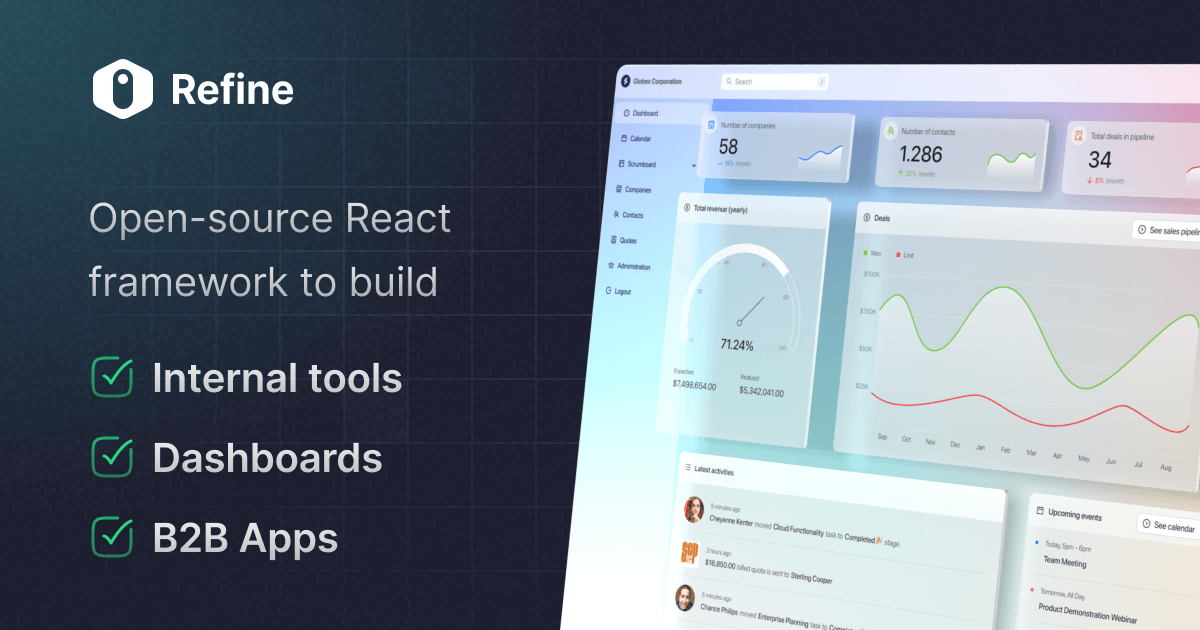
Refine Product overview

Refine is an open-source, React-based framework for rapidly building enterprise-grade internal tools, admin panels, dashboards, and B2B applications. It combines the speed of low-code solutions with the flexibility of full-code development, featuring an AI-powered generator to instantly create applications from APIs.

Preview

Quick facts

Compare product focus, pricing models and audiences. Highlighted rows indicate different listed information; unknown pricing does not mean free.

CopilotKit VS Refine — Quick facts
Quick factsCopilotKitRefine
Pricing modelFreemiumFreemium
Product typeWebWeb
Primary focusFrameworksInternal Tools
Audience and rolesNo data availableNo data available
CategoriesFrameworks · Low Code No Code · AutomationInternal Tools · Low Code No Code · Developer Tools
AddedAug 12, 2025Aug 13, 2025
UpdatedNov 19, 2026Nov 19, 2026

Features, usage and use cases

Explore the listed product descriptions, features and workflows. Taxonomy labels alone are not feature evaluations.

CopilotKit

CopilotKit is a comprehensive, open-source agentic framework designed to empower developers to seamlessly integrate sophisticated AI copilots directly into their applications. It serves as a full-stack solution, bridging the gap between powerful backend AI agents and interactive frontend user experiences. With a focus on creating user-facing, context-aware AI assistants, CopilotKit provides the necessary tools to build everything from simple conversational interfaces to complex agentic applications that can automate workflows and enhance user productivity.

At its core, CopilotKit is built around the Agent-User Interaction Protocol (AG-UI), an open standard that ensures interoperability between different agent frameworks and the user interface. This allows developers to avoid vendor lock-in and leverage the best tools for their specific needs, whether it's LangChain, LlamaIndex, CrewAI, or others. The framework is trusted by over 100,000 developers and has a significant open-source community, reflecting its robustness and utility in real-world applications.

How to use CopilotKit

Getting started with CopilotKit is designed to be fast and straightforward for developers. The process typically involves these steps:

  1. Initialization: Begin by adding CopilotKit to your project with a single command: npx copilotkit@latest init.
  2. Frontend Integration: Use the provided React components (like CopilotPopup or CopilotTextarea) to embed the AI chat interface into your application's UI. The library offers both pre-built components for speed and headless UI options for maximum customization.
  3. Backend Actions: Define 'Copilot Actions' in your backend code. These are functions that the AI agent can execute to perform tasks, such as fetching data from your database, calling an external API, or manipulating the application state. This is how the copilot interacts with your application's logic.
  4. Connect your Agent/LLM: Configure CopilotKit to connect to your chosen Large Language Model (LLM) and, if applicable, your preferred agent framework. The framework is designed to be model-agnostic.
  5. Deployment: Deploy your application. CopilotKit supports both self-hosting for the open-source version and a managed cloud platform for teams that require additional features and support.

Core Features of CopilotKit

  • Full-Stack Agentic Framework: Provides all the tools needed to build AI agents, from frontend UI to backend logic and third-party integrations.
  • Frontend Components: A rich library of pre-built and headless UI components for React, enabling rapid development and full design control.
  • Copilot Actions: Allows AI to securely interact with your application's backend, enabling it to perform meaningful tasks on behalf of the user.
  • Generative UI: Empowers the AI to dynamically generate and render UI components in response to user interactions, creating truly interactive experiences.
  • Multi-Agent Framework Integration: Native support for popular frameworks like LangChain, LlamaIndex, CrewAI, and LangGraph via the AG-UI protocol.
  • Bring Your Own LLM (BYOLLM): Complete flexibility to use any LLM, including models from OpenAI, Anthropic, or open-source alternatives.
  • Retrieval-Augmented Generation (RAG): Built-in capabilities to create knowledge-based copilots that can chat with your documents, data, or knowledge base.
  • Human-in-the-Loop (HITL): Designed to build agents that collaborate with users, allowing for monitoring, steering, and interactive Q&A.

Use Cases for CopilotKit

CopilotKit is versatile and can be applied to a wide range of applications:

  • SaaS Copilots: Embed an intelligent assistant in your SaaS platform to help users navigate complex dashboards, automate repetitive tasks, and understand data through natural language queries.
  • Productivity Tools: Create agentic applications that amplify user productivity, such as an AI research canvas, an intelligent travel planner, or a copilot that assists in filling out complex forms.
  • Developer Tools: Build AI-powered assistants into IDEs or developer platforms to help with code generation, debugging, and documentation lookup.
  • Data Interaction: Develop 'Chat with your data' features that allow non-technical users to query databases and visualize information conversationally.
  • Complex Workflow Automation: Transform multi-step, complex user workflows into simple, manageable conversational state machines guided by an AI agent.

Advantages of CopilotKit

The primary advantages of using CopilotKit include:

  • Accelerated Development: Go from concept to a functional in-app copilot in minutes, not months, thanks to pre-built components and a streamlined workflow.
  • Seamless Integration: Acts as the 'last mile' for AI, connecting powerful backend agent capabilities to a polished frontend user experience.
  • Extreme Customization: Supports the full spectrum of needs, from ready-to-use components to fully customizable headless UIs.
  • Open and Interoperable: Built on the open AG-UI protocol, it prevents vendor lock-in and ensures compatibility with a growing ecosystem of AI tools.
  • Scalable and Secure: Offers solutions for every scale, from individual developers using the open-source version to large enterprises needing features like SSO, on-premise hosting, and dedicated support.

Pricing and Plans

CopilotKit offers a flexible pricing structure to suit different needs:

  • Developer (Free): Includes up to 100 Monthly Active Users (MAU), the core CopilotKit agent framework, integrations, cloud hosting, and Discord community support.
  • Pro Teams ($249 / month): For growing teams, this plan includes up to 1000 MAU, everything in the Developer plan, plus team accounts, onboarding consultation, and dedicated Slack support with an SLA.
  • Enterprise (Custom Pricing): For large-scale applications with over 1000 MAU. It includes all Pro features plus SSO, on-premise cloud options, internationalization, accessibility support, and premium support.
  • Open Source: A self-hosted, always-free version that provides access to the core platform features for those who prefer to manage their own infrastructure.

Refine

Refine is a comprehensive, open-source, React-based framework designed to streamline and accelerate the development of data-intensive web applications. It serves as an ideal solution for building admin panels, internal tools, dashboards, and B2B applications with unparalleled flexibility. Positioned as the 'sweet spot between low-code and full-code,' Refine offers the rapid development speed of drag-and-drop tools at the project's outset, while providing the infinite scalability and control of traditional coding for long-term complexity.

The core philosophy of Refine is to eliminate repetitive coding for common tasks such as CRUD (Create, Read, Update, Delete) operations, state management, authentication, and authorization. It achieves this through a headless architecture, meaning it is unopinionated about UI libraries, backend services, or routing, giving developers complete freedom to choose their preferred technology stack. Recently, Refine introduced 'Refine AI,' a powerful feature that can instantly transform your existing APIs into fully functional, enterprise-grade admin panels and dashboards, significantly reducing development time.

How to use Refine

Getting started with Refine is designed to be quick and intuitive. Developers can bootstrap a new project in seconds using either a CLI command or a browser-based scaffolder.

  1. Scaffolding a Project: Run the command npm create refine-app@latest in your terminal. This will launch an interactive wizard that guides you through selecting your project configuration, including your preferred React platform (like Next.js or Vite), UI framework (Ant Design, Material UI, Chakra UI, etc.), backend data provider (Supabase, Strapi, REST API, GraphQL), and authentication method.
  2. Connecting to Data: Once the project is set up, you connect it to your data source. Refine provides out-of-the-box data providers for over 15 services, as well as generic providers for any REST or GraphQL API.
  3. Building the UI: Utilize Refine's powerful hooks (e.g., useList, useForm, useTable) to fetch data and build your user interface. These hooks are designed to work seamlessly with your chosen UI library, automatically handling loading states, errors, and data management.
  4. Implementing Features: Add core functionalities like authentication, authorization, and routing using Refine's dedicated providers and components. This abstracts away complex logic, allowing you to focus on your application's unique features.
  5. Using Refine AI: For maximum speed, you can use Refine AI to automatically generate views and components by simply pointing it to your API endpoint.

Core Features of Refine

  • Refine AI: Instantly generates enterprise-grade admin panels and dashboards from your APIs, automating the initial development process.
  • Headless Architecture: Complete freedom to choose your UI framework, data source, and other tools without vendor lock-in. You always have 100% control over your code.
  • Extensive Integrations: Native support for 15+ backend services including Supabase, Airtable, Strapi, NestJS, and Hasura, as well as popular UI libraries like Ant Design, Material UI, Mantine, and Chakra UI.
  • Automated CRUD Operations: A rich set of hooks and components that simplify data fetching, state management, and mutations for CRUD functionalities.
  • Enterprise-Grade Security: Built-in support for authentication (Okta, Azure AD, Google Cloud Identity), authorization models (ACL, RBAC, ABAC), and audit logging.
  • Self-Hosting Capability: Deploy your application on your own infrastructure to maintain full control over compliance, security, and performance.
  • Developer-Friendly Tooling: Includes a powerful CLI, browser-based project scaffolder, and comprehensive documentation to enhance productivity.
  • Strong Community & Open Source: Backed by a vibrant community, Y Combinator, and thousands of stars on GitHub, ensuring continuous improvement and support.

Use Cases for Refine

Refine is versatile and can be used to build a wide range of applications:

  • Internal Tools: Create custom applications for internal teams like customer support portals, inventory management systems, and operational dashboards.
  • Admin Panels: Build powerful and intuitive admin panels for managing users, content, and application settings for any web or mobile app.
  • B2B SaaS Applications: Develop complex, multi-tenant B2B applications with robust authentication and fine-grained access control.
  • Data Dashboards: Construct real-time monitoring and analytics dashboards to visualize key business metrics.
  • Specific Applications: The framework is well-suited for building CRM applications, e-commerce backends, HR management platforms, and DevOps dashboards.

Advantages of Refine

Refine offers a distinct advantage over both pure low-code platforms and traditional from-scratch development. It accelerates development without sacrificing flexibility or control. Developers can start quickly with pre-built components and automated logic, but can also dive into the 100% pure React code at any time to implement custom logic or complex features. This approach avoids the 'black box' problem of many platforms and prevents developers from hitting a complexity wall. Its open-source nature and strong enterprise focus on security and self-hosting make it a reliable choice for organizations of all sizes.

Pricing and Plans

Refine operates on a freemium model. The core framework is completely free and open-source, available to everyone. For larger organizations and enterprises with more advanced needs, Refine offers a paid Enterprise Edition. This edition includes priority support, training, consulting, and advanced features such as a dedicated Okta Auth Provider, Devtools, and multitenancy solutions.

Positioning

Their taxonomy shows where the products overlap and where each one has a more distinct focus. Unknown fields are shown explicitly and are never filled with assumptions.

Categories

Shared
Low Code No Code
Only CopilotKit
FrameworksAutomation
Only Refine
Internal ToolsDeveloper Tools

Tags

Shared
developer toolsframeworkopen sourcereact
Only CopilotKit
AI agentCopilotgenerative uiin-app aiLangChainSaaSSDK
Only Refine
admin panelAPIB2B appsCRUDdashboardfull-codeinternal toolsjavascriptlow-code

Audience and roles

Shared
No listed items
Only CopilotKit
No listed items
Only Refine
No listed items

Traffic comparison

Traffic is shown on the same scale so differences in market visibility are not visually understated.

How to interpret the traffic data

Both charts share the same months and vertical scale. Each tool identifies its latest reporting month; missing months are left blank, not counted as zero. Regional and source visit counts are estimates calculated from the reported shares.

CopilotKit monthly traffic:

Latest traffic · 2026-05

Monthly visits
169.6K
Avg. visit duration
1:56
Pages per visit
2.96
Bounce rate
42.32%
Data updated 2026-06-15

Monthly traffic trend

  • 2025-09: 153.3K
  • 2026-01: 231.9K
  • 2026-02: 193.2K
  • 2026-03: 164.7K
  • 2026-04: 160.9K
  • 2026-05: 169.6K

Top regions

Top 5 countries/regions
Country/regionPercentageEstimated visits
🇺🇸United States41.88%71K
🇨🇳China32.12%54.5K
🇮🇳India14.68%24.9K
🇳🇬Nigeria6.35%10.8K
🇩🇪Germany4.97%8.4K

Traffic sources

Source typePercentageEstimated visits
Direct81.51%138.2K
Referral17.17%29.1K
Email1.32%2.2K

Search keywords

ag-uicopilot kitcopilotkitcopilotkit ag-ui and a2-uigenerative ui

Refine monthly traffic:

Latest traffic · 2026-05

Monthly visits
269.4K
Avg. visit duration
0:48
Pages per visit
2.48
Bounce rate
41.25%
Data updated 2026-06-15

Monthly traffic trend

  • 2025-09: 385.8K
  • 2026-01: 385.5K
  • 2026-02: 299.1K
  • 2026-03: 301.9K
  • 2026-04: 275.7K
  • 2026-05: 269.4K

Top regions

Top 5 countries/regions
Country/regionPercentageEstimated visits
🇺🇸United States25.94%69.9K
🇮🇳India25.16%67.8K
🇻🇳Vietnam16.66%44.9K
🇬🇧United Kingdom16.61%44.8K
🇧🇷Brazil15.63%42.1K

Traffic sources

Source typePercentageEstimated visits
Direct81.53%219.7K
Referral16.72%45K
Email1.75%4.7K

Search keywords

framer motiongithub alternativeslovable airefinerefine framework

Community signals

Ratings, comments, favorites, and likes are community signals—not a substitute for product fit.

CopilotKit

Rating
No data available
Comments
0
Favorites
162
Likes
135

Refine

Rating
No data available
Comments
0
Favorites
170
Likes
190

CopilotKit vs Refine · Comparison FAQ

What do CopilotKit and Refine have in common?
Both tools are listed under Low Code No Code. These categories indicate overlapping use cases; compare their detailed descriptions for workflows, capabilities and limitations.
Are CopilotKit and Refine free?
Listed pricing models: CopilotKit — Freemium; Refine — Freemium. Missing pricing is not proof of a free plan, and freemium does not mean every feature is free. Check official sites for current plans, limits and trials.
How should I choose between CopilotKit and Refine?
The primary listed category is Frameworks for CopilotKit, and Internal Tools for Refine. Compare features, steps and use cases, then verify pricing, data permissions and deployment needs. This page does not include hands-on testing and does not declare a winner from traffic or tags.

Sources and comparison methodology

This page is assembled from ToolMage product listings, taxonomy, traffic statistics and on-site user feedback. It is not a hands-on test or an independent review.
  • Feature and plan descriptions reflect information in the listings, not real-time guarantees. Verify pricing, quotas, availability and privacy terms on the official sites.
  • Traffic uses the reporting months shown. Missing statistics do not mean zero visits, and different periods do not establish growth or superiority. Regional and source visit counts are estimates based on shares.
  • Different tags indicate differences in the listings, not proof that the other product lacks a capability. Ratings, favorites and visits are not used to declare a winner.

Related comparisons