ToolMage
Sign in

AI TOOL COMPARISON

Emergent vs GitStart

What is the difference, and which fits your workflow? Compare features, usage, pricing models and traffic side by side.

Jump to key differences

Product overview

Emergent Product overview

Emergent is the world's first agentic vibe-coding platform, designed to build ambitious full-stack applications using AI. It translates natural language descriptions and intent into functional code, empowering developers and teams to prototype, build, and iterate on software faster than ever before.

Preview

GitStart Product overview

GitStart is an elastic engineering platform that scales your software development capacity on demand. It combines powerful AI agents with a global network of expert developers to autonomously handle engineering tickets and deliver production-ready pull requests, allowing your core team to ship up to 10x more work.

Preview

Quick facts

Compare product focus, pricing models and audiences. Highlighted rows indicate different listed information; unknown pricing does not mean free.

Emergent VS GitStart — Quick facts
Quick factsEmergentGitStart
Pricing modelFreemiumPaid
Product typeWebWeb
Primary focusDevelopmentSoftware Development
Audience and rolesBackend Developer · Frontend Developer · Full-Stack Developer · Product Manager · Software Developer · Tech Entrepreneur · UI/UX DesignerNo data available
CategoriesDevelopment · Code Generation · Low Code No CodeSoftware Development · Code Generation · Task Management
AddedSep 13, 2025Aug 13, 2025
UpdatedNov 19, 2026Nov 19, 2026

Features, usage and use cases

Explore the listed product descriptions, features and workflows. Taxonomy labels alone are not feature evaluations.

Emergent

Emergent introduces a revolutionary approach to software development with its pioneering agentic vibe-coding platform. It is engineered for developers, product managers, and tech entrepreneurs who aim to build complex, full-stack applications with unprecedented speed and efficiency. By leveraging a team of specialized AI agents, Emergent transforms high-level ideas and natural language prompts—the "vibe"—into robust, production-ready code. This eliminates the need for tedious boilerplate setup and allows creators to focus on the core logic and user experience of their applications.

The platform is designed to handle the entire development lifecycle, from initial concept to deployment. It intelligently generates both frontend and backend components, sets up databases, and configures APIs based on user descriptions. This holistic approach ensures that all parts of the application are seamlessly integrated, significantly reducing development friction and accelerating the path to a minimum viable product (MVP) and beyond.

How to use Emergent

Using Emergent is an intuitive and collaborative process with AI agents. The workflow is designed to be straightforward and iterative:

  1. Project Initialization: Start by creating a new project and providing a high-level description of the application you want to build. This could be anything from a social media platform to an internal business tool.
  2. Vibe-Coding with AI Agents: Interact with the AI agents using natural language. Describe the features, user interface elements, data models, and business logic you need. For example, you could say, "Create a user authentication system with email/password and Google login," or "Build a dashboard to display real-time sales data."
  3. Code Generation and Review: The AI agents will interpret your requests and generate the corresponding full-stack code, including the necessary files and directory structure. You can review the generated code in real-time.
  4. Iterate and Refine: Test the application and provide feedback for modifications. You can ask the agents to change UI elements, add new features, or refactor existing code. The platform maintains context, allowing for continuous and seamless iteration.
  5. Export and Deploy: Once you are satisfied with the application, you can export the entire codebase to a GitHub repository for further custom development or use integrated tools to deploy it directly to a cloud provider.

Core Features of Emergent

  • Agentic AI Architecture: Utilizes a team of specialized AI agents that collaborate to handle different aspects of development, such as UI design, backend logic, database management, and testing.
  • Natural Language to Full-Stack Code: Translates plain English descriptions into complete, functional code for both frontend (e.g., React, Next.js) and backend (e.g., Node.js, Python) frameworks.
  • Iterative and Context-Aware Development: The AI maintains the context of your project, allowing you to make incremental changes and refinements easily.
  • Rapid Prototyping and MVP Generation: Build and launch functional prototypes and MVPs in a fraction of the time it would take with traditional methods.
  • Full Code Ownership and Export: Provides complete access to the generated source code, which can be exported to GitHub, ensuring no vendor lock-in.
  • Integrated Development Environment: Offers a web-based IDE where you can view, edit, and manage the code generated by the AI agents.

Use Cases for Emergent

Emergent is versatile and can be used for a wide range of software projects:

  • Startups and Entrepreneurs: Quickly build and test MVPs to validate business ideas and attract investors without a large engineering team.
  • Software Developers: Accelerate development by automating boilerplate code, building features faster, and focusing on complex problem-solving.
  • Product Managers: Create functional prototypes to visualize product features and gather user feedback early in the development cycle.
  • Internal Tools: Rapidly develop custom internal applications, dashboards, and automation workflows for business operations.
  • SaaS Products: Build the foundation for new Software-as-a-Service applications, from user management to core feature implementation.

Advantages of Emergent

The primary advantage of Emergent is its ability to dramatically accelerate the software development process. By translating intent into code, it bridges the gap between idea and execution. This leads to a 10x increase in development speed, reduces costs, and allows teams to be more agile and responsive to market changes. The platform empowers both seasoned developers and individuals with less technical expertise to build sophisticated applications, democratizing software creation.

Pricing and Plans

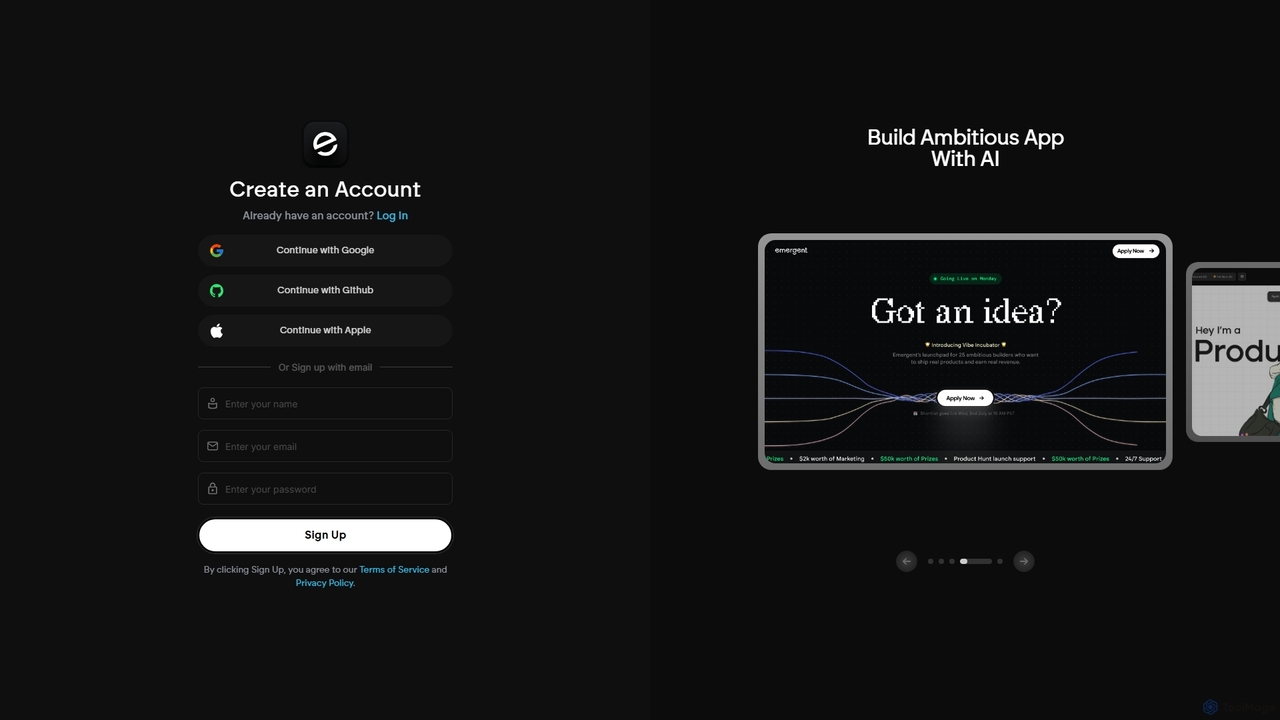
Emergent likely offers a freemium model to cater to different user needs. While specific details are not provided on the registration page, a typical structure would be:

  • Free Plan: A limited plan for individuals and hobbyists to explore the platform, with restrictions on the number of projects, AI agent usage, and advanced features.
  • Pro Plan: A subscription-based plan for professional developers and startups, offering more generous AI credits, unlimited projects, and priority support.
  • Team/Enterprise Plan: A custom plan for larger teams and organizations, featuring collaboration tools, enhanced security, dedicated support, and custom integrations.

GitStart

GitStart is redefining the future of software engineering by providing a seamless, scalable solution for development teams. It acts as an elastic engineering capacity layer, integrating directly into your existing workflow. The platform leverages a unique hybrid model, combining advanced Large Language Models (LLMs) as 'Hybrid Agents' with a vetted, global community of real developers. This synergy allows GitStart to absorb context from your codebase, tackle complex tasks, and deliver high-quality, production-ready code with a remarkable 98% merge rate.

The core mission of GitStart is to make software development faster, more efficient, and accessible. By handling tasks ranging from technical debt and support tickets to building entire features from scratch, GitStart frees up your in-house engineers to focus on core architecture, product strategy, and the most complex technical challenges. The platform has a proven track record, having shipped over a billion lines of code for forward-thinking companies and contributed to major open-source projects like Firefox, Sourcegraph, and Cal.com.

How to use GitStart

The process of integrating GitStart into your team is designed to be simple and non-disruptive, allowing you to get started within days.

  1. Assign Tickets: Simply integrate your project management tools like Jira or Linear. Assign tickets to your dedicated GitStart agents just as you would to an in-house developer. For optimal results, tickets should have clear requirements. GitStart's AI Ticket Studio can even assist in scoping and creating well-defined tickets.
  2. Autonomous Work: Once a ticket is assigned, GitStart's platform takes over. It uses a proprietary technology called 'GitSlice' to securely isolate relevant sections of your codebase. The AI agents work on these slices in secure, dynamic environments to generate the initial code.
  3. Human Review & Polish: The AI-generated code is then passed to expert human developers from GitStart's global network. They review, test, and polish the code to ensure it meets your quality standards and coding conventions.
  4. Receive Pull Requests: You receive a fully-vetted, production-ready Pull Request (PR) directly in your GitHub or GitLab repository. Your team's only task is to conduct the final review and merge the PR, maintaining full ownership and control over the codebase.

Core Features of GitStart

  • Hybrid Agents (AI + Human): Combines the speed and scale of LLMs with the nuance, context, and quality assurance of expert human developers.
  • Autonomous Pull Request Delivery: Manages the entire development lifecycle from ticket assignment to a ready-to-merge PR, minimizing management overhead.
  • GitSlice Secure Code Layer: A proprietary technology that isolates codebase sections for secure and efficient work by AI agents, enhancing both security and performance.
  • Seamless Integration: Natively integrates with standard developer tools including GitHub, GitLab, Jira, Linear, and Slack for a smooth workflow.
  • Broad Technology Support: The developer community is proficient in over 15 languages and frameworks, including React, Node.js, Python, Django, Ruby on Rails, and more.
  • AI-Powered Scoping & Review: Offers tools like the GitStart AI Ticket Studio to help create well-scoped tickets and is developing the GitStart AI Review Studio to scale code reviews.

Use Cases for GitStart

GitStart is versatile and can be adapted to various engineering needs:

  • Tackling Technical Debt: Systematically address backlogs of tech debt, refactoring code, and improving codebase health without distracting your core team.
  • Accelerating Feature Development: Augment your team to build and ship new features faster, increasing your product velocity.
  • Handling Support & Bug Fixes: Manage incoming support tickets and bug reports efficiently, ensuring a stable and reliable product for your users.
  • Building an MVP or Entire Product: For startups or new projects, GitStart can act as the entire engineering team, building a product from the ground up.
  • Open-Source Contributions: GitStart has successfully contributed to complex open-source projects, resolving long-standing issues.

Advantages of GitStart

By partnering with GitStart, engineering teams gain a significant competitive edge:

  • Massive Scalability: Instantly scale your engineering output up or down based on project needs, with the potential to ship up to 10x more work.
  • Increased Efficiency: Frees your senior engineers from routine coding tasks, allowing them to focus on high-impact strategic work.
  • Cost-Effective: Eliminates the time and expense associated with hiring, onboarding, and managing additional full-time developers.
  • High-Quality Code: Achieves an industry-leading 98% merge rate with an average of just 1.7 code review cycles, ensuring code quality and consistency.
  • Speed to Market: Drastically reduces development cycle times, helping you launch products and features faster.

Pricing and Plans

GitStart provides flexible engagement options and tailored solutions designed to align with your specific project requirements and budget. Pricing is not publicly listed. To get a customized quote and learn more about the engagement models, you are encouraged to book a demo or contact their sales team directly through the official website.

Positioning

Their taxonomy shows where the products overlap and where each one has a more distinct focus. Unknown fields are shown explicitly and are never filled with assumptions.

Categories

Shared
Code Generation
Only Emergent
DevelopmentLow Code No Code
Only GitStart
Software DevelopmentTask Management

Tags

Shared
code generationsoftware development
Only Emergent
AI agentapplication builderdeveloper toolfull-stacklow-codeMVPnatural language processingrapid prototypingvibe coding
Only GitStart
AI developercode automationdeveloper toolsengineering teamGitJira integrationpull requesttask automationtech debt

Audience and roles

Shared
No listed items
Only Emergent
Backend DeveloperFrontend DeveloperFull-Stack DeveloperProduct ManagerSoftware DeveloperTech EntrepreneurUI/UX Designer
Only GitStart
No listed items

Traffic comparison

Traffic is shown on the same scale so differences in market visibility are not visually understated.

How to interpret the traffic data

Both charts share the same months and vertical scale. Each tool identifies its latest reporting month; missing months are left blank, not counted as zero. Regional and source visit counts are estimates calculated from the reported shares.

Emergent monthly traffic:

Latest traffic · 2026-05

Monthly visits
7.6M
Avg. visit duration
4:54
Pages per visit
5.08
Bounce rate
39.72%
Data updated 2026-06-15

Monthly traffic trend

  • 2025-09: 4M
  • 2026-01: 5.1M
  • 2026-02: 6.4M
  • 2026-03: 5.9M
  • 2026-04: 6.7M
  • 2026-05: 7.6M

Top regions

Top 5 countries/regions
Country/regionPercentageEstimated visits
🇮🇳India45.07%3.4M
🇺🇸United States30.1%2.3M
🇬🇧United Kingdom10.52%795.7K
🇮🇩Indonesia7.4%559.7K
🇧🇷Brazil6.91%522.6K

Traffic sources

Source typePercentageEstimated visits
Direct61.31%4.6M
Referral34.83%2.6M
Email3.86%292K

Search keywords

base44emergentemergent ailovablereplit

GitStart monthly traffic:

Latest traffic · 2026-05

Monthly visits
1.8K
Avg. visit duration
0:00
Pages per visit
1.08
Bounce rate
39.06%
Data updated 2026-06-15

Monthly traffic trend

  • 2025-09: 2.4K
  • 2026-01: 2.3K
  • 2026-02: 1.9K
  • 2026-03: 1.5K
  • 2026-04: 1.1K
  • 2026-05: 1.8K

Top regions

Top 5 countries/regions
Country/regionPercentageEstimated visits
🇺🇸United States52.56%946
🇮🇳India47.44%854

Search keywords

afghan computer science programmergitstartgitstart acquiredgitstart careershackerhouse san francisco

Community signals

Ratings, comments, favorites, and likes are community signals—not a substitute for product fit.

Emergent

Rating
No data available
Comments
0
Favorites
158
Likes
148

GitStart

Rating
No data available
Comments
0
Favorites
199
Likes
204

Emergent vs GitStart · Comparison FAQ

What do Emergent and GitStart have in common?
Both tools are listed under Code Generation. These categories indicate overlapping use cases; compare their detailed descriptions for workflows, capabilities and limitations.
Are Emergent and GitStart free?
Listed pricing models: Emergent — Freemium; GitStart — Paid. Missing pricing is not proof of a free plan, and freemium does not mean every feature is free. Check official sites for current plans, limits and trials.
How should I choose between Emergent and GitStart?
The primary listed category is Development for Emergent, and Software Development for GitStart. Compare features, steps and use cases, then verify pricing, data permissions and deployment needs. This page does not include hands-on testing and does not declare a winner from traffic or tags.

Sources and comparison methodology

This page is assembled from ToolMage product listings, taxonomy, traffic statistics and on-site user feedback. It is not a hands-on test or an independent review.
  • Feature and plan descriptions reflect information in the listings, not real-time guarantees. Verify pricing, quotas, availability and privacy terms on the official sites.
  • Traffic uses the reporting months shown. Missing statistics do not mean zero visits, and different periods do not establish growth or superiority. Regional and source visit counts are estimates based on shares.
  • Different tags indicate differences in the listings, not proof that the other product lacks a capability. Ratings, favorites and visits are not used to declare a winner.

Related comparisons