ToolMage
Sign in

AI TOOL COMPARISON

fullstackdeeplearning vs Lightning AI

What is the difference, and which fits your workflow? Compare features, usage, pricing models and traffic side by side.

Jump to key differences

Product overview

fullstackdeeplearning Product overview

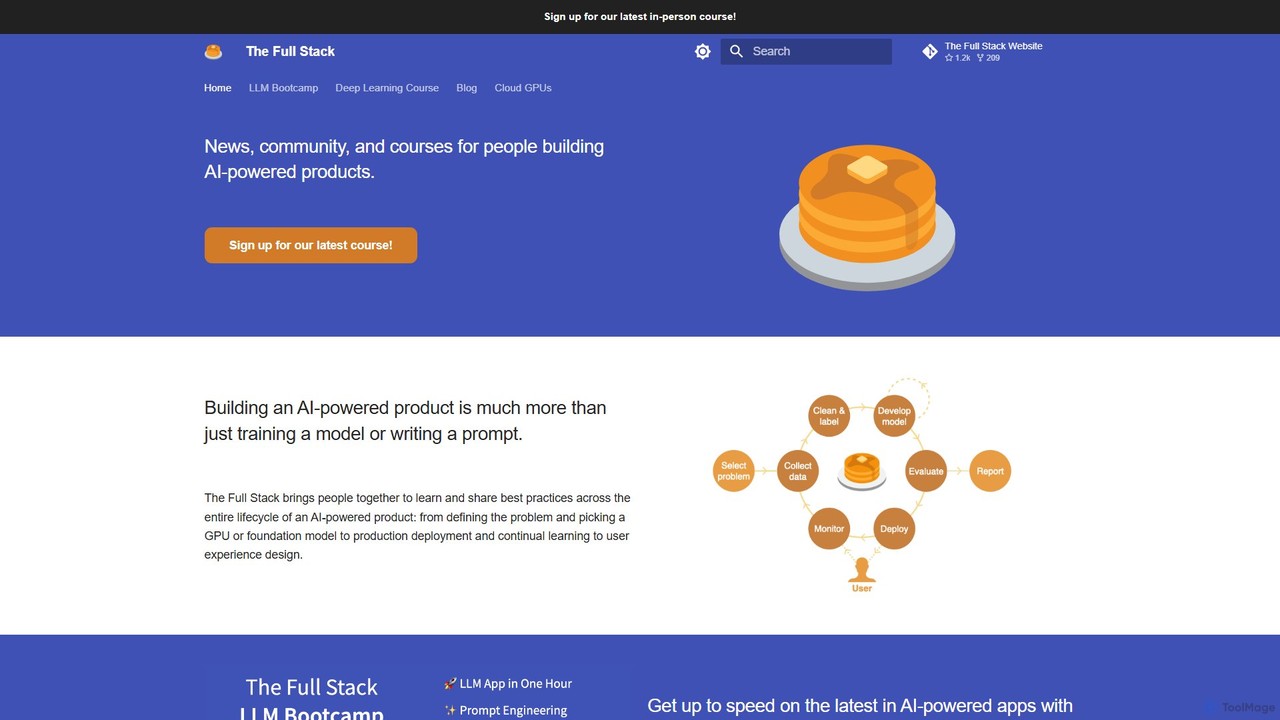
An educational platform offering courses, community, and resources for professionals building real-world AI products. It covers the entire development lifecycle, from model training and MLOps to deployment and user experience design.

Preview

Lightning AI Product overview

Lightning AI is a cloud platform designed to build, train, and deploy AI models at scale. It combines the popular open-source PyTorch Lightning framework with Lightning AI Studio, a collaborative, browser-based environment with zero setup. Access powerful GPUs, scale from a laptop to the cloud seamlessly, and accelerate your entire AI development workflow.

Preview

Quick facts

Compare product focus, pricing models and audiences. Highlighted rows indicate different listed information; unknown pricing does not mean free.

fullstackdeeplearning VS Lightning AI — Quick facts
Quick factsfullstackdeeplearningLightning AI
Pricing modelPaidFreemium
Product typeWebWeb
Primary focusTech CommunityPlatform As A Service (Paas)
Audience and rolesNo data availableNo data available
CategoriesTech Community · Machine Learning · ProgrammingPlatform As A Service (Paas) · Machine Learning · Collaboration
AddedAug 16, 2025Aug 5, 2025
UpdatedNov 19, 2026Nov 19, 2026

Features, usage and use cases

Explore the listed product descriptions, features and workflows. Taxonomy labels alone are not feature evaluations.

fullstackdeeplearning

fullstackdeeplearning is a comprehensive educational platform and community designed for engineers, researchers, and entrepreneurs who are building products powered by artificial intelligence. It distinguishes itself by focusing on the entire 'full stack' of machine learning development, moving beyond just model training to encompass the complete lifecycle of an AI product. This includes problem definition, data management, model development, production deployment, monitoring, and user experience design.

The platform offers a range of high-quality content, including in-depth courses, practical labs, and insightful blog posts. It aims to bridge the gap between theoretical knowledge and real-world application, equipping learners with the best practices and tools necessary to succeed in the fast-evolving AI industry.

How to use fullstackdeeplearning

Engaging with fullstackdeeplearning involves several key activities:

  1. Enroll in Courses: Sign up for their flagship courses, such as the 'Large Language Models Bootcamp' or the 'Deep Learning Course'. These courses are structured to take you from foundational concepts to advanced application development.
  2. Participate in Labs: Work through hands-on labs that guide you in building a complete AI application from scratch, such as a text recognizer. These labs are designed for accessibility, offering one-click setup on Google Colab with free GPU access, or can be run on a local Linux machine.
  3. Read the Blog: Stay updated with the latest trends and deep technical dives by reading the official blog. It features expert-written articles on topics like novel model architectures (e.g., RWKV) and deploying large-scale models.
  4. Join the Community: Connect with a global community of peers, instructors, and industry experts through their Discord server and other social channels. This is a space for asking questions, sharing projects, and networking.
  5. Build a Project: Apply your skills by creating a final project. The platform showcases outstanding student projects, providing inspiration and a benchmark for quality.

Core Features of fullstackdeeplearning

  • End-to-End Curriculum: Covers the full lifecycle of AI product development, from ideation and data collection to deployment, MLOps, and UX.
  • Practical, Hands-on Labs: Step-by-step labs for building real applications, with easy setup on Google Colab.
  • Expert-Led Courses: In-depth courses on cutting-edge topics like Deep Learning and Large Language Models (LLMs).
  • Focus on Best Practices: Teaches industry-standard tools and best practices for building robust, scalable, and maintainable AI systems.
  • Vibrant Community: Access to a network of AI professionals and enthusiasts for collaboration and support.
  • Project-Based Learning: Encourages students to build and showcase their own AI-powered products.
  • Technical Blog: Provides deep-dive articles on advanced ML topics and engineering challenges.

Use Cases for fullstackdeeplearning

The skills and knowledge gained from the platform can be applied to a wide array of real-world projects, as demonstrated by their student showcases:

  • Computer Vision: Developing systems for breast cancer detection, deforestation monitoring from satellite images, and real-time sitting posture coaching.
  • Natural Language Processing (NLP): Building tools like a YouTube highlighter for creators or deploying large language models like GLM-130B.
  • Creative AI: Creating an artificial manga panel dataset.
  • Real-Time Monitoring: Designing a real-time nail-biting alerter.
  • Scientific Research: Classifying human proteins from single-cell images or building a bird song classifier.

Advantages of fullstackdeeplearning

The primary advantage of fullstackdeeplearning is its holistic and practical approach. Unlike purely academic courses, it emphasizes the engineering challenges of making AI work in the real world. The focus on MLOps, deployment, and agility prepares learners for the actual demands of an AI/ML engineering role. The use of accessible tools like Google Colab lowers the barrier to entry, while the strong community provides an invaluable support system for continuous learning and career growth.

Pricing and Plans

fullstackdeeplearning operates on a paid model for its comprehensive courses, such as the LLM Bootcamp and Deep Learning Course. While specific prices can vary per course and cohort, they are premium educational offerings. The platform also provides free resources, including its technical blog and community access. For the most current pricing and enrollment details, prospective students should visit the official website.

Lightning AI

Lightning AI is a comprehensive platform engineered to empower everyone, from individual researchers to large enterprises, to build and deploy artificial intelligence. It was created by the team behind PyTorch Lightning, a highly popular open-source framework that simplifies and structures PyTorch code for training and finetuning AI models. The platform's core is the Lightning AI Studio, a cloud-based environment that eliminates the complexities of infrastructure management, allowing developers to focus purely on building models.

The platform is built on the principle of speed and efficiency. It enables users to go from an idea to a trained model significantly faster. With over 200 million downloads of PyTorch Lightning and more than 240,000 users on AI Studio, Lightning AI has established itself as a leader in the AI development space, backed by major investors and partnered with industry giants like NVIDIA, Meta, AWS, and Google.

How to use Lightning AI

Getting started with Lightning AI is designed to be straightforward and frictionless:

  1. Sign Up: Create a free account. The free tier requires no credit card and provides monthly credits to get started.
  2. Start a Studio: A Studio is a pre-configured, cloud-based development environment. It comes with everything you need, including Python, PyTorch, and necessary drivers, eliminating any local setup.
  3. Choose Your Hardware: You can start with a free CPU instance and seamlessly switch to powerful GPUs (like T4, L40S, A100, H100) with a single click as your needs grow. No need to manually manage files or environments.
  4. Code and Collaborate: Write your code directly in the browser-based IDE, which supports notebooks and terminals. You can also connect your local IDE like VSCode or PyCharm. Invite team members to your Studio for real-time, multiplayer collaboration.
  5. Train and Scale: Use PyTorch Lightning to structure your code for scalable training. Easily scale from a single GPU to multi-GPU and even multi-node training for massive models without significant code changes.
  6. Deploy Models: Once your model is trained, use Lightning AI's tools to deploy it as an endpoint or host it as an interactive AI application.

Core Features of Lightning AI

  • Lightning AI Studio: A zero-setup, browser-based IDE with persistent storage, pre-configured environments, and real-time collaboration features.
  • On-Demand GPUs: Access a wide range of GPUs from leading cloud providers (AWS, GCP) on a pay-as-you-go basis. Includes high-performance options like NVIDIA A100 and H100.
  • Seamless Scaling: Effortlessly scale your training jobs from your local machine to single or multi-node cloud instances.
  • Cost-Effective: Utilize a generous free tier, pay-as-you-go pricing, and save up to 80% with interruptible (spot) instances.
  • Open-Source Ecosystem: Built around PyTorch Lightning and includes other powerful tools like LitGPT, Fabric, and Torchmetrics to streamline the entire ML lifecycle.
  • Enterprise-Ready: Offers enterprise-grade features including SOC 2 compliance, HIPAA, SAML/SSO, VPC deployment, and dedicated support.
  • Multi-Cloud Abstraction: Access the world's best clouds from a single, unified platform.
  • Automation SDK: Automate your workflows, from data preparation to model deployment, using the Lightning SDK.

Use Cases for Lightning AI

Lightning AI is versatile and supports a wide array of applications across different industries:

  • Academic Research: Researchers can rapidly prototype and validate hypotheses without worrying about infrastructure. MIT's Sustainable Design Lab reduced model validation time from 36 hours to a single day.
  • Startups and Small Teams: Startups like OctAI have used the platform to validate their ideas quickly and cost-effectively, taking a fraction of the time it would have otherwise.
  • Enterprise AI Development: Large organizations can build, train, and deploy secure, scalable AI models, leveraging enterprise features for compliance and security.
  • Generative AI: Fine-tune and deploy large language models (LLMs) and diffusion models for applications like text generation and text-to-image synthesis.
  • Scientific Computing: Used in fields like drug discovery (NVIDIA BioNeMo) and environmental science (Microsoft CameraTraps for wildlife detection).

Advantages of Lightning AI

The primary advantage of Lightning AI is the radical simplification and acceleration of the AI development process. It removes the most common bottlenecks: environment setup, hardware provisioning, and scaling complexity. Users can prototype up to 6x faster, collaborate seamlessly to solve problems like the "it works on my machine" issue, and scale their projects without being infrastructure experts. The flexible, pay-as-you-go pricing model makes powerful AI development accessible to everyone, from students to large corporations.

Pricing and Plans

Lightning AI offers a tiered pricing structure to cater to different needs:

  • Free Plan: $0/month. Ideal for students, researchers, and hobbyists. Includes 1 free active CPU Studio, 15 monthly Lightning credits (approx. 80 GPU hours on interruptible machines), and community support.
  • Pro Plan: Starts at $40/month (billed annually). Aimed at professional developers and scientists. Includes more credits, a 24/7 running Studio, access to multi-GPU setups, and increased storage.
  • Teams Plan: Starts at $119/user/month (billed annually). Designed for research labs and small teams. Offers more credits, access to high-end full-node GPUs (A100, H100), multi-node training capabilities, and real-time cost controls.
  • Enterprise Plan: Custom pricing. Provides a fully customizable, secure AI platform with features like VPC deployment, SOC 2 compliance, unlimited concurrent GPUs, use of your own cloud credits (AWS/GCP), and dedicated expert support.

Positioning

Their taxonomy shows where the products overlap and where each one has a more distinct focus. Unknown fields are shown explicitly and are never filled with assumptions.

Categories

Shared
Machine Learning
Only fullstackdeeplearning
Tech CommunityProgramming
Only Lightning AI
Platform As A Service (Paas)Collaboration

Tags

Shared
AI developmentdeep learningmachine learningMLOpspytorch
Only fullstackdeeplearning
AI communitydeveloper educationllmonline coursepython
Only Lightning AI
cloud idecollaborationdata scienceGPUmodel trainingPaaS

Audience and roles

Shared
No listed items
Only fullstackdeeplearning
No listed items
Only Lightning AI
No listed items

Traffic comparison

Traffic is shown on the same scale so differences in market visibility are not visually understated.

How to interpret the traffic data

Both charts share the same months and vertical scale. Each tool identifies its latest reporting month; missing months are left blank, not counted as zero. Regional and source visit counts are estimates calculated from the reported shares.

fullstackdeeplearning monthly traffic:

Latest traffic · 2026-05

Monthly visits
64.8K
Avg. visit duration
0:18
Pages per visit
1.89
Bounce rate
41.88%
Data updated 2026-06-15

Monthly traffic trend

  • 2025-09: 54K
  • 2026-01: 48K
  • 2026-02: 53.5K
  • 2026-03: 52K
  • 2026-04: 42.2K
  • 2026-05: 64.8K

Top regions

Top 5 countries/regions
Country/regionPercentageEstimated visits
🇮🇳India32.37%21K
🇺🇸United States26.66%17.3K
🇬🇧United Kingdom15.25%9.9K
🇻🇳Vietnam13.89%9K
🇳🇬Nigeria11.83%7.7K

Traffic sources

Source typePercentageEstimated visits
Direct85.25%55.2K
Referral13.57%8.8K
Email1.18%765

Search keywords

full stack deep learningfullstackdeeplearningfullstackdeeplearning.com expiredfull stack llm bootcampfull stack llm boot camp the full stack

Lightning AI monthly traffic:

Latest traffic · 2026-05

Monthly visits
466.9K
Avg. visit duration
4:47
Pages per visit
5.12
Bounce rate
34.74%
Data updated 2026-06-15

Monthly traffic trend

  • 2025-09: 384.6K
  • 2026-01: 437.5K
  • 2026-02: 423.7K
  • 2026-03: 423K
  • 2026-04: 454.8K
  • 2026-05: 466.9K

Top regions

Top 5 countries/regions
Country/regionPercentageEstimated visits
🇮🇳India37.36%174.4K
🇻🇳Vietnam24.94%116.4K
🇺🇸United States24.88%116.2K
🇨🇳China7.21%33.7K
🇫🇷France5.61%26.2K

Traffic sources

Source typePercentageEstimated visits
Direct85.94%401.3K
Referral9.98%46.6K
Email4.08%19.1K

Search keywords

ai studiolighting ailightninglightning aipytorch lightning

Community signals

Ratings, comments, favorites, and likes are community signals—not a substitute for product fit.

fullstackdeeplearning

Rating
No data available
Comments
0
Favorites
145
Likes
162

Lightning AI

Rating
No data available
Comments
0
Favorites
166
Likes
162

fullstackdeeplearning vs Lightning AI · Comparison FAQ

What do fullstackdeeplearning and Lightning AI have in common?
Both tools are listed under Machine Learning. These categories indicate overlapping use cases; compare their detailed descriptions for workflows, capabilities and limitations.
Are fullstackdeeplearning and Lightning AI free?
Listed pricing models: fullstackdeeplearning — Paid; Lightning AI — Freemium. Missing pricing is not proof of a free plan, and freemium does not mean every feature is free. Check official sites for current plans, limits and trials.
How should I choose between fullstackdeeplearning and Lightning AI?
The primary listed category is Tech Community for fullstackdeeplearning, and Platform As A Service (Paas) for Lightning AI. Compare features, steps and use cases, then verify pricing, data permissions and deployment needs. This page does not include hands-on testing and does not declare a winner from traffic or tags.

Sources and comparison methodology

This page is assembled from ToolMage product listings, taxonomy, traffic statistics and on-site user feedback. It is not a hands-on test or an independent review.

  • Feature and plan descriptions reflect information in the listings, not real-time guarantees. Verify pricing, quotas, availability and privacy terms on the official sites.
  • Traffic uses the reporting months shown. Missing statistics do not mean zero visits, and different periods do not establish growth or superiority. Regional and source visit counts are estimates based on shares.
  • Different tags indicate differences in the listings, not proof that the other product lacks a capability. Ratings, favorites and visits are not used to declare a winner.

Related comparisons