ToolMage
Sign in

AI TOOL COMPARISON

fullstackdeeplearning vs Kaggle

What is the difference, and which fits your workflow? Compare features, usage, pricing models and traffic side by side.

Jump to key differences

Product overview

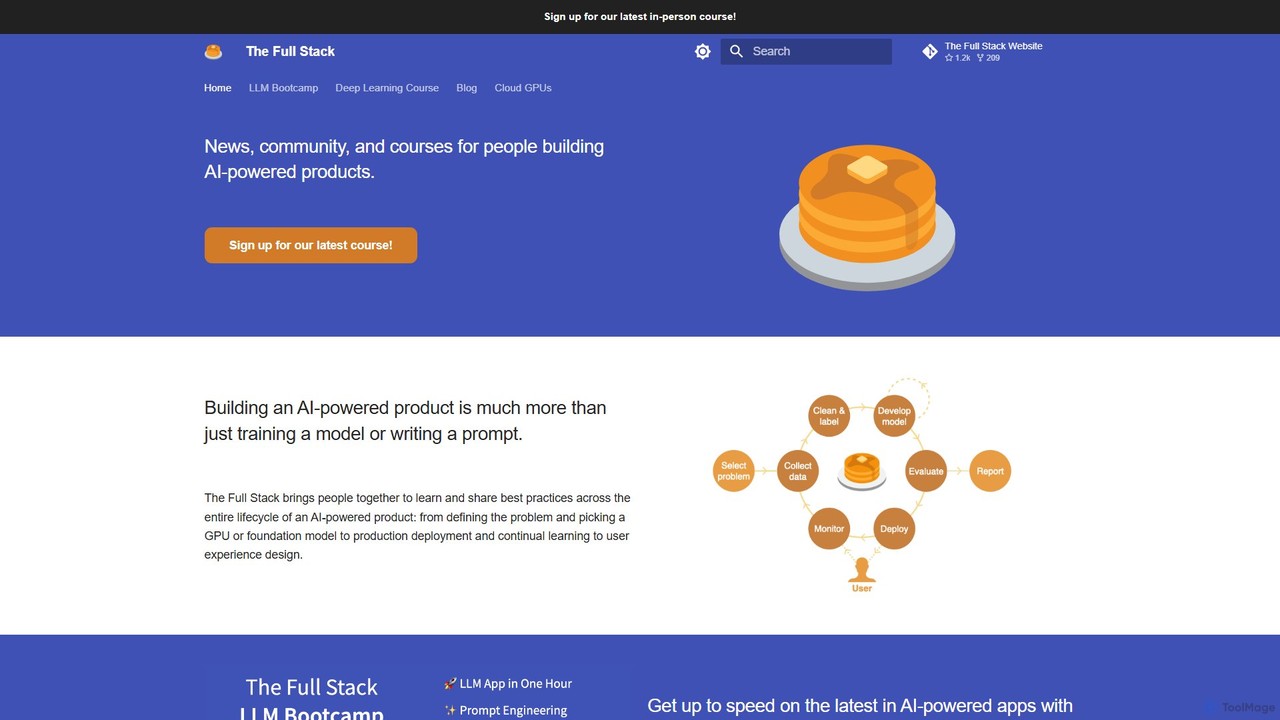
fullstackdeeplearning Product overview

An educational platform offering courses, community, and resources for professionals building real-world AI products. It covers the entire development lifecycle, from model training and MLOps to deployment and user experience design.

Preview

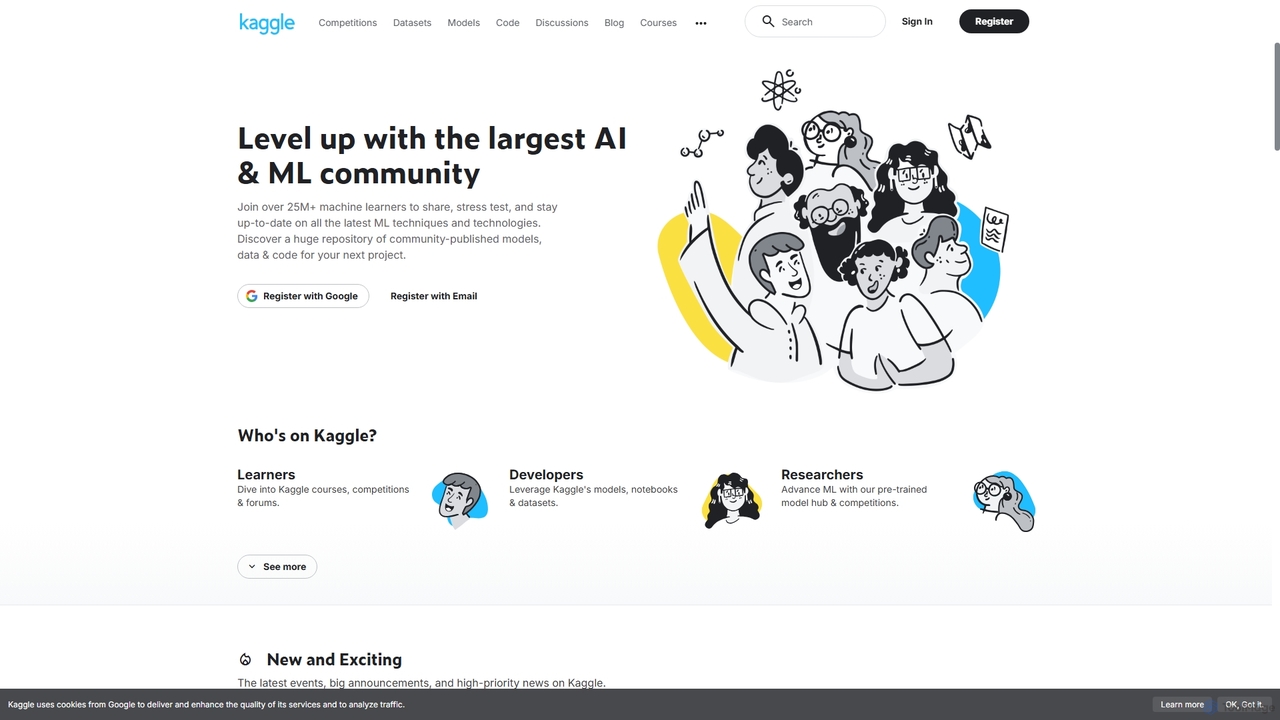
Kaggle Product overview

Kaggle is the world's largest online community for data scientists and machine learning practitioners. Owned by Google, it provides a platform to explore datasets, build models in a web-based environment, compete in machine learning challenges, and access educational resources. It offers free access to powerful computational resources, including GPUs and TPUs, making it an essential tool for anyone from beginners to seasoned experts in the AI and data science fields.

Preview

Quick facts

Compare product focus, pricing models and audiences. Highlighted rows indicate different listed information; unknown pricing does not mean free.

fullstackdeeplearning VS Kaggle — Quick facts
Quick factsfullstackdeeplearningKaggle
Pricing modelPaidFreemium
Product typeWebWeb
Primary focusTech CommunityDatasets
Audience and rolesNo data availableAI Developer · Data Analyst · Data Scientist · Machine Learning Engineer · Quantitative Analyst · Researcher · Software Developer · Student
CategoriesTech Community · Machine Learning · ProgrammingDatasets · Machine Learning · Data Science
AddedAug 16, 2025Sep 18, 2025
UpdatedNov 19, 2026Nov 19, 2026

Features, usage and use cases

Explore the listed product descriptions, features and workflows. Taxonomy labels alone are not feature evaluations.

fullstackdeeplearning

fullstackdeeplearning is a comprehensive educational platform and community designed for engineers, researchers, and entrepreneurs who are building products powered by artificial intelligence. It distinguishes itself by focusing on the entire 'full stack' of machine learning development, moving beyond just model training to encompass the complete lifecycle of an AI product. This includes problem definition, data management, model development, production deployment, monitoring, and user experience design.

The platform offers a range of high-quality content, including in-depth courses, practical labs, and insightful blog posts. It aims to bridge the gap between theoretical knowledge and real-world application, equipping learners with the best practices and tools necessary to succeed in the fast-evolving AI industry.

How to use fullstackdeeplearning

Engaging with fullstackdeeplearning involves several key activities:

  1. Enroll in Courses: Sign up for their flagship courses, such as the 'Large Language Models Bootcamp' or the 'Deep Learning Course'. These courses are structured to take you from foundational concepts to advanced application development.
  2. Participate in Labs: Work through hands-on labs that guide you in building a complete AI application from scratch, such as a text recognizer. These labs are designed for accessibility, offering one-click setup on Google Colab with free GPU access, or can be run on a local Linux machine.
  3. Read the Blog: Stay updated with the latest trends and deep technical dives by reading the official blog. It features expert-written articles on topics like novel model architectures (e.g., RWKV) and deploying large-scale models.
  4. Join the Community: Connect with a global community of peers, instructors, and industry experts through their Discord server and other social channels. This is a space for asking questions, sharing projects, and networking.
  5. Build a Project: Apply your skills by creating a final project. The platform showcases outstanding student projects, providing inspiration and a benchmark for quality.

Core Features of fullstackdeeplearning

  • End-to-End Curriculum: Covers the full lifecycle of AI product development, from ideation and data collection to deployment, MLOps, and UX.
  • Practical, Hands-on Labs: Step-by-step labs for building real applications, with easy setup on Google Colab.
  • Expert-Led Courses: In-depth courses on cutting-edge topics like Deep Learning and Large Language Models (LLMs).
  • Focus on Best Practices: Teaches industry-standard tools and best practices for building robust, scalable, and maintainable AI systems.
  • Vibrant Community: Access to a network of AI professionals and enthusiasts for collaboration and support.
  • Project-Based Learning: Encourages students to build and showcase their own AI-powered products.
  • Technical Blog: Provides deep-dive articles on advanced ML topics and engineering challenges.

Use Cases for fullstackdeeplearning

The skills and knowledge gained from the platform can be applied to a wide array of real-world projects, as demonstrated by their student showcases:

  • Computer Vision: Developing systems for breast cancer detection, deforestation monitoring from satellite images, and real-time sitting posture coaching.
  • Natural Language Processing (NLP): Building tools like a YouTube highlighter for creators or deploying large language models like GLM-130B.
  • Creative AI: Creating an artificial manga panel dataset.
  • Real-Time Monitoring: Designing a real-time nail-biting alerter.
  • Scientific Research: Classifying human proteins from single-cell images or building a bird song classifier.

Advantages of fullstackdeeplearning

The primary advantage of fullstackdeeplearning is its holistic and practical approach. Unlike purely academic courses, it emphasizes the engineering challenges of making AI work in the real world. The focus on MLOps, deployment, and agility prepares learners for the actual demands of an AI/ML engineering role. The use of accessible tools like Google Colab lowers the barrier to entry, while the strong community provides an invaluable support system for continuous learning and career growth.

Pricing and Plans

fullstackdeeplearning operates on a paid model for its comprehensive courses, such as the LLM Bootcamp and Deep Learning Course. While specific prices can vary per course and cohort, they are premium educational offerings. The platform also provides free resources, including its technical blog and community access. For the most current pricing and enrollment details, prospective students should visit the official website.

Kaggle

Kaggle, a subsidiary of Google, stands as the premier online platform and community for data science and machine learning enthusiasts. With a global community of over 25 million users, it serves as a comprehensive ecosystem where individuals and teams can discover and publish datasets, explore and build models using a powerful, free notebook environment, compete in challenging machine learning competitions, and learn from a vast collection of educational resources. Kaggle's mission is to help data scientists and machine learning engineers at all stages of their careers to learn, grow, and make an impact.

How to use Kaggle

Getting started with Kaggle is a straightforward process designed to onboard users quickly into the world of data science:

  1. Create an Account: Register for a free account on the Kaggle website using a Google account or an email address.
  2. Learn the Basics: For newcomers, Kaggle offers a series of free, hands-on courses called Kaggle Learn. These cover essential topics like Python, Pandas, Data Visualization, and Intro to Machine Learning.
  3. Explore Datasets: Navigate to the Datasets section to browse over 500,000 public datasets. You can find data on virtually any topic, from avocado prices to medical imaging, to use in your personal projects.
  4. Utilize Notebooks: Launch a free Kaggle Notebook, a cloud-based Jupyter environment. It comes pre-installed with major data science libraries. You can write and execute code, and most importantly, enable free GPU or TPU accelerators for computationally intensive tasks.
  5. Enter a Competition: The heart of Kaggle is its competitions. Beginners can start with 'Getting Started' competitions like the famous 'Titanic: Machine Learning from Disaster'. In a competition, you download the data, build a predictive model in a Notebook, generate a submission file with your predictions, and upload it to see your real-time ranking on the leaderboard.
  6. Collaborate and Share: Engage with the community through discussion forums, comment on public notebooks, or fork (copy) a notebook to build upon someone else's work. You can also form teams to tackle competitions together.
  7. Leverage Pre-trained Models: Explore the Models hub to find thousands of pre-trained models, such as Google's Gemma or Meta's Llama 2, which you can use as a starting point for your own projects.

Core Features of Kaggle

  • Machine Learning Competitions: Kaggle is renowned for hosting ML competitions sponsored by companies and research organizations, with prize pools reaching up to $1 million. These challenges cover a wide range of problems, including classification, regression, and computer vision.
  • Vast Public Datasets Repository: A collection of over 525,000 datasets, making it one of the largest resources for finding high-quality, diverse data for any project.
  • Kaggle Notebooks: A free, cloud-based coding environment that supports Python and R. It offers free access to powerful hardware, including NVIDIA GPUs and Google's TPUs, which significantly speeds up model training.
  • Pre-trained Models Hub: A growing library of over 28,000 ready-to-deploy ML models that can be easily integrated into Kaggle Notebooks, saving time and computational resources.
  • Kaggle Learn Courses: A suite of free, interactive micro-courses designed to teach practical data science skills quickly and efficiently, from data manipulation to deep learning.
  • Global Community and Discussion Forums: An active community of millions of users who share code, offer advice, and discuss the latest trends in AI and machine learning.
  • Progression System: A gamified system that rewards users with medals and tiers (Novice, Contributor, Expert, Master, Grandmaster) for their achievements in competitions, datasets, notebooks, and discussions, providing a clear path for skill recognition.

Use Cases for Kaggle

Kaggle is a versatile platform that caters to a wide audience:

  • Students and Aspiring Data Scientists: A perfect environment to learn practical skills, apply theoretical knowledge to real-world problems, build a professional portfolio, and gain visibility in the data science community.
  • Professional Data Scientists and ML Engineers: A place to benchmark skills against the best in the world, experiment with new techniques on unique datasets, win substantial cash prizes, and stay at the forefront of the industry.
  • Academic Researchers: A platform to host research-oriented competitions, crowdsource solutions to complex scientific problems, and access a vast array of public data for studies.
  • Businesses and Organizations: A way to crowdsource innovative and highly accurate predictive models for challenging business problems by hosting 'Featured Competitions', effectively tapping into a global pool of top data science talent.

Advantages of Kaggle

The key advantages of using Kaggle include:

  • Democratized Access to Compute Power: The provision of free GPUs and TPUs levels the playing field, allowing anyone to work on large-scale machine learning projects without needing expensive hardware.
  • Unmatched Learning Opportunities: The combination of real-world competitions, extensive datasets, shared code, and active forums creates an unparalleled learning environment.
  • Career Advancement: A strong Kaggle profile, especially with high rankings in competitions, is a highly respected credential that can significantly boost career prospects in the data science field.
  • Real-World Problem Solving: Competitions are based on actual business and research challenges, providing invaluable hands-on experience that is directly applicable in a professional setting.

Pricing and Plans

Kaggle's pricing model is designed to be accessible to individuals while offering premium services for organizations.

  • For Individuals (Learners, Practitioners): The platform is completely free. This includes participation in competitions, access to all datasets, use of Kaggle Notebooks with free GPU/TPU quotas, and all Kaggle Learn courses.
  • For Competition Hosts:
    • Community Competitions: Free to set up for educational purposes, small businesses, or ML enthusiasts.
    • Featured Competitions: A paid service for businesses looking to solve complex problems with cash prizes and dedicated support from the Kaggle team. Pricing is variable and tailored to the project's needs.
    • Research Competitions: Designed for academic and non-profit institutions, with potential grants available to cover costs.

Positioning

Their taxonomy shows where the products overlap and where each one has a more distinct focus. Unknown fields are shown explicitly and are never filled with assumptions.

Categories

Shared
Machine Learning
Only fullstackdeeplearning
Tech CommunityProgramming
Only Kaggle
DatasetsData Science

Tags

Shared
AI communitydeep learningmachine learningpython
Only fullstackdeeplearning
AI developmentdeveloper educationllmMLOpsonline coursepytorch
Only Kaggle
competitionsdata analysisdata sciencedatasetsGPUnotebookspredictive modelingRtpu

Audience and roles

Shared
No listed items
Only fullstackdeeplearning
No listed items
Only Kaggle
AI DeveloperData AnalystData ScientistMachine Learning EngineerQuantitative AnalystResearcherSoftware DeveloperStudent

Traffic comparison

Traffic is shown on the same scale so differences in market visibility are not visually understated.

How to interpret the traffic data

Both charts share the same months and vertical scale. Each tool identifies its latest reporting month; missing months are left blank, not counted as zero. Regional and source visit counts are estimates calculated from the reported shares.

fullstackdeeplearning monthly traffic:

Latest traffic · 2026-05

Monthly visits
64.8K
Avg. visit duration
0:18
Pages per visit
1.89
Bounce rate
41.88%
Data updated 2026-06-15

Monthly traffic trend

  • 2025-09: 54K
  • 2026-01: 48K
  • 2026-02: 53.5K
  • 2026-03: 52K
  • 2026-04: 42.2K
  • 2026-05: 64.8K

Top regions

Top 5 countries/regions
Country/regionPercentageEstimated visits
🇮🇳India32.37%21K
🇺🇸United States26.66%17.3K
🇬🇧United Kingdom15.25%9.9K
🇻🇳Vietnam13.89%9K
🇳🇬Nigeria11.83%7.7K

Traffic sources

Source typePercentageEstimated visits
Direct85.25%55.2K
Referral13.57%8.8K
Email1.18%765

Search keywords

full stack deep learningfullstackdeeplearningfullstackdeeplearning.com expiredfull stack llm bootcampfull stack llm boot camp the full stack

Kaggle monthly traffic:

Latest traffic · 2026-05

Monthly visits
12.4M
Avg. visit duration
5:57
Pages per visit
6.31
Bounce rate
35.58%
Data updated 2026-06-15

Monthly traffic trend

  • 2025-09: 10.4M
  • 2026-01: 10.5M
  • 2026-02: 10.4M
  • 2026-03: 12.8M
  • 2026-04: 13.2M
  • 2026-05: 12.4M

Top regions

Top 5 countries/regions
Country/regionPercentageEstimated visits
🇮🇳India47.79%5.9M
🇺🇸United States30.24%3.7M
🇨🇳China9.29%1.2M
🇮🇩Indonesia8.22%1M
🇬🇧United Kingdom4.46%552.7K

Traffic sources

Source typePercentageEstimated visits
Direct83.01%10.3M
Referral13.97%1.7M
Email3.02%374.3K

Search keywords

anigumimdbkagglekaggle datasetskeggle

Community signals

Ratings, comments, favorites, and likes are community signals—not a substitute for product fit.

fullstackdeeplearning

Rating
No data available
Comments
0
Favorites
145
Likes
162

Kaggle

Rating
No data available
Comments
0
Favorites
169
Likes
175

fullstackdeeplearning vs Kaggle · Comparison FAQ

What do fullstackdeeplearning and Kaggle have in common?
Both tools are listed under Machine Learning. These categories indicate overlapping use cases; compare their detailed descriptions for workflows, capabilities and limitations.
Are fullstackdeeplearning and Kaggle free?
Listed pricing models: fullstackdeeplearning — Paid; Kaggle — Freemium. Missing pricing is not proof of a free plan, and freemium does not mean every feature is free. Check official sites for current plans, limits and trials.
How should I choose between fullstackdeeplearning and Kaggle?
The primary listed category is Tech Community for fullstackdeeplearning, and Datasets for Kaggle. Compare features, steps and use cases, then verify pricing, data permissions and deployment needs. This page does not include hands-on testing and does not declare a winner from traffic or tags.

Sources and comparison methodology

This page is assembled from ToolMage product listings, taxonomy, traffic statistics and on-site user feedback. It is not a hands-on test or an independent review.

  • Feature and plan descriptions reflect information in the listings, not real-time guarantees. Verify pricing, quotas, availability and privacy terms on the official sites.
  • Traffic uses the reporting months shown. Missing statistics do not mean zero visits, and different periods do not establish growth or superiority. Regional and source visit counts are estimates based on shares.
  • Different tags indicate differences in the listings, not proof that the other product lacks a capability. Ratings, favorites and visits are not used to declare a winner.

Related comparisons