

ToolMage
Sign in
kansei
Customer Support · 1.4K monthly visits

kansei is an AI-powered platform designed for user research and qualitative data analysis. It helps teams automatically analyze and synthesize vast amounts of user feedback from sources like interviews, surveys, and support tickets to uncover actionable insights, identify pain points, and track user sentiment.


VS
User Evaluation
Customer Support · 972 monthly visits

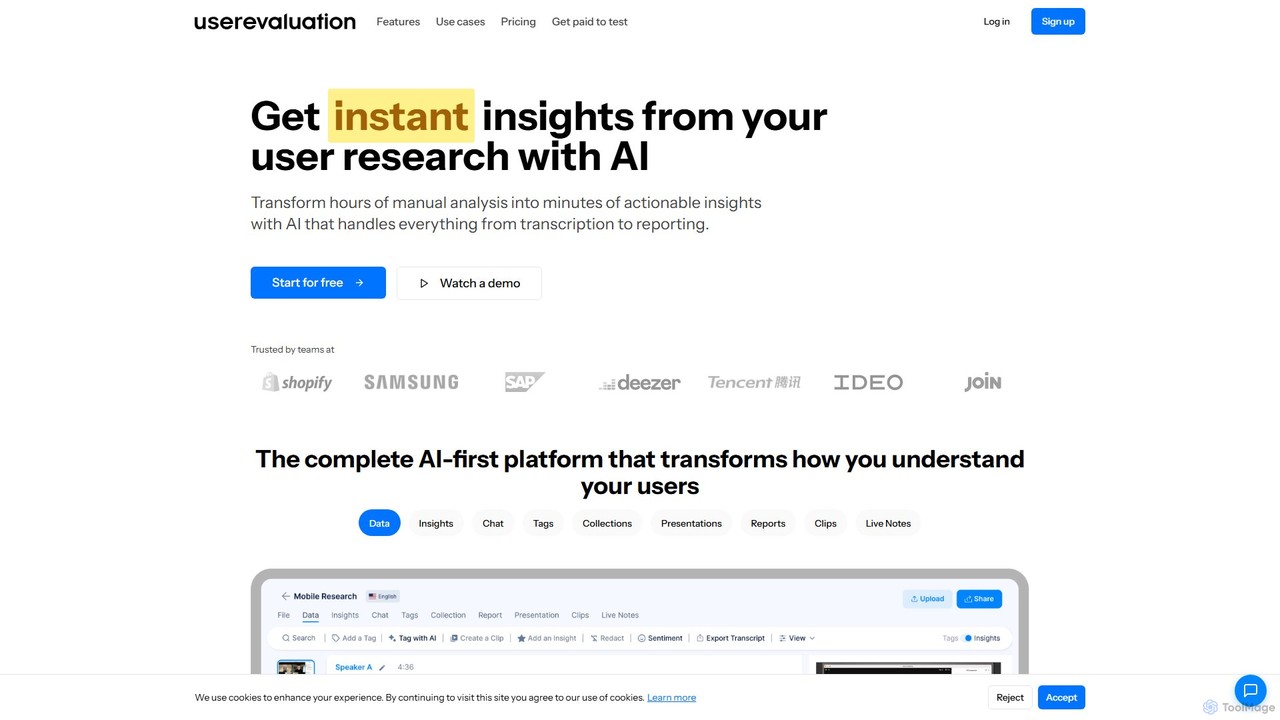
User Evaluation is an AI-first user research platform designed to transform qualitative and quantitative data into actionable insights. It automates transcription, analysis, and reporting from audio, video, and text, enabling teams to understand their users faster and make data-driven decisions with confidence.

kansei vs User Evaluation: pricing, features, traffic, and use cases

Compare kansei and User Evaluation across positioning, pricing, traffic, and user feedback using structured factual data.

Updated Aug 5, 2026

Product overview

kansei Product overview

kansei is an AI-powered platform designed for user research and qualitative data analysis. It helps teams automatically analyze and synthesize vast amounts of user feedback from sources like interviews, surveys, and support tickets to uncover actionable insights, identify pain points, and track user sentiment.
Preview

User Evaluation Product overview

User Evaluation is an AI-first user research platform designed to transform qualitative and quantitative data into actionable insights. It automates transcription, analysis, and reporting from audio, video, and text, enabling teams to understand their users faster and make data-driven decisions with confidence.

Preview

Detailed feature comparison

FeaturekanseiUser Evaluation
Primary categoryCustomer SupportCustomer Support
Added2025-08-142025-08-07
PricingFreemiumFreemium
Official websitekansei.appuserevaluation.com
Product typeWebsiteWebsite
Performance data
User ratingNot verifiedNot verified
Comments00
Monthly visits1.4K972
Monthly growth1895.8%-17.3%
Favorites130124
DetailsView detailsView details

kansei vs User Evaluation monthly traffic

Compare kansei and User Evaluation by monthly reach, traffic trend, visit depth, top regions, and acquisition sources.

How to interpret the traffic data

In the kansei vs User Evaluation monthly traffic comparison, kansei currently shows 1.4K visits and User Evaluation shows 972; kansei has about 1.5 times the visible traffic of User Evaluation, an absolute difference of about 445 visits. This reflects visible reach, not feature quality or paid users.

Both tools provide verified traffic details, so monthly trends, visit depth, regions, and acquisition sources can be compared on the same basis.

kansei monthly traffic:

Latest traffic

Monthly visits
1.4K
Avg. visit duration
0:35
Pages per visit
1.69
Bounce rate
51.18%
Data updated 2026-06-11

Monthly traffic trend

  • 2025/9: 5.2K Monthly visits
  • 2026/1: 1.8K Monthly visits
  • 2026/2: 629 Monthly visits
  • 2026/3: 1.8K Monthly visits
  • 2026/4: 71 Monthly visits
  • 2026/5: 1.4K Monthly visits

Top regions

Top 5 countries/regions
Country/regionPercentageTraffic
🇺🇸United States100%1.4K

Search keywords

english dominance helps cultures exchangejapanese grammarkanjikanseilinguistic relativity hypothesis

User Evaluation monthly traffic:

Latest traffic

Monthly visits
972
Avg. visit duration
0:00
Pages per visit
1.04
Bounce rate
40.06%
Data updated 2026-06-15

Monthly traffic trend

  • 2025/9: 3.9K Monthly visits
  • 2026/1: 1.9K Monthly visits
  • 2026/2: 2.6K Monthly visits
  • 2026/3: 2.3K Monthly visits
  • 2026/4: 1.2K Monthly visits
  • 2026/5: 972 Monthly visits

Top regions

Top 5 countries/regions
Country/regionPercentageTraffic
🇺🇸United States100%972

Search keywords

quantitative research examplestypes of quantitative researchuser aiusereuserevaluation
Traffic-based selection guidance: If public market visibility is an important first-pass criterion, investigate kansei first. The final choice should still follow taxonomy, use case, and a real trial because higher traffic does not prove broader capabilities or better workflow fit.

Usage comparison

Compare the core capabilities of kansei and User Evaluation

kansei Core features

Customer Support
Research

User Evaluation Core features

Customer Support
Research
Analytics

Use cases

kansei Use cases

customer feedback
data analysis
product management
qualitative analysis
sentiment analysis
user research
insight generation
NLP
UX

User Evaluation Use cases

customer feedback
data analysis
product management
qualitative analysis
sentiment analysis
user research
AI report generator
meeting summary
transcription
UX research

kansei vs User Evaluation:In-depth comparison and selection guidance

First decide whether the products solve the same kind of need

This in-depth kansei vs User Evaluation comparison uses only the product records, taxonomy, audience, traffic, and community signals available on this page. kansei is primarily listed under “Customer Support”, while User Evaluation is primarily listed under “Customer Support”, so the first decision is whether your actual task matches their recorded scope.

The structured fields currently show these decision-relevant differences: Monthly visits (kansei: 1.4K; User Evaluation: 972); Monthly growth (kansei: 1895.8%; User Evaluation: -17.3%); Favorites (kansei: 130; User Evaluation: 124); Website (kansei: kansei.app; User Evaluation: userevaluation.com); Added (kansei: 2025-08-14; User Evaluation: 2025-08-07). These facts are more useful for selection than brand visibility alone.

What market visibility and monthly traffic mean

In the kansei vs User Evaluation monthly traffic comparison, kansei currently shows 1.4K visits and User Evaluation shows 972; kansei has about 1.5 times the visible traffic of User Evaluation, an absolute difference of about 445 visits. This reflects visible reach, not feature quality or paid users.

Both tools provide verified traffic details, so monthly trends, visit depth, regions, and acquisition sources can be compared on the same basis.

If public market visibility is an important first-pass criterion, investigate kansei first. The final choice should still follow taxonomy, use case, and a real trial because higher traffic does not prove broader capabilities or better workflow fit.

Product positioning, use cases, and roles

kansei and User Evaluation currently overlap in shared categories: Customer Support and Research; shared tags: customer feedback, data analysis, product management, qualitative analysis, sentiment analysis, and user research. This can place both on the same shortlist, but it does not prove equal implementation, depth, or cost.

kansei's unique categories/tags are insight generation, NLP, and UX; User Evaluation's are Analytics, AI report generator, meeting summary, transcription, and UX research. These unique fields are the strongest differentiators: validate the product whose recorded scope matches the task instead of following traffic alone.

What ratings, comments, and favorites can tell you

kansei has no verified rating, 0 comments, 130 favorites, and 133 likes;User Evaluation has no verified rating, 0 comments, 124 favorites, and 124 likes。

Neither product has enough rating or comment samples for a credible reputation ranking.

Selection guidance by actual need

When to evaluate kansei first

Put kansei on the priority trial list when the task aligns with “Customer Support” and especially insight generation, NLP, and UX. This follows recorded positioning and does not imply unlisted capabilities are absent.

kansei also currently records: pricing is freemium, product type is website, 1.4K verified monthly visits, no verified user rating. Verify any hard requirement around price, platform, or reach before trial, and do not let sparse review data substitute for testing.

When to evaluate User Evaluation first

Put User Evaluation on the priority trial list when the task aligns with “Customer Support” and especially Analytics, AI report generator, meeting summary, transcription, and UX research. This follows recorded positioning and does not imply unlisted capabilities are absent.

User Evaluation also currently records: pricing is freemium, product type is website, 972 verified monthly visits, no verified user rating. Verify any hard requirement around price, platform, or reach before trial, and do not let sparse review data substitute for testing.

How to validate the recommendation before deciding

The available data describes positioning, public visibility, and community signals, but it cannot prove output quality, speed, integration effort, privacy, or long-term cost in your workflow. Before deciding, run the same representative tasks in kansei and User Evaluation, then record completion time, accuracy, manual corrections, and the real paid threshold. A like-for-like trial turns this comparison into a defensible adoption decision.

Comparison FAQ

How should I choose between kansei and User Evaluation?
Compare positioning, pricing, taxonomy, and traffic maturity, then verify the latest details on each official website.
Where does this comparison data come from?
The factual baseline is derived from product, taxonomy, traffic, and community data. Reviewed editorial conclusions show their source and verification date.
What do unknown fields mean?
Unknown means there is not enough reliable evidence; the page does not fill gaps with assumptions.