ToolMage
Sign in

AI TOOL COMPARISON

Langflow vs Vext

What is the difference, and which fits your workflow? Compare features, usage, pricing models and traffic side by side.

Jump to key differences

Product overview

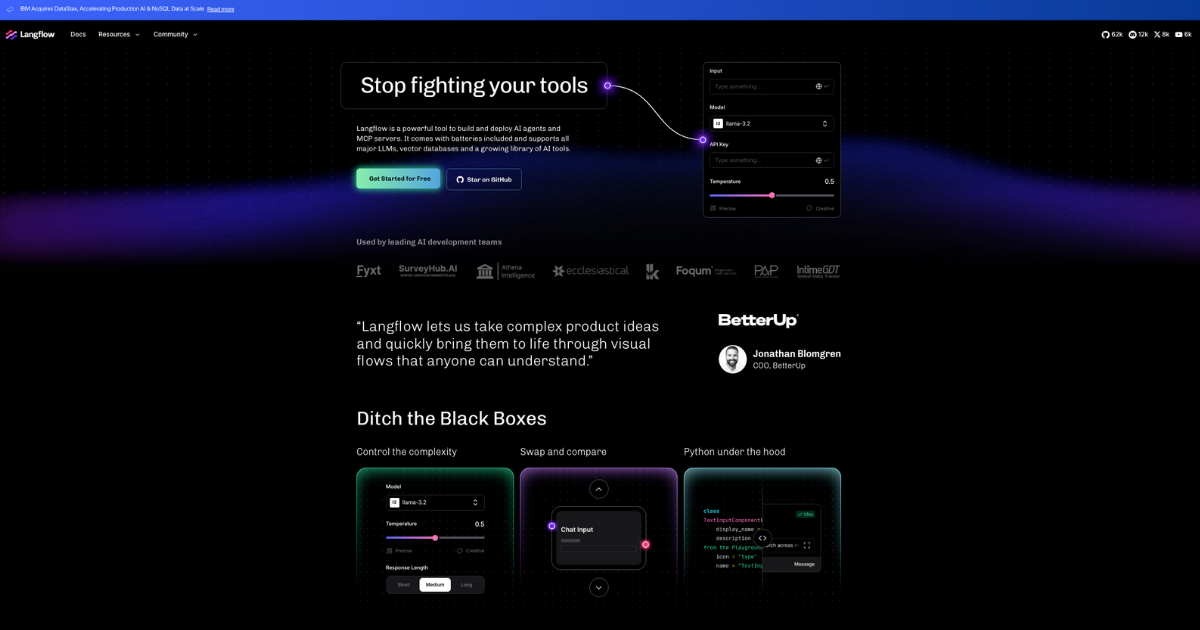
Langflow Product overview

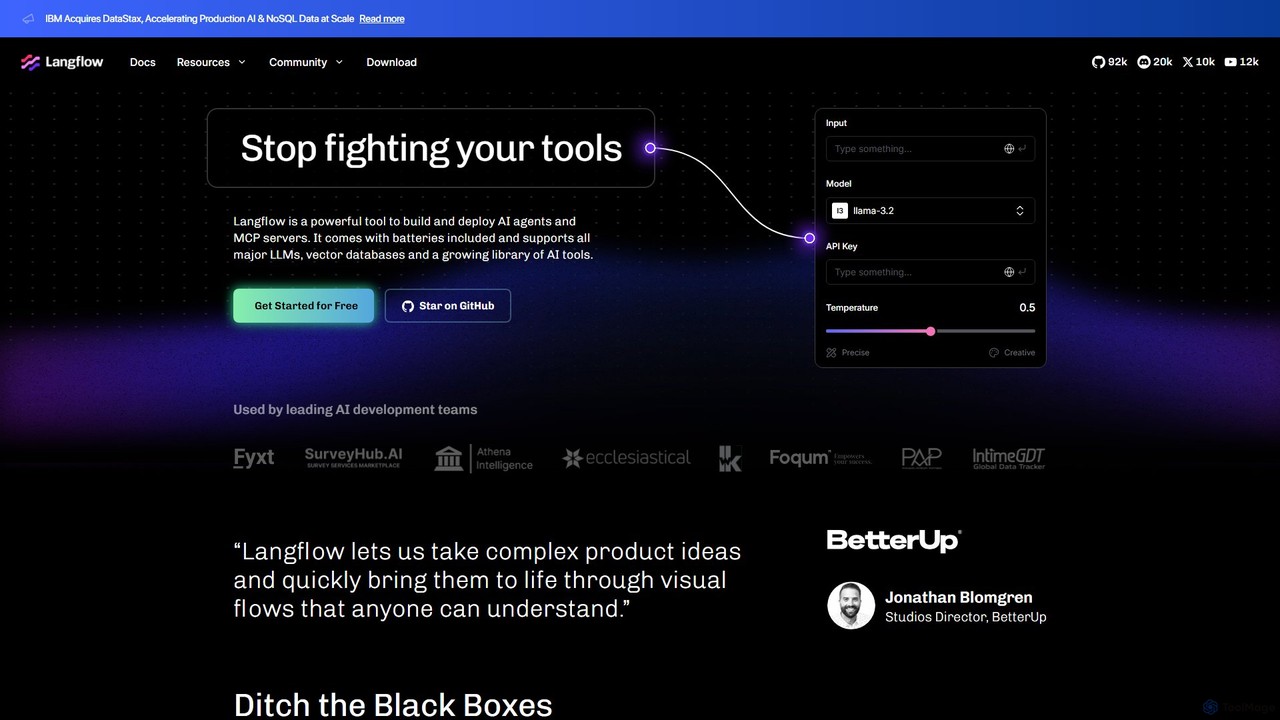
Langflow is an open-source, visual UI for building and deploying AI applications. It features a drag-and-drop interface to chain LLMs, agents, and tools, enabling rapid prototyping and deployment of complex workflows like RAG and multi-agent systems. It supports extensive integrations and offers both self-hosted and cloud options.

Preview

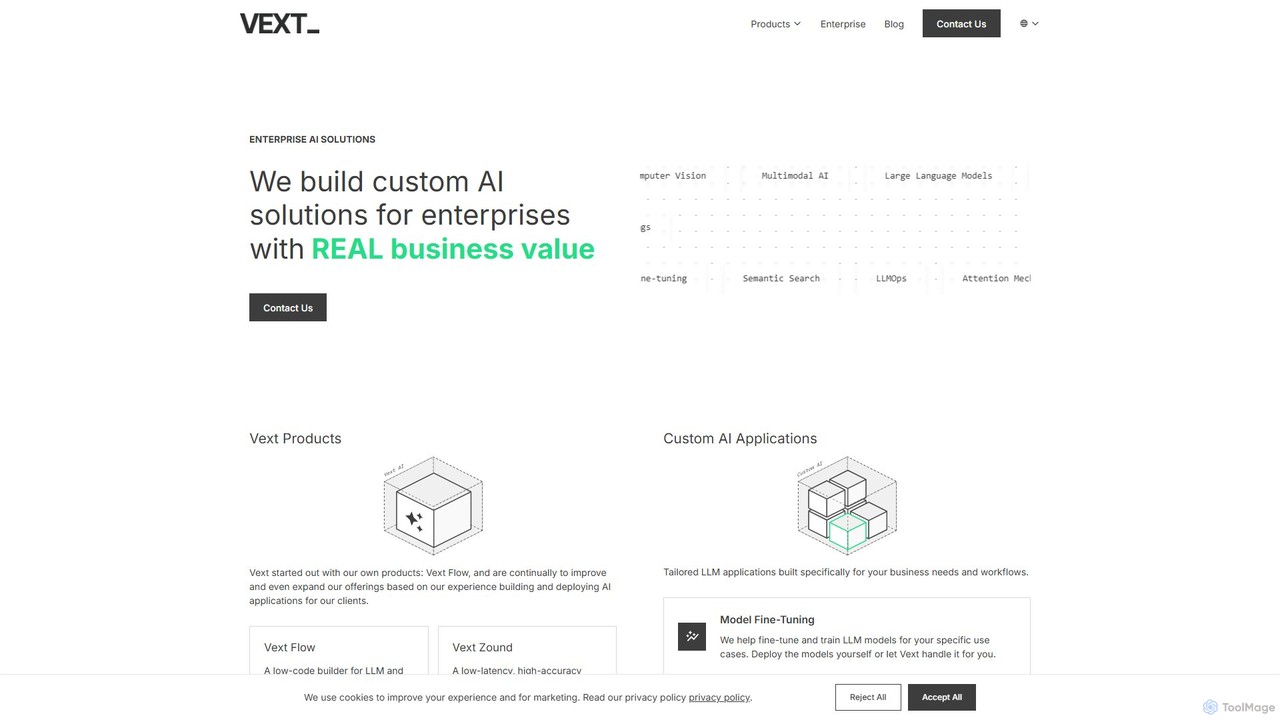
Vext Product overview

Vext is an enterprise AI solutions partner, offering custom AI application development, model fine-tuning, and managed hosting. It features Vext Flow, a low-code builder for creating and deploying LLM and agent workflows, and Vext Zound, a real-time AI subtitle and translation technology.

Preview

Quick facts

Compare product focus, pricing models and audiences. Highlighted rows indicate different listed information; unknown pricing does not mean free.

Langflow VS Vext — Quick facts
Quick factsLangflowVext
Pricing modelFreemiumFreemium
Product typeWebWeb
Primary focusLow Code No CodeAi Platform
Audience and rolesNo data availableNo data available
CategoriesLow Code No Code · Workflow AutomationAi Platform · Data Analysis · Low Code No Code · Workflow Automation
AddedAug 14, 2025Aug 12, 2025
UpdatedNov 19, 2026Nov 19, 2026

Features, usage and use cases

Explore the listed product descriptions, features and workflows. Taxonomy labels alone are not feature evaluations.

Langflow

Langflow is a powerful open-source framework designed to streamline the development and deployment of AI applications, particularly those leveraging Large Language Models (LLMs). It provides an intuitive, visual, graph-based user interface where developers can build, experiment with, and deploy complex AI workflows without getting bogged down in boilerplate code. By offering a drag-and-drop canvas, Langflow makes the intricate process of connecting models, data sources, and tools transparent and manageable.

The platform is built with flexibility in mind, catering to both beginners and expert developers. It allows for rapid iteration, enabling users to quickly swap components, compare different models like Llama 3 or GPT-4, and adjust parameters on the fly. This visual approach demystifies the 'black box' nature of AI development, making it easier to understand, debug, and optimize application logic. Langflow is not just a UI; it's a complete ecosystem for creating everything from simple chatbots to sophisticated multi-agent systems.

How to use Langflow

Getting started with Langflow is straightforward, offering paths for both local development and cloud deployment.

  1. Installation (Self-Hosted): For developers who prefer full control, Langflow can be installed locally via pip with a simple command: pip install langflow. Once installed, you can run it from your terminal and access the visual interface in your browser.
  2. Cloud Account: For a hassle-free experience, users can sign up for a free cloud account on the Langflow website. This provides an enterprise-grade, secure platform to build and deploy applications without managing infrastructure.
  3. Building a Flow: On the canvas, you can drag components from the extensive sidebar menu. These components include LLMs (from OpenAI, Anthropic, HuggingFace, etc.), vector stores (Pinecone, Weaviate, Qdrant), data loaders, and various tools (e.g., Serp API, Wikipedia).
  4. Connecting Components: Connect the output of one component to the input of another to create a logical flow. For example, you can connect a document loader to an embedding model, then to a vector store, and finally link it to an LLM for a Retrieval-Augmented Generation (RAG) setup.
  5. Customization with Python: For unique requirements, you can create custom components or modify existing ones using Python. This allows for limitless control and extensibility.
  6. Testing and Deployment: Test your workflow directly within the interface. Once satisfied, you can deploy the entire flow as a single API endpoint with just a few clicks, making it easy to integrate into your existing applications.

Core Features of Langflow

  • Visual Flow Builder: An intuitive drag-and-drop interface that simplifies the creation of complex AI application logic.
  • Extensive Integrations: A vast library of built-in components for major LLMs (OpenAI, Meta, Mistral, Anthropic), vector databases (Pinecone, Weaviate, Milvus), data sources (Google Drive, Notion, Github), and tools (Serp API, Zapier, Crew AI).
  • Agent and Multi-Agent Systems: Natively supports the creation and orchestration of single or multiple AI agents, allowing them to use components as tools to perform complex tasks.
  • Python Under the Hood: While it's a low-code platform, it provides full access to the underlying Python code. Users can customize anything and everything, ensuring no limitations on complexity.
  • Reusable Components and Flows: Save and share your components and entire workflows, fostering collaboration and accelerating development. Choose from hundreds of pre-built flows to get started.
  • One-Click API Deployment: Deploy your visual flows as production-ready API endpoints through the Langflow cloud platform.
  • Open-Source and Cloud Flexibility: Use the open-source version for complete control and self-hosting, or leverage the managed cloud platform for scalability and ease of use.

Use Cases for Langflow

Langflow is versatile and can be used to build a wide range of AI-powered solutions:

  • Retrieval-Augmented Generation (RAG): Quickly build and experiment with advanced RAG pipelines for question-answering systems over private data.
  • AI Agent Development: Design autonomous agents that can browse the web, perform searches, interact with APIs, and complete multi-step tasks.
  • Rapid Prototyping: Develop and test proof-of-concept AI applications in hours instead of weeks, allowing teams to validate ideas quickly.
  • Chatbot and Conversational AI: Create sophisticated chatbots with access to external knowledge bases and tools.
  • Automated Content Creation: Build workflows that generate reports, marketing copy, or code by chaining together different LLMs and data sources.
  • Educational Tool: An excellent resource for learning how LLM-based applications are structured and how different components interact.

Advantages of Langflow

Leading development teams choose Langflow for several key reasons:

  • Accelerated Development: The visual interface and reusable components significantly reduce development time and boilerplate code.
  • Enhanced Collaboration: Visual flows are easy for both technical and non-technical team members to understand, improving communication and collaboration.
  • Transparency and Control: Ditch the 'black box'. The visual graph provides a clear view of the application's state and logic, while Python customization offers deep control.
  • Flexibility: Seamlessly switch between different models, vector stores, or other components to find the optimal configuration for your application.
  • Scalability: From a local notebook to a production-grade cloud deployment, Langflow scales with your needs.

Pricing and Plans

Langflow operates on a freemium model, making it accessible to everyone.

  • Open Source (OSS): The core Langflow framework is completely free and open-source. You can download, modify, and self-host it on your own infrastructure without any cost.
  • Free Cloud Tier: Langflow offers a generous free cloud account that allows users to build, deploy, and scale applications on an enterprise-grade, secure platform. This is ideal for individual developers, startups, and for prototyping.
  • Enterprise/Paid Plans: For larger teams and more demanding applications, it is anticipated that Langflow will offer paid plans with advanced features, higher usage limits, dedicated support, and enhanced security. For the most up-to-date details, please visit the official Langflow website.

Vext

Vext positions itself as a comprehensive Enterprise AI Solutions Partner, dedicated to helping businesses integrate advanced AI capabilities at scale. The company's mission is to simplify AI transformation, making it accessible for teams regardless of their technical expertise. Vext offers a suite of products and custom services designed to deliver tangible business value, all while upholding the highest standards of security and compliance.

The core of Vext's offering revolves around building, deploying, and managing sophisticated AI systems. They cater to a wide range of needs, from hobbyist projects and prototypes to full-scale, mission-critical enterprise applications. Their services are built on a foundation of cutting-edge technologies, including Large Language Models (LLMs), Retrieval-Augmented Generation (RAG), AI Agents, Vector Databases, and Computer Vision.

How to use Vext

Interacting with Vext's platform and services can be done in several ways, depending on the user's needs:

  1. Vext Flow: For developers and teams looking to build their own AI workflows, Vext Flow provides an intuitive low-code/no-code interface. Users can visually drag and drop components to construct complex pipelines, such as a RAG system powered by vector storage, or a workflow that combines multiple LLMs and external data sources like internet searches. For those who prefer coding, Vext Flow also exposes robust API endpoints, allowing for deep integration and custom solutions. A simple API call can trigger a complex, pre-built workflow.
  2. Custom Enterprise Solutions: For businesses requiring tailored AI solutions, Vext offers a structured, four-step engagement process:
    Discovery: An initial consultation to understand business needs, challenges, and objectives.
    Prototype: A 1-2 week phase to create detailed specifications and system architecture.
    Build: A 3-6 week development cycle with rigorous testing and iterative feedback.
    Pilot & Production: Seamless deployment with comprehensive support and continuous maintenance.
  3. Contact Sales: To access services like model fine-tuning, managed hosting, or full application development, the primary method is to contact the Vext team directly to initiate the discovery process.

Core Features of Vext

  • Vext Flow: A production-ready, low-code builder for LLM and agent workflows. It allows users to create, customize, and deploy AI pipelines rapidly, supporting both codeless and code-based development.
  • Vext Zound: A low-latency, high-accuracy real-time AI subtitle technology. It provides speech-to-text and real-time translation capabilities, designed for seamless integration into various applications.
  • Custom AI Applications: End-to-end development of bespoke AI-powered applications tailored to specific business workflows, from system design to frontend and backend implementation.
  • Model Fine-Tuning: Specialized services to fine-tune and train LLMs on custom datasets for niche tasks like industry-specific sentiment analysis, classification, or specialized knowledge retrieval.
  • Managed Hosting: Secure, scalable, and reliable infrastructure for hosting AI models and applications, backed by a 99.9% uptime guarantee and enterprise-level support.
  • Custom LLM API Services: Design and development of custom API applications that wrap complex LLM logic into a single, easy-to-use interface for business integration.

Use Cases for Vext

Vext's technology can be applied across various industries and functions:

  • Enhanced Customer Support: Building sophisticated RAG-powered chatbots with Vext Flow that can query internal knowledge bases to provide accurate, context-aware answers to customer inquiries.
  • Internal Knowledge Management: Deploying a semantic search engine that allows employees to find information across company documents, wikis, and databases using natural language.
  • Content Creation and Automation: Creating automated workflows that generate marketing copy, reports, or summaries by combining different LLMs and data sources.
  • Global Communication: Integrating Vext Zound into video conferencing platforms or live events to provide real-time transcription and translation for a global audience.
  • Specialized Data Analysis: Fine-tuning an LLM to analyze industry-specific texts, such as legal documents, financial reports, or medical records, for sentiment analysis or data extraction.

Advantages of Vext

Vext offers several key advantages for businesses looking to adopt AI:

  • Enterprise-Grade Security: Vext is SOC2 Type II certified and GDPR-ready, ensuring data is handled with the highest standards of security and compliance. They also conduct regular third-party security audits.
  • Deployment Flexibility: Clients can choose between on-premises deployment or private cloud solutions, ensuring data sovereignty and meeting specific security requirements.
  • Speed and Scalability: The Vext Flow platform enables rapid prototyping and deployment of AI pipelines, significantly reducing development time. The infrastructure is built to scale from small projects to enterprise-level traffic.
  • Accessibility: With its dual low-code and API-driven approach, Vext empowers both non-technical users and seasoned developers to leverage the power of generative AI.
  • End-to-End Partnership: Vext acts as more than just a tool provider; they are a solutions partner that guides clients through the entire AI implementation lifecycle, from strategy to deployment and beyond.

Pricing and Plans

Vext employs a hybrid pricing model. Vext Flow is offered on a freemium basis, with a "Start for Free" option that allows users to explore its capabilities for hobby projects and prototypes. For more advanced use and enterprise features, paid plans are available. All other services, including Custom AI Applications, Model Fine-Tuning, and Managed Hosting, are priced on a custom basis. Interested parties are encouraged to contact the Vext sales team to discuss their specific requirements and receive a tailored quote.

Positioning

Their taxonomy shows where the products overlap and where each one has a more distinct focus. Unknown fields are shown explicitly and are never filled with assumptions.

Categories

Shared
Low Code No CodeWorkflow Automation
Only Langflow
No listed items
Only Vext
Ai PlatformData Analysis

Tags

Shared
AI agentllmlow-codeno-codeRAG
Only Langflow
APIdeveloper toolsmulti-agent systemsopen sourcevisual builderworkflow automation
Only Vext
AI orchestrationcustom AIenterprise AImodel fine-tuningSOC2speech to textvector databaseworkflow builder

Audience and roles

Shared
No listed items
Only Langflow
No listed items
Only Vext
No listed items

Traffic comparison

Traffic is shown on the same scale so differences in market visibility are not visually understated.

How to interpret the traffic data

Both charts share the same months and vertical scale. Each tool identifies its latest reporting month; missing months are left blank, not counted as zero. Regional and source visit counts are estimates calculated from the reported shares.

Langflow monthly traffic:

Latest traffic · 2026-05

Monthly visits
243.6K
Avg. visit duration
1:09
Pages per visit
1.95
Bounce rate
44.67%
Data updated 2026-06-15

Monthly traffic trend

  • 2025-09: 454.9K
  • 2026-01: 269.8K
  • 2026-02: 226.5K
  • 2026-03: 239.5K
  • 2026-04: 229.4K
  • 2026-05: 243.6K

Top regions

Top 5 countries/regions
Country/regionPercentageEstimated visits
🇨🇳China42.24%102.9K
🇮🇳India18.05%44K
🇺🇸United States16.88%41.1K
🇮🇩Indonesia16.72%40.7K
🇬🇧United Kingdom6.11%14.9K

Traffic sources

Source typePercentageEstimated visits
Direct78.32%190.8K
Referral20.42%49.7K
Email1.26%3.1K

Search keywords

composiolangflowlangfuseopenrouterpdf to markdown

Vext

No data available

Community signals

Ratings, comments, favorites, and likes are community signals—not a substitute for product fit.

Langflow

Rating
No data available
Comments
0
Favorites
139
Likes
141

Vext

Rating
No data available
Comments
0
Favorites
135
Likes
123

Langflow vs Vext · Comparison FAQ

What do Langflow and Vext have in common?
Both tools are listed under Low Code No Code、Workflow Automation. These categories indicate overlapping use cases; compare their detailed descriptions for workflows, capabilities and limitations.
Are Langflow and Vext free?
Listed pricing models: Langflow — Freemium; Vext — Freemium. Missing pricing is not proof of a free plan, and freemium does not mean every feature is free. Check official sites for current plans, limits and trials.
How should I choose between Langflow and Vext?
The primary listed category is Low Code No Code for Langflow, and Ai Platform for Vext. Compare features, steps and use cases, then verify pricing, data permissions and deployment needs. This page does not include hands-on testing and does not declare a winner from traffic or tags.

Sources and comparison methodology

This page is assembled from ToolMage product listings, taxonomy, traffic statistics and on-site user feedback. It is not a hands-on test or an independent review.

  • Feature and plan descriptions reflect information in the listings, not real-time guarantees. Verify pricing, quotas, availability and privacy terms on the official sites.
  • Traffic uses the reporting months shown. Missing statistics do not mean zero visits, and different periods do not establish growth or superiority. Regional and source visit counts are estimates based on shares.
  • Different tags indicate differences in the listings, not proof that the other product lacks a capability. Ratings, favorites and visits are not used to declare a winner.

Related comparisons