ToolMage
Sign in

AI TOOL COMPARISON

Openlayer vs Truefoundry

What is the difference, and which fits your workflow? Compare features, usage, pricing models and traffic side by side.

Jump to key differences

Product overview

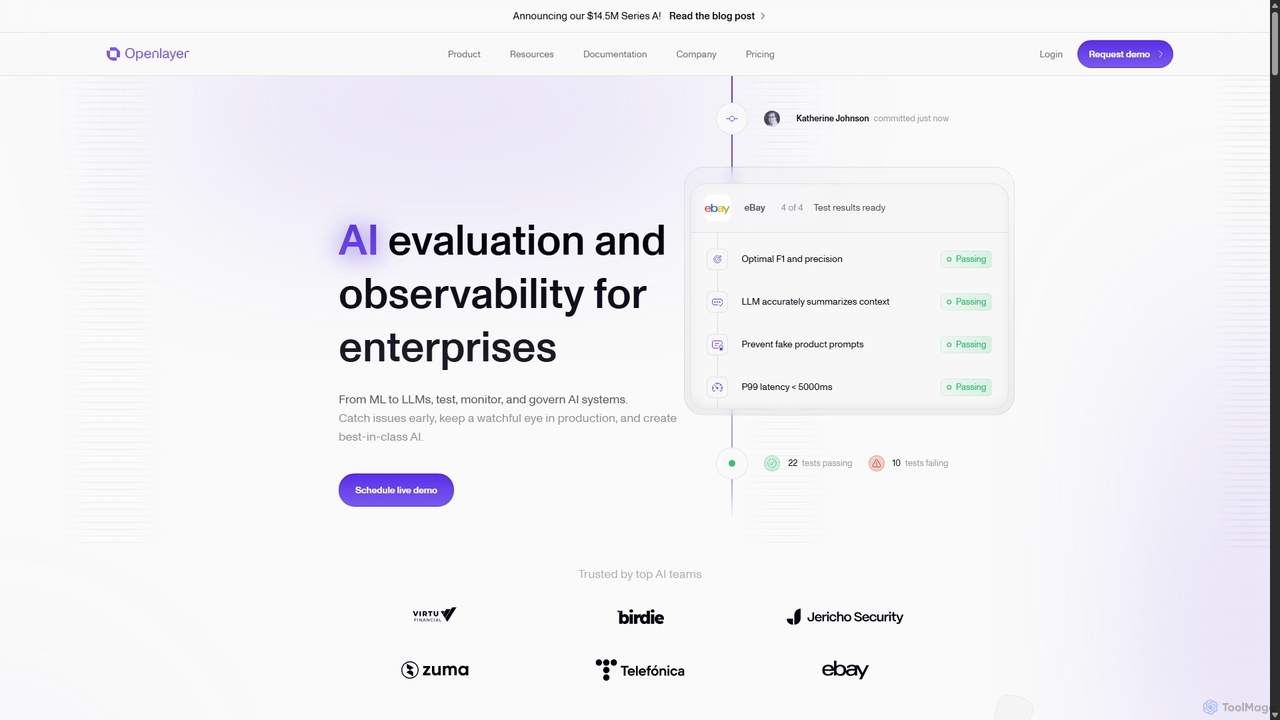
Openlayer Product overview

Openlayer is an enterprise-grade platform for AI evaluation and observability. It empowers teams to test, monitor, and govern both traditional machine learning models and large language models (LLMs) throughout their entire lifecycle, from development to production, ensuring reliability and compliance.

Preview

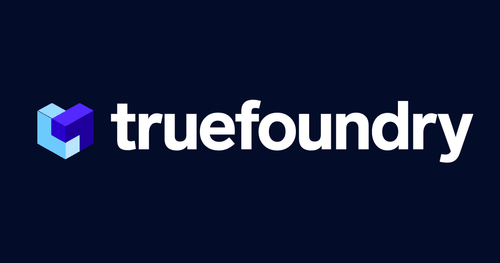
Truefoundry Product overview

Truefoundry is an enterprise-ready platform for deploying, managing, and scaling agentic AI applications. It provides a unified AI Gateway to orchestrate complex AI workflows, manage models, and ensure security, governance, and observability. Designed for developers and MLOps teams, it supports on-premise, cloud, and hybrid deployments, optimizing GPU utilization and accelerating time-to-production.

Preview

Quick facts

Compare product focus, pricing models and audiences. Highlighted rows indicate different listed information; unknown pricing does not mean free.

Openlayer VS Truefoundry — Quick facts
Quick factsOpenlayerTruefoundry
Pricing modelFreemiumFreemium
Product typeWebWeb
Primary focusAnalyticsCloud Computing
Audience and rolesAI Developer · AI Researcher · CTO · Data Scientist · DevOps Engineer · Machine Learning Engineer · MLOps Engineer · Product ManagerCTO · Data Scientist · DevOps Engineer · IT Manager · Machine Learning Engineer · MLOps Engineer · Product Manager · Software Developer
CategoriesAnalytics · Machine Learning · Testing · MonitoringCloud Computing · Machine Learning · Infrastructure · Mlops
AddedSep 14, 2025Dec 10, 2025
UpdatedNov 19, 2026Nov 19, 2026

Features, usage and use cases

Explore the listed product descriptions, features and workflows. Taxonomy labels alone are not feature evaluations.

Openlayer

Openlayer is a comprehensive platform designed to bring reliability, transparency, and trust to AI systems. In an era where AI is transforming industries, Openlayer addresses the critical challenge of inconsistent performance and the lack of robust testing. It provides a unified environment for AI teams to confidently develop, deploy, and monitor their systems, whether they are complex machine learning models or sophisticated LLM-based applications. The platform streamlines the entire AI lifecycle, enabling teams to catch issues early, prevent regressions in production, and build best-in-class AI that is both dependable and impactful.

How to use Openlayer

Integrating Openlayer into your workflow is designed to be seamless. The process typically follows these steps:

  1. Integration: Connect Openlayer to your existing development environment. This can be done through its Git integrations, language-specific SDKs (like Python and TypeScript), a powerful Command-Line Interface (CLI), or its comprehensive REST APIs.
  2. Project Setup: Create a new project in Openlayer. You can start from scratch or accelerate the process by using one of the many pre-configured templates for common AI patterns, such as RAG pipelines, chatbots, or churn prediction models.
  3. Define Tests: Configure a suite of tests to evaluate your AI system's performance, integrity, and safety. Openlayer offers an expansive library of customizable tests, covering aspects like data drift, PII leakage, response harmfulness, answer relevancy, and latency.
  4. Development & Testing: As you commit new versions of your AI system, Openlayer automatically runs the defined tests, providing immediate feedback within your CI/CD pipeline. This allows you to catch regressions and bugs before they reach production.
  5. Deployment & Monitoring: Once deployed, Openlayer's observability features take over. It tracks and traces all production requests in real-time, monitoring key metrics like cost, latency, token usage, and data quality.
  6. Analysis & Iteration: Use the platform's dashboards to analyze performance, debug error cases, and gather insights from human feedback annotations. Set up alerts to be notified of anomalies or failing tests, allowing your team to fix issues within minutes and continuously improve the AI system.

Core Features of Openlayer

  • AI System Testing & Evaluation: A vast library of customizable tests to systematically evaluate models and applications against performance, fairness, security, and robustness metrics.
  • Production Monitoring & Observability: Real-time tracing and tracking of all system requests, with detailed monitoring of cost, latency, tokens, and data quality. Includes alerting and annotation features.
  • Governance & Compliance: Tools to help align AI systems with major industry standards and regulations, such as ISO/IEC 42001, OWASP, NIST, and the EU AI Act, simplifying the governance process.
  • Automated Data Quality Checks: Automatically connect to data pipelines to test for schema changes, drift, and anomalies, ensuring bad data doesn't compromise model performance.
  • Seamless Workflow Integration: Deep integrations with Git, SDKs for Python and TypeScript, a full-featured CLI, and REST APIs allow Openlayer to fit into any MLOps or LLMOps workflow without friction.
  • Team Collaboration: A shared workspace where team members can collaborate on defining tests, debugging issues, and assigning roles, ensuring all stakeholders are aligned.
  • Project Templates: A collection of pre-configured sample projects for common AI use cases (e.g., RAG, PDF Extraction, Chatbots) to help teams get started in seconds.

Use Cases for Openlayer

Openlayer is versatile and trusted by teams across various industries:

  • E-commerce: Monitoring recommendation engines for drift, testing chatbots for response quality, and ensuring pricing models are accurate and fair.
  • Cybersecurity: Validating that AI-generated phishing messages do not reveal their origin, and monitoring fraud detection models for low false-positive rates.
  • Recruiting & HR: Ensuring resume processing pipelines accurately extract information and that AI-powered screening tools are free from bias.
  • Travel & Tourism: Monitoring dynamic pricing models and ensuring personalized travel recommendation systems provide relevant and diverse suggestions.
  • Fintech: Evaluating credit scoring models for fairness and accuracy, and monitoring transaction fraud detection systems in real-time.

Advantages of Openlayer

By using Openlayer, AI teams gain significant advantages:

  • Ship with Confidence: A robust testing framework prevents regressions and ensures new deployments are reliable.
  • Accelerated Development: Teams see a significant increase in deployment frequency and throughput by automating the evaluation process.
  • Proactive Issue Resolution: Real-time monitoring and alerting allow teams to detect and fix production issues before they impact users.
  • Simplified Compliance: Effortlessly align with global AI standards and regulations, reducing legal and reputational risk.
  • Improved Model Performance: Powerful debugging and error analysis tools help data scientists pinpoint and fix the root causes of model failures, leading to continuous improvement.

Pricing and Plans

Openlayer offers a flexible pricing structure to accommodate teams of all sizes:

  • Basic Plan: A free-to-start tier perfect for individuals and small teams. It includes access for 1 member, 5 projects, 20,000 inferences per month, the full AI test library, observability features, CLI/SDK/API access, and community support.
  • Enterprise Plan: A custom plan tailored for larger businesses with advanced needs. It includes all features of the Basic plan plus unlimited members and projects, custom inference volumes, team access controls, on-premise deployment options, SAML SSO, a 99.99% SLA, white-glove onboarding, and advanced support. Pricing is available upon contacting sales.

Truefoundry

Truefoundry is a comprehensive, enterprise-grade platform designed to govern, deploy, scale, and trace Agentic AI applications. It serves as a unified control plane for the entire AI/ML lifecycle, from experimentation to production. The platform is built to run in any environment, including on-premise, VPC, air-gapped, or multi-cloud setups, ensuring complete data sovereignty. It empowers organizations to accelerate AI adoption securely and efficiently by providing robust tools for MLOps, LLMops, and infrastructure management.

How to use Truefoundry

1. Register for an account on the Truefoundry website. You will receive a unique URL for your organization (e.g., your-company.truefoundry.cloud).
2. Activate your account via the confirmation email to log in.
3. Utilize the AI Gateway to connect and manage various LLMs through a single, unified API endpoint.
4. Deploy any AI model, including LLMs, embedding models, or custom models, using high-performance backends.
5. Use the platform to fine-tune models on your own data and deploy them directly to production.
6. Configure and enforce governance policies, such as role-based access control (RBAC), rate limits, and cost budgets.
7. Monitor every aspect of your AI stack, from prompt execution and token usage to GPU performance, using the integrated observability dashboards.

Core Features of Truefoundry

  • AI Gateway: A centralized gateway to manage, route, and secure all LLM requests with features like load balancing, fallbacks, semantic caching, and rate limiting.
  • Agentic AI Orchestration: Enables intelligent multi-step reasoning, tool usage, and memory for complex AI agents and workflows.
  • Model Deployment & Serving: Host any open-source or custom AI model with optimized backends like vLLM and TGI. Supports frameworks like Langgraph, CrewAI, and AutoGen.
  • LLM Finetuning: A streamlined workflow to launch fine-tuning jobs, track experiments, and deploy updated models.
  • Enterprise Governance & Security: Features granular RBAC, SSO, immutable audit logs, and real-time policy enforcement. Compliant with SOC 2, HIPAA, and GDPR standards.
  • Comprehensive Observability: Provides full-stack tracing from prompt execution to GPU performance, with integrations for Grafana, Datadog, and Prometheus.
  • Automated Infrastructure Optimization: Automatically manages GPU orchestration, autoscaling, and fractional GPU support to maximize utilization and reduce cloud costs.

Use Cases for Truefoundry

For MLOps and DevOps Teams: Streamlining the deployment, scaling, and monitoring of ML models, reducing DevOps burden and infrastructure overhead.
For Enterprise AI Platforms: Building a centralized, secure, and governed AI infrastructure to enable safe AI experimentation and productionization across the organization.
For Data Science Teams: Accelerating the transition from model experimentation to production-ready services, with integrated tools for fine-tuning and deployment.
For AI Application Developers: Building and deploying complex RAG and agentic applications faster with a managed, production-ready stack.

Advantages of Truefoundry

Accelerated Time-to-Value: Reduces model deployment timelines by over 60% and time-to-production for models by up to 80%.
Significant Cost Reduction: Lowers cloud spend by 40-50% through automated infrastructure rightsizing and up to 80% higher GPU cluster utilization.
Unified Control & Governance: Provides a single platform to manage security, observability, and policies across all AI models and clouds.
Deployment Flexibility: Offers complete sovereignty with support for on-premise, VPC, air-gapped, and multi-cloud deployments.
High Performance: The AI Gateway is designed for low latency (adding only ~3ms) and high throughput (350+ RPS on 1 vCPU), ensuring a responsive user experience.

Pricing and Plans

Truefoundry offers flexible plans designed for different team sizes and needs:
- Developer Plan: $0/month. Includes 50k requests per month and support for up to 3 users. Ideal for individuals and early-stage experimentation.
- Pro Plan: $499/month. Includes 1 million requests per month and support for up to 10 users. Unlocks advanced features like semantic caching, advanced routing, and higher limits.
- Enterprise Plan: Custom pricing. Designed for large organizations with needs for custom request volumes, advanced security (SSO, GDPR, HIPAA), on-premise/VPC deployment, and enterprise-grade SLAs.

Positioning

Their taxonomy shows where the products overlap and where each one has a more distinct focus. Unknown fields are shown explicitly and are never filled with assumptions.

Categories

Shared
Machine Learning
Only Openlayer
AnalyticsTestingMonitoring
Only Truefoundry
Cloud ComputingInfrastructureMlops

Tags

Shared
MLOps
Only Openlayer
AI evaluationAI governanceAI observabilityai testingcompliancedata driftLLMOpsmachine learning testingmodel monitoringmodel performanceRAG evaluation
Only Truefoundry
agentic AIAI Gatewaycloud managemententerprise AIfine-tuninggovernanceGPU optimizationllmmodel deploymentobservability

Audience and roles

Shared
CTOData ScientistDevOps EngineerMachine Learning EngineerMLOps EngineerProduct Manager
Only Openlayer
AI DeveloperAI Researcher
Only Truefoundry
IT ManagerSoftware Developer

Traffic comparison

Traffic is shown on the same scale so differences in market visibility are not visually understated.

How to interpret the traffic data

Both charts share the same months and vertical scale. Each tool identifies its latest reporting month; missing months are left blank, not counted as zero. Regional and source visit counts are estimates calculated from the reported shares.

Openlayer monthly traffic:

Latest traffic · 2026-05

Monthly visits
24.3K
Avg. visit duration
0:44
Pages per visit
1.86
Bounce rate
42.49%
Data updated 2026-06-15

Monthly traffic trend

  • 2025-09: 18.6K
  • 2026-01: 10.8K
  • 2026-02: 9.8K
  • 2026-03: 20.1K
  • 2026-04: 24.3K
  • 2026-05: 24.3K

Top regions

Top 5 countries/regions
Country/regionPercentageEstimated visits
🇺🇸United States38.9%9.4K
🇳🇬Nigeria22.13%5.4K
🇮🇳India20.93%5.1K
🇩🇪Germany9.78%2.4K
🇧🇷Brazil8.26%2K

Search keywords

best multi agent architecture system that self codescoding benchamrk 2026ks score meaningopenlayeroptimality of bce for binary classification

Truefoundry monthly traffic:

Latest traffic · 2026-05

Monthly visits
200.9K
Avg. visit duration
0:44
Pages per visit
1.99
Bounce rate
43.09%
Data updated 2026-06-15

Monthly traffic trend

  • 2025-09: No data available
  • 2026-01: 81.2K
  • 2026-02: 89.7K
  • 2026-03: 141.7K
  • 2026-04: 173.6K
  • 2026-05: 200.9K

Top regions

Top 5 countries/regions
Country/regionPercentageEstimated visits
🇮🇳India39.73%79.8K
🇺🇸United States35.03%70.4K
🇩🇪Germany9.15%18.4K
🇻🇳Vietnam8.16%16.4K
🇬🇧United Kingdom7.93%15.9K

Traffic sources

Source typePercentageEstimated visits
Direct64.74%130.1K
Referral33.08%66.5K
Email2.18%4.4K

Search keywords

claude dangerously skip permissionstruefoundarytrue foundrytruefoundryvercel pricing

Community signals

Ratings, comments, favorites, and likes are community signals—not a substitute for product fit.

Openlayer

Rating
No data available
Comments
0
Favorites
215
Likes
231

Truefoundry

Rating
No data available
Comments
0
Favorites
131
Likes
139

Openlayer vs Truefoundry · Comparison FAQ

What do Openlayer and Truefoundry have in common?
Both tools are listed under Machine Learning. These categories indicate overlapping use cases; compare their detailed descriptions for workflows, capabilities and limitations.
Are Openlayer and Truefoundry free?
Listed pricing models: Openlayer — Freemium; Truefoundry — Freemium. Missing pricing is not proof of a free plan, and freemium does not mean every feature is free. Check official sites for current plans, limits and trials.
How should I choose between Openlayer and Truefoundry?
The primary listed category is Analytics for Openlayer, and Cloud Computing for Truefoundry. Compare features, steps and use cases, then verify pricing, data permissions and deployment needs. This page does not include hands-on testing and does not declare a winner from traffic or tags.

Truefoundry · Comparison FAQ

What happens if I exceed the request limits on my plan?

If you exceed your plan's limits, you will be billed for additional usage. For the Pro plan, additional capacity can be purchased, for example, at a rate of $499 per month for an extra 2 million requests and 5 API keys.

Does Truefoundry support on-premise or VPC deployments?

Yes, the Enterprise plan supports full VPC and air-gapped installations for both the control plane and gateway planes, ensuring your data and models remain within your infrastructure.

What are the different deployment options available?

Truefoundry offers several deployment options: 1. Fully managed SaaS AI Gateway. 2. SaaS AI Gateway with data storage on your own infrastructure. 3. Self-hosted Gateway Plane only. 4. Self-hosted Control Plane and Gateway Plane for maximum control.

Are there additional infrastructure costs for self-hosting?

If you use the fully managed SaaS version, there are no hosting costs. For self-hosted options (Gateway or Control Plane), you will incur infrastructure costs, which are typically around $600–$1,000 per month.

What compliance standards does Truefoundry meet?

The Truefoundry platform is built to meet high security and compliance standards, including SOC 2, HIPAA, and GDPR, making it suitable for enterprise use cases with strict data protection requirements.

Sources and comparison methodology

This page is assembled from ToolMage product listings, taxonomy, traffic statistics and on-site user feedback. It is not a hands-on test or an independent review.
  • Feature and plan descriptions reflect information in the listings, not real-time guarantees. Verify pricing, quotas, availability and privacy terms on the official sites.
  • Traffic uses the reporting months shown. Missing statistics do not mean zero visits, and different periods do not establish growth or superiority. Regional and source visit counts are estimates based on shares.
  • Different tags indicate differences in the listings, not proof that the other product lacks a capability. Ratings, favorites and visits are not used to declare a winner.

Related comparisons