ToolMage
Sign in

AI TOOL COMPARISON

ParseHub vs webscrapeai

What is the difference, and which fits your workflow? Compare features, usage, pricing models and traffic side by side.

Jump to key differences

Product overview

ParseHub Product overview

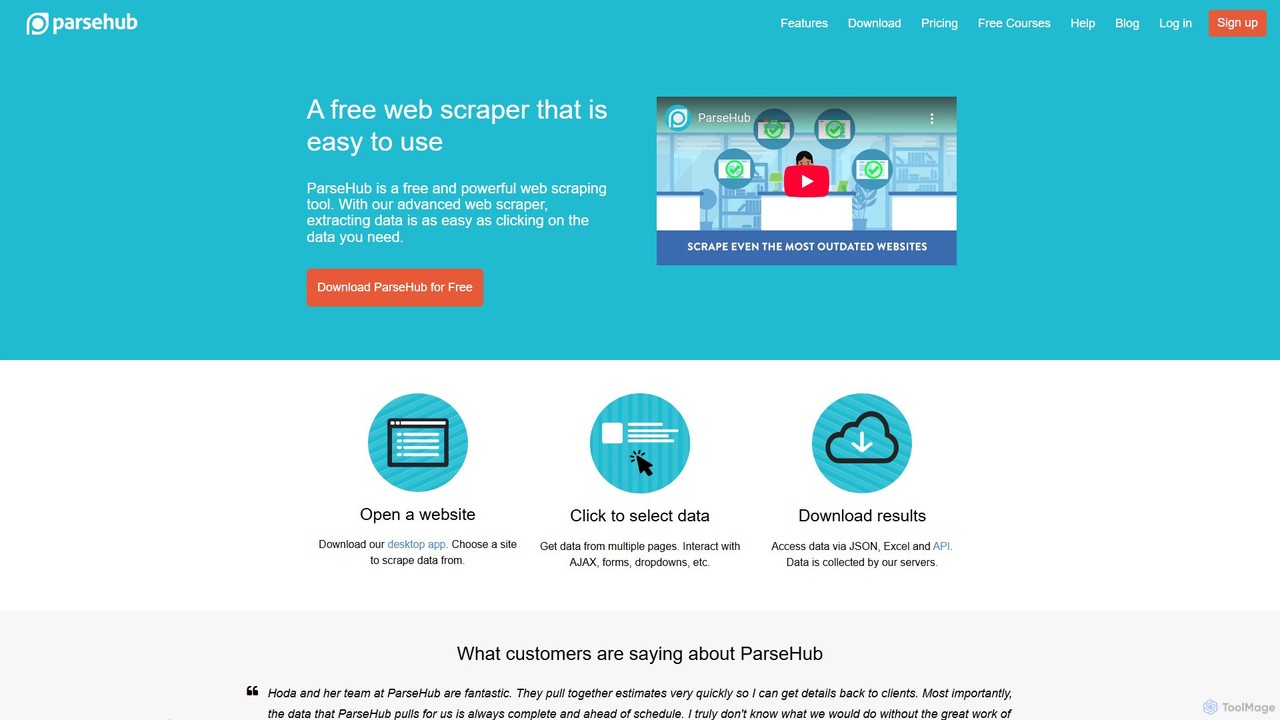
ParseHub is a powerful, no-code web scraping tool that allows users to extract data from any website with a simple point-and-click interface. It's designed to handle complex, dynamic sites with JavaScript, AJAX, forms, and infinite scroll. Data can be collected on a schedule, exported as JSON/Excel, or accessed via API, making it ideal for lead generation, market research, and data aggregation.

Preview

webscrapeai Product overview

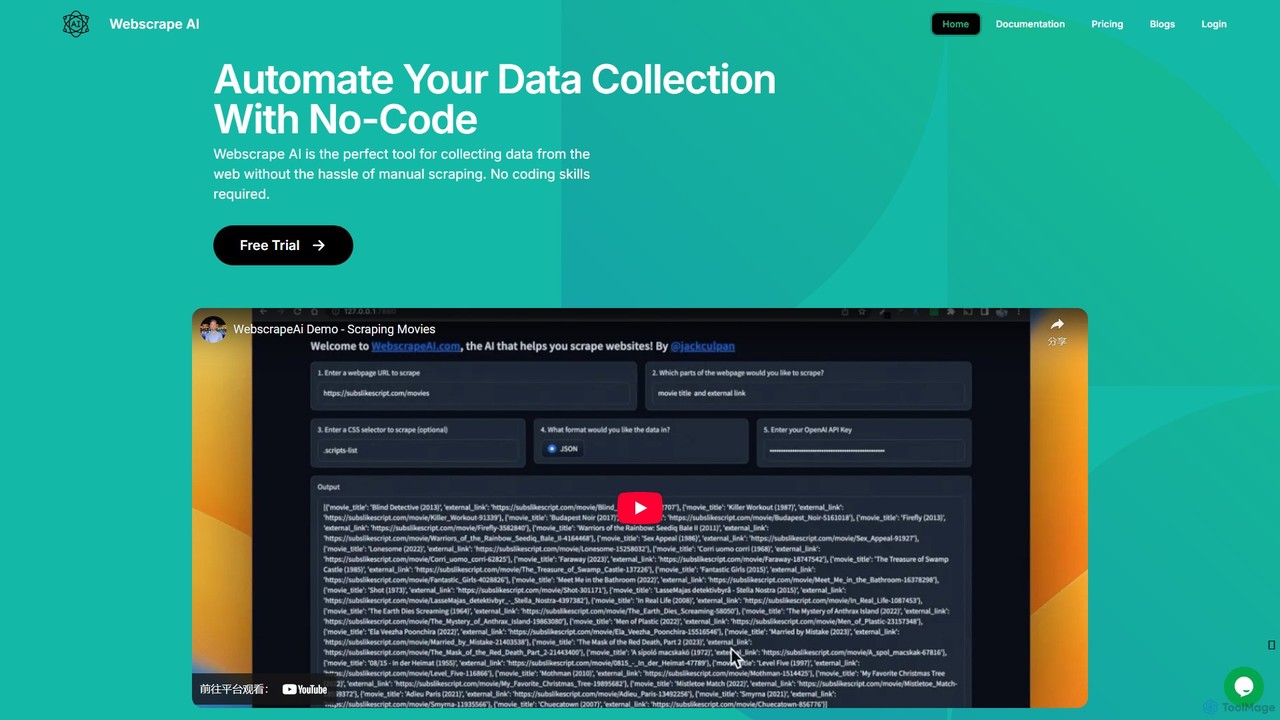
WebscrapeAI is a no-code, AI-powered platform designed to automate web data collection. Simply provide a URL and specify the data you need, and the AI handles the entire scraping process. It supports dynamic websites, bulk scraping, proxy integration, and offers an API for developers, making data extraction fast, accurate, and accessible to everyone.

Preview

Quick facts

Compare product focus, pricing models and audiences. Highlighted rows indicate different listed information; unknown pricing does not mean free.

ParseHub VS webscrapeai — Quick facts
Quick factsParseHubwebscrapeai
Pricing modelFreemiumFreemium
Product typeAppWeb
Primary focusWeb ScrapingWeb Scraping
Audience and rolesNo data availableNo data available
CategoriesWeb Scraping · Data Extraction · Lead Generation · AutomationWeb Scraping · Api · Lead Generation · Automation
AddedAug 6, 2025Aug 11, 2025
UpdatedNov 19, 2026Nov 19, 2026

Features, usage and use cases

Explore the listed product descriptions, features and workflows. Taxonomy labels alone are not feature evaluations.

ParseHub

ParseHub is a free and powerful web scraping tool designed to make data extraction from the web accessible to everyone, regardless of their coding skills. With its advanced visual interface, extracting data is as simple as clicking on the information you need. It's a robust solution for anyone from data scientists and marketers to developers and e-commerce specialists who need to gather data from the web efficiently.

The tool is particularly adept at handling modern, complex websites. It can navigate through interactive elements like forms, dropdown menus, logins, and maps. It also seamlessly manages sites with infinite scroll, tabs, and pop-ups, which are often challenging for other scrapers. ParseHub's machine learning relationship engine intelligently analyzes the page structure, understands the hierarchy of elements, and pulls the desired data in seconds, eliminating the need for manual data entry or complex scriptwriting.

How to use ParseHub

Getting started with ParseHub is a straightforward, three-step process:

  1. Download and Install: First, download the free ParseHub desktop application for your operating system and install it.
  2. Select Data: Open the application, enter the URL of the website you want to scrape. Once the site loads, simply click on the data fields you wish to extract. ParseHub's selection tool will intelligently identify similar elements to capture data from multiple items on a page. You can train it to handle pagination to scrape multiple pages, interact with forms to submit search queries, and much more.
  3. Run and Download: Once your project is configured, you can run the scrape. The data is collected on ParseHub's cloud servers, which means you can close the app while it works. After the run is complete, you can access the extracted data via the API or download it in various formats, including Excel and JSON, ready for analysis or integration into other systems.

Core Features of ParseHub

  • No-Code Interface: A user-friendly, graphical interface that allows you to build scrapers by simply clicking on elements.
  • Dynamic Website Handling: Capable of scraping data from sites that use JavaScript, AJAX, cookies, and redirects. It can handle logins, pop-ups, dropdowns, and more.
  • Cloud-Based Scraping: All data extraction happens on ParseHub's servers, freeing up your local computer's resources.
  • Scheduled Collection: Set your projects to run automatically on a daily, weekly, or custom schedule to get the latest data.
  • IP Rotation: Automatically rotates through a large pool of IP addresses to prevent being blocked while scraping.
  • Powerful Data Cleaning: Use Regular Expressions (RegEx) to clean and format text and HTML directly within the app before downloading.
  • API and Integrations: Access your data programmatically with a REST API and use webhooks for real-time notifications. It also integrates with Google Sheets, Tableau, and Dropbox.
  • Flexible Data Export: Download your scraped data in JSON, CSV, and Excel formats for easy analysis and use in other applications.

Use Cases for ParseHub

ParseHub is a versatile tool used across various industries:

  • E-commerce: Scrape product details, prices, ratings, and reviews from competitor websites for price monitoring and market analysis.
  • Lead Generation: Extract contact information from online directories, professional networks, and communities to build sales funnels.
  • Market Research: Aggregate data for industry analysis, competitor tracking, and identifying market trends.
  • Data Journalism & Academia: Collect large datasets from public sources for research projects, reports, and data-driven stories.
  • Content Aggregation: Gather articles, news, and posts from multiple websites to power a news aggregator or content platform.
  • Real Estate: Scrape property listings, prices, and agent details from real estate websites.

Advantages of ParseHub

ParseHub stands out for several key reasons. Its primary advantage is its **ease of use**, which democratizes web scraping by removing the coding barrier. The **power and flexibility** to handle any interactive website make it a reliable tool for complex tasks. Being **cloud-based and scalable**, it can handle projects of any size, from a few pages to millions, without requiring users to manage any infrastructure. This saves significant time and resources, allowing users to focus on analyzing data rather than collecting it.

Pricing and Plans

ParseHub offers a range of plans to suit different needs:

  • Free Plan: Ideal for small projects and learning. It includes 200 pages per run, 5 public projects, and 14-day data retention.
  • Standard Plan ($189/month): Designed for professionals. It offers 10,000 pages per run, 20 private projects, IP rotation, and scheduled scraping.
  • Professional Plan ($599/month): For heavy-duty scraping. It includes unlimited pages per run, 120 private projects, priority support, and 30-day data retention.
  • ParseHub Plus (Enterprise): A custom plan for businesses with large-scale data needs, offering dedicated support, custom features, and expert assistance in setting up scraping projects.

Discounts are available for non-profits, students, and academic institutions. All prices are in USD.

webscrapeai

WebscrapeAI is a powerful and intuitive tool designed to revolutionize the way users collect data from the web. By leveraging advanced artificial intelligence, it offers a completely no-code solution for web scraping, making it accessible to businesses, researchers, and individuals regardless of their technical skills. The platform is built to handle the complexities of modern websites, automating the data extraction process to save you time and effort.

The core principle of WebscrapeAI is simplicity. Users can start scraping in just a few steps without writing a single line of code. The AI-driven engine intelligently analyzes website structures to identify and extract the requested data with high accuracy. Whether you need to scrape a single page or thousands of URLs in bulk, WebscrapeAI provides a scalable and cost-effective solution.

How to use webscrapeai

Using WebscrapeAI is a streamlined process designed for efficiency and ease of use:

  1. Enter URL: Start by providing the exact URL of the website you wish to scrape.
  2. Specify Data Requirements: Use a simple, command-line-like input to tell the AI what data you want to extract (e.g., "I want to extract all the product names, prices, and ratings").
  3. Generate Schema: The AI will analyze the website and automatically generate a data schema based on your command. You can review and modify this schema manually if needed to ensure it matches your requirements perfectly.
  4. Run the Scraper: Once the schema is confirmed, click the "Run Web Scraper" button. The AI model will then begin the extraction process. For advanced plans, you can configure settings like proxies, custom headers, and JavaScript instructions (e.g., to click buttons, scroll, or wait for elements to load) before running.
  5. Download Data: After the scraping is complete, you can download the extracted data in your preferred format, including CSV, JSON, or plain Text.
  6. API Integration: For developers, WebscrapeAI offers a REST API. By making an HTTP request with your API key, URL, and data command, you can integrate automated scraping directly into your applications.

Core Features of webscrapeai

  • AI-Powered Scraping: Utilizes advanced AI to understand website structures and extract data based on natural language commands, eliminating the need for manual selector configuration.
  • No-Code Interface: A user-friendly platform that requires no programming skills to operate.
  • Bulk Scraping: The Bulk plan allows users to scrape data from multiple URLs simultaneously, ideal for large-scale data collection projects.
  • Dynamic Website Handling: Pro and Bulk plans support JavaScript execution, allowing the scraper to interact with dynamic pages, click buttons, handle infinite scroll, and wait for content to load.
  • Proxy Support: Users can integrate their own proxies to manage their IP footprint, avoid blocks, and access geo-restricted content.
  • Custom Headers: Set custom request headers (e.g., User-Agent) to mimic real browser behavior and gain access to specific website versions.
  • Multiple Export Formats: Export collected data as CSV for spreadsheets, JSON for applications, or simple Text.
  • Developer API: A robust API is available for integrating WebscrapeAI's capabilities into custom applications and workflows.
  • Pagination Support: Automatically handles scraping data across multiple pages.

Use Cases for webscrapeai

WebscrapeAI is versatile and can be applied across various industries:

  • Market Research: Collect competitor pricing, product details, and customer reviews to analyze market trends and strategies.
  • Lead Generation: Extract contact information (emails, phone numbers, social profiles) from business directories and professional networks.
  • E-commerce: Monitor product prices, stock availability, and new arrivals on e-commerce sites like Amazon.
  • Content Aggregation: Gather articles, news, and posts from various sources for a content hub or news aggregator.
  • Financial Analysis: Scrape stock market data, financial statements, and real estate listings for analysis and investment decisions.
  • Academic Research: Collect large datasets from online sources for scientific studies and social science research.

Advantages of webscrapeai

WebscrapeAI offers several key advantages:

  • Ease of Use: The no-code approach significantly lowers the barrier to entry for web scraping.
  • Accuracy: Advanced AI algorithms ensure that the collected data is precise and reliable.
  • Time-Saving: Automates a traditionally manual and time-consuming process, freeing up valuable time for analysis and other tasks.
  • Cost-Effective: Provides affordable pricing plans suitable for businesses of all sizes, from startups to large enterprises.
  • Speed: Employs state-of-the-art methods to ensure rapid data collection.
  • Flexibility: Highly customizable with support for proxies, headers, and JS instructions to tackle complex scraping scenarios.

Pricing and Plans

WebscrapeAI offers several subscription plans, available monthly or with a discount for annual billing. All plans include no-code functionality and live support.

  • Free Trial: A free trial is available for users to test the platform's capabilities.
  • WebScrapeAI Plan: $27/month. Includes 250 URLs per month. Ideal for basic, single-URL scraping tasks.
  • WebScrapeAI Pro Plan: $47/month. Includes 500 URLs per month. Adds Proxy Support, Wait For Load / JS execution, and other extra scraping features for dynamic websites.
  • WebScrapeAI Bulk Plan: $87/month. Includes 1000 URLs per month. Contains all features of the Pro plan, plus the ability to scrape URLs in bulk and support for pagination.

Positioning

Their taxonomy shows where the products overlap and where each one has a more distinct focus. Unknown fields are shown explicitly and are never filled with assumptions.

Categories

Shared
Web ScrapingLead GenerationAutomation
Only ParseHub
Data Extraction
Only webscrapeai
Api

Tags

Shared
automationdata collectiondata extractionlead generationmarket researchno-codeweb scraping
Only ParseHub
data miningprice tracking
Only webscrapeai
AI scraperAPIcsvJSON

Audience and roles

Shared
No listed items
Only ParseHub
No listed items
Only webscrapeai
No listed items

Traffic comparison

Traffic is shown on the same scale so differences in market visibility are not visually understated.

How to interpret the traffic data

Both charts share the same months and vertical scale. Each tool identifies its latest reporting month; missing months are left blank, not counted as zero. Regional and source visit counts are estimates calculated from the reported shares.

ParseHub monthly traffic:

Latest traffic · 2026-05

Monthly visits
68.7K
Avg. visit duration
0:19
Pages per visit
1.89
Bounce rate
39.47%
Data updated 2026-06-11

Monthly traffic trend

  • 2025-09: 136.2K
  • 2026-01: 120.4K
  • 2026-02: 102.7K
  • 2026-03: 82.7K
  • 2026-04: 74K
  • 2026-05: 68.7K

Top regions

Top 5 countries/regions
Country/regionPercentageEstimated visits
🇺🇸United States39.93%27.4K
🇮🇳India23.24%16K
🇳🇬Nigeria14.19%9.7K
🇬🇧United Kingdom13.27%9.1K
🇧🇷Brazil9.37%6.4K

Traffic sources

Source typePercentageEstimated visits
Direct91.62%62.9K
Referral6.21%4.3K
Email2.17%1.5K

Search keywords

free webscraping coursehow to get an html sentence for a specific value on a websitepareshubparsehubparse hub how to click on gdpr agreement first

webscrapeai monthly traffic:

Latest traffic · 2026-05

Monthly visits
352
Avg. visit duration
0:00
Pages per visit
1.03
Bounce rate
32.99%
Data updated 2026-06-15

Monthly traffic trend

  • 2025-09: 3.6K
  • 2026-01: 622
  • 2026-02: 460
  • 2026-03: 1.2K
  • 2026-04: 227
  • 2026-05: 352

Search keywords

google webdriver for web scrappinghttps error 444scrapper yiwebscrapewebscraper

Community signals

Ratings, comments, favorites, and likes are community signals—not a substitute for product fit.

ParseHub

Rating
No data available
Comments
0
Favorites
166
Likes
165

webscrapeai

Rating
No data available
Comments
0
Favorites
157
Likes
182

ParseHub vs webscrapeai · Comparison FAQ

What do ParseHub and webscrapeai have in common?
Both tools are listed under Web Scraping、Lead Generation、Automation. These categories indicate overlapping use cases; compare their detailed descriptions for workflows, capabilities and limitations.
Are ParseHub and webscrapeai free?
Listed pricing models: ParseHub — Freemium; webscrapeai — Freemium. Missing pricing is not proof of a free plan, and freemium does not mean every feature is free. Check official sites for current plans, limits and trials.
How should I choose between ParseHub and webscrapeai?
The primary listed category is Web Scraping for ParseHub, and Web Scraping for webscrapeai. Compare features, steps and use cases, then verify pricing, data permissions and deployment needs. This page does not include hands-on testing and does not declare a winner from traffic or tags.

Sources and comparison methodology

This page is assembled from ToolMage product listings, taxonomy, traffic statistics and on-site user feedback. It is not a hands-on test or an independent review.

  • Feature and plan descriptions reflect information in the listings, not real-time guarantees. Verify pricing, quotas, availability and privacy terms on the official sites.
  • Traffic uses the reporting months shown. Missing statistics do not mean zero visits, and different periods do not establish growth or superiority. Regional and source visit counts are estimates based on shares.
  • Different tags indicate differences in the listings, not proof that the other product lacks a capability. Ratings, favorites and visits are not used to declare a winner.

Related comparisons