ToolMage
Sign in

AI TOOL COMPARISON

Speechllect vs TextSynth

What is the difference, and which fits your workflow? Compare features, usage, pricing models and traffic side by side.

Jump to key differences

Product overview

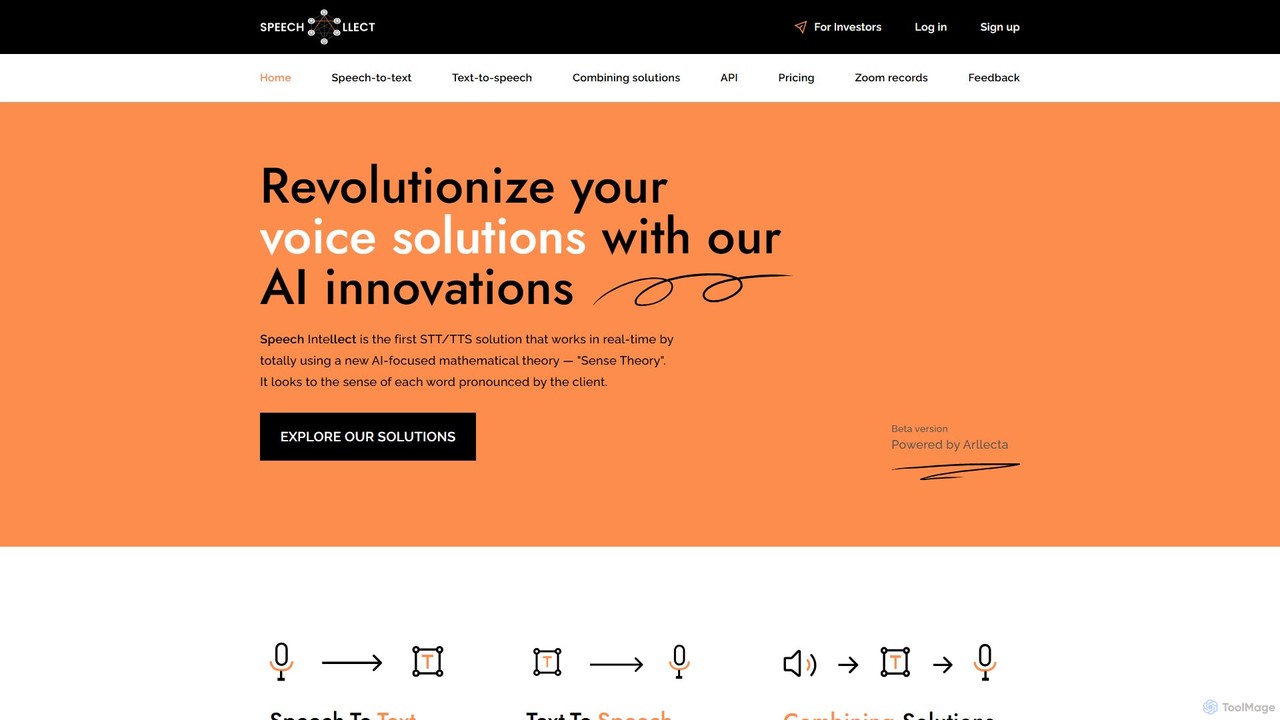
Speechllect Product overview

Speechllect is an advanced AI-powered speech-to-text (STT) and text-to-speech (TTS) platform. It utilizes a unique "Sense Theory" to not only transcribe and synthesize speech but also to understand and generate emotional tone and intonation. This makes it ideal for creating human-like voice interactions for businesses, developers, and content creators.

Preview

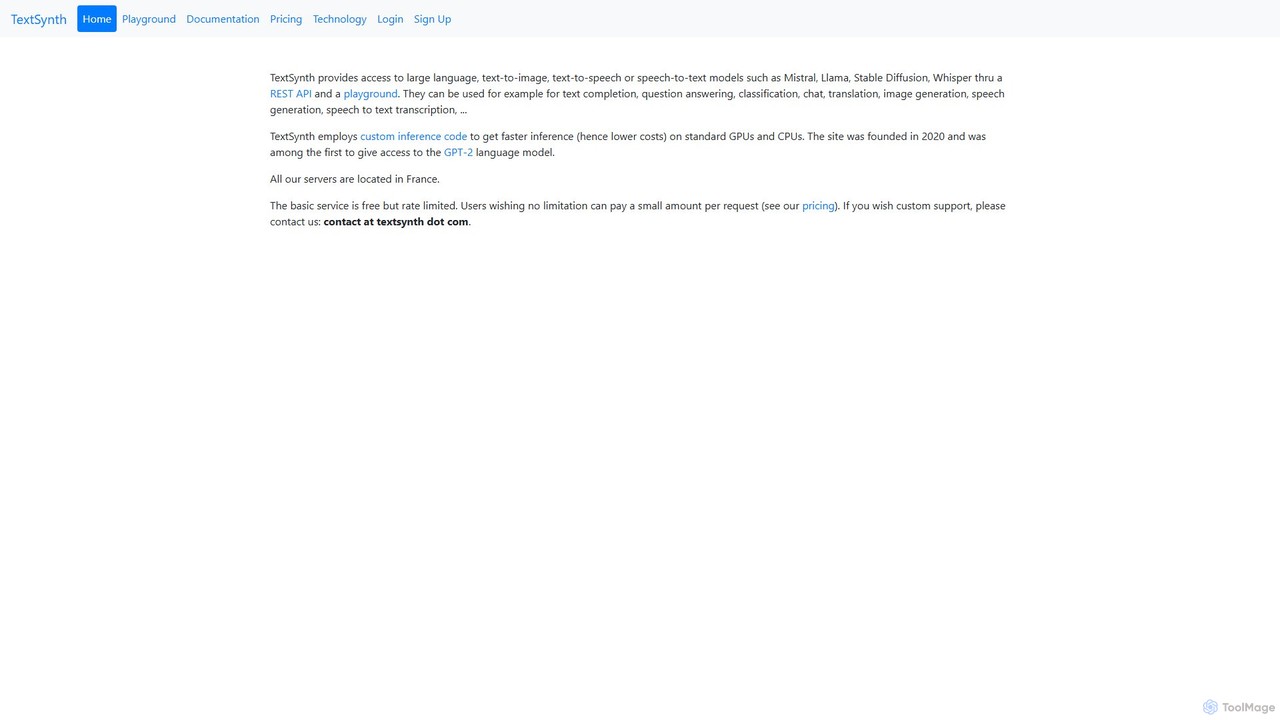
TextSynth Product overview

TextSynth offers developers powerful, cost-effective access to a suite of AI models, including large language models (LLMs), text-to-image, text-to-speech, and speech-to-text, through a flexible REST API and an interactive playground. It features models like Llama, Mistral, Stable Diffusion, and Whisper, optimized for speed and affordability.

Preview

Quick facts

Compare product focus, pricing models and audiences. Highlighted rows indicate different listed information; unknown pricing does not mean free.

Speechllect VS TextSynth — Quick facts
Quick factsSpeechllectTextSynth
Pricing modelFreemiumFreemium
Product typeWebWeb
Primary focusSpeech SynthesisSpeech Synthesis
Audience and rolesNo data availableNo data available
CategoriesSpeech Synthesis · Automation · Api · TranscriptionSpeech Synthesis · Transcription · Api · Image Generation · Writing
AddedAug 12, 2025Aug 12, 2025
UpdatedNov 19, 2026Nov 19, 2026

Features, usage and use cases

Explore the listed product descriptions, features and workflows. Taxonomy labels alone are not feature evaluations.

Speechllect

Speechllect introduces a revolutionary approach to voice solutions with its proprietary AI innovations. At its core is the "Sense Theory," a new mathematical framework that allows the system to operate in real-time, focusing on the semantic and emotional sense of each word. This technology enables Speechllect to deliver highly accurate and emotionally intelligent Speech-to-Text (STT) and Text-to-Speech (TTS) services, setting it apart from conventional solutions.

The platform is designed for a wide range of applications, from automating customer service in call centers to providing realistic character voices in video games. By understanding the tonality of a speaker, Speechllect's STT can provide deeper insights into conversations. Similarly, its TTS can generate speech with specific emotional coloring, age, and gender characteristics, resulting in a truly humanoid voice experience. The combined STT and TTS solution can fully automate complex interaction scenarios, adapting its conversational style to be friendly and respectful as needed.

How to use Speechllect

Getting started with Speechllect is a straightforward process:

  1. Registration: Create an account by providing your name, email, and a secure password. You'll need to verify your email to complete the registration. Registered users receive 30 free requests to test the services.
  2. Using Speech-to-Text (STT): Navigate to the STT page. You can either record audio directly using your microphone or upload a pre-existing audio file. The system will process the audio and provide a text transcription that also captures the emotional tone.
  3. Using Text-to-Speech (TTS): On the TTS page, select your desired language and voice characteristics. Type or paste your text into the provided box, and the service will generate a high-quality audio file with natural intonation and emotion.
  4. Combined Solution: The combined feature allows you to input an audio file, have it transcribed to text (STT), and then immediately converted back into a synthesized voice (TTS), streamlining processes like voice-over dubbing or interactive response systems.
  5. Zoom Integration: Install the Speechllect app from the Zoom App Marketplace to transcribe your Zoom meeting recordings directly. You can select the language and initiate transcription for any recording in your account.
  6. API Integration: For developers, Speechllect provides a comprehensive API. You can find your API key in your user profile and use it to integrate STT, TTS, and combined solutions into your own applications and services.

Core Features of Speechllect

  • Emotion-Aware Speech-to-Text: Transcribes spoken words while also identifying the emotion and tone of the speaker.
  • Humanoid Text-to-Speech: Synthesizes text into voice with realistic intonation, emotion, age, and gender characteristics based on its "sense-to-sense" algorithm.
  • Combined STT/TTS Solution: A seamless workflow that converts speech to text and back to speech, enabling full automation of voice-based interactions.
  • Sense Theory AI: A unique underlying technology that focuses on the meaning and feeling behind words for superior accuracy and naturalness.
  • Amorphous Encryption Security: Employs revolutionary cryptographic technology without private keys to ensure 100% data safety and protection against hacker attacks.
  • Developer API: A flexible and powerful API for integrating Speechllect's voice technologies into third-party applications.
  • Zoom Integration: Directly transcribe audio from Zoom cloud recordings to improve meeting productivity.

Use Cases for Speechllect

Speechllect's technology is versatile and can be applied across various industries:

  • Call Center Automation: Automate up to 99.9% of sales or technical support interactions, with the AI independently selecting actions and adjusting its tone based on the customer's emotions.
  • Gaming and Entertainment: Generate dynamic and realistic humanoid voices for video game characters, enhancing the immersive experience.
  • Website and Virtual Assistants: Power virtual communicators on websites, providing a more engaging and natural user experience.
  • Smart Home Devices: Enable more comfortable and intuitive conversations with smart home systems.
  • Content Creation: Quickly generate high-quality voice-overs for videos, podcasts, and e-learning materials.
  • Manufacturing and Operations: Reduce costs by coordinating work stages through voice commands and automated feedback, replacing human coordinators in certain roles.

Advantages of Speechllect

Speechllect offers significant advantages over traditional voice tools:

  • Emotional Intelligence: Its key differentiator is the ability to process and generate the emotional subtext of speech, leading to more meaningful and effective communication.
  • Enhanced Security: The use of "Amorphous Encryption" provides a superior level of data security, a critical feature for businesses handling sensitive user data.
  • Flexibility and Customization: Users can define complex work scenarios to fit their specific business needs, from simple reception tasks to intricate technical support flows.
  • High-Speed Cloud Computing: The entire suite of algorithms runs on a high-speed, global private cloud, ensuring fast processing and compliance with international data laws.
  • Cost Reduction: By automating complex voice-based tasks, businesses can significantly reduce operational costs and free up human agents for more strategic work.

Pricing and Plans

Speechllect operates on a flexible, pay-as-you-go pricing model with a freemium entry point.

  • Free Trial: New registered users receive 30 free requests to use across all services (STT, TTS, Combined).
  • Pay-as-you-go Packages: Users can purchase request packages that never expire. The price per request decreases with volume.
  • Starting from 1,000 requests: $10.00 per 1,000 requests.
  • Starting from 10,000 requests: $9.00 per 1,000 requests (10% discount).
  • Starting from 100,000 requests: $7.50 per 1,000 requests (25% discount).
  • Custom Plans: For users with larger needs, custom plans can be arranged by contacting the sales team.

TextSynth

TextSynth is a comprehensive AI platform that provides access to a diverse range of cutting-edge generative AI models through a simple and efficient REST API. Founded in 2020, it has established itself as a reliable and cost-effective solution for developers, researchers, and businesses looking to integrate advanced AI capabilities into their applications. The platform's core offering revolves around providing access to large language models (LLMs), text-to-image generators, speech-to-text transcription, and text-to-speech synthesis. Key models available include Mistral, Llama, Gemma, Stable Diffusion, and Whisper. A standout feature of TextSynth is its custom inference code, which optimizes performance on standard GPUs and CPUs, resulting in faster inference speeds and significantly lower costs for users.

How to use TextSynth

Using TextSynth is straightforward for developers. The primary method of interaction is through its REST API. To get started, you need to create an account on the TextSynth website to obtain an API key. This key must be included in the header of every API request for authentication (Authorization: Bearer YOUR_API_KEY). The platform offers various endpoints tailored to specific tasks:

  • Completions: For text generation, question answering, and classification.
  • Chat: A dedicated endpoint for building conversational applications.
  • Translate: Utilizes models like MADLAD-400 to translate text between hundreds of languages.
  • Text-to-Image: Generate images from text prompts using models like Stable Diffusion.
  • Transcript: Transcribe audio files into text with high accuracy using Whisper.
  • Speech: Convert text into natural-sounding speech.
  • Embeddings: Generate vector embeddings for text, ideal for RAG applications.

For non-programmatic use or quick testing, TextSynth also provides a user-friendly playground where you can directly interact with the models for text completion, chat, image generation, and more.

Core Features of TextSynth

  • Multi-Modal API: Access text, image, and audio models through a single, unified API.
  • Diverse Model Selection: Offers a wide range of open-source and powerful models, including Llama3, Mistral 7B, Gemma 3, Stable Diffusion, and Whisper Large v3.
  • High-Performance Inference: Utilizes custom-built inference code to deliver faster results and lower operational costs compared to standard implementations.
  • Advanced Generation Controls: Provides fine-grained control over AI output with parameters like temperature, top_k, top_p, and supports constrained generation using BNF grammar or JSON schemas.
  • Extensive Translation Capabilities: The MADLAD-400 model supports translation between approximately 400 languages.
  • Developer-Friendly Tools: Features detailed API documentation, a playground for experimentation, and endpoints for utility functions like tokenization.
  • Privacy-Focused: The Standard Plan does not log the content of user requests, and all servers are located in France, adhering to strong privacy standards.

Use Cases for TextSynth

TextSynth's versatile models can be applied to a wide array of applications:

  • Content Creation: Automate the generation of articles, marketing copy, emails, and creative stories.
  • Chatbot and Virtual Assistants: Build intelligent, responsive chatbots for customer service or interactive applications.
  • Multilingual Support: Integrate real-time translation services into websites and applications to reach a global audience.
  • Data Analysis: Perform sentiment analysis, text classification, and entity extraction on large datasets.
  • AI Art and Design: Create unique images and visuals from text descriptions for marketing, design, or entertainment.
  • Audio and Video Transcription: Automatically transcribe interviews, meetings, podcasts, and video content with timestamps.
  • Voice Applications: Generate voiceovers for videos, create audio guides, or build voice-enabled services.

Advantages of TextSynth

TextSynth stands out for several key reasons. Its primary advantage is cost-effectiveness, achieved through its optimized inference engine, which makes powerful AI accessible at a lower price point. The platform's pay-as-you-go credit system provides transparent and predictable pricing, eliminating the risk of unexpected expenses. Furthermore, it offers a broad selection of state-of-the-art models, giving developers the flexibility to choose the best tool for their specific needs. The combination of a robust API, detailed documentation, and a free tier for testing makes it an exceptionally developer-friendly platform.

Pricing and Plans

TextSynth offers a simple and transparent pricing structure with two main plans:

  • Free Plan: Provides free, rate-limited access to all language models. It's ideal for testing and small-scale projects. This plan has a limit of 200 generated tokens per request, a 3-minute limit for speech transcription, and requires periodic captcha completion. All requests on the free plan are logged.
  • Standard Plan: This is a pay-as-you-go plan based on pre-purchased credits. It removes all limitations of the free plan: no rate limits, no token limits, and no logging of request content. The minimum credit purchase is $20 or €20, and credits are valid for one year.

Pricing is based on usage:

  • Large Language Models: Priced per million input and output tokens (e.g., Llama3.1 8B Instruct costs $0.20 per million input tokens and $2.00 per million generated tokens).
  • Image Generation: Priced per image (e.g., Stable Diffusion costs $0.005 per image).
  • Speech to Text: Priced per minute of audio (e.g., Whisper Large V3 costs $0.003 per minute).
  • Text to Speech: Priced per million input characters (e.g., Parler-TTS costs $14.00 per million characters).

Positioning

Their taxonomy shows where the products overlap and where each one has a more distinct focus. Unknown fields are shown explicitly and are never filled with assumptions.

Categories

Shared
Speech SynthesisApi
Only Speechllect
AutomationTranscription
Only TextSynth
TranscriptionImage GenerationWriting

Tags

Shared
APIspeech to texttext to speech
Only Speechllect
AI voicecall center automationemotional intelligencereal-time speech processingtranscriptionvoice cloningvoice synthesiszoom integration
Only TextSynth
developer toolsimage generationlarge language modelLlamallmMistralstable diffusiontext generationtranslationwhisper

Audience and roles

Shared
No listed items
Only Speechllect
No listed items
Only TextSynth
No listed items

Traffic comparison

Traffic is shown on the same scale so differences in market visibility are not visually understated.

How to interpret the traffic data

Both charts share the same months and vertical scale. Each tool identifies its latest reporting month; missing months are left blank, not counted as zero. Regional and source visit counts are estimates calculated from the reported shares.

Speechllect

No data available

TextSynth monthly traffic:

Latest traffic · 2026-05

Monthly visits
3.3K
Avg. visit duration
0:09
Pages per visit
1.56
Bounce rate
50.88%
Data updated 2026-06-15

Monthly traffic trend

  • 2025-09: 5.8K
  • 2026-01: 2.4K
  • 2026-02: 2.8K
  • 2026-03: 3.1K
  • 2026-04: 5.6K
  • 2026-05: 3.3K

Top regions

Top 5 countries/regions
Country/regionPercentageEstimated visits
🇺🇸United States80.54%2.7K
🇵🇱Poland11.07%369
🇮🇹Italy7.35%245
🇪🇸Spain1.04%35

Search keywords

completiontext completion aitext completion llmtext completion playgroundtextsynth

Community signals

Ratings, comments, favorites, and likes are community signals—not a substitute for product fit.

Speechllect

Rating
No data available
Comments
0
Favorites
166
Likes
143

TextSynth

Rating
No data available
Comments
0
Favorites
167
Likes
161

Speechllect vs TextSynth · Comparison FAQ

What do Speechllect and TextSynth have in common?
Both tools are listed under Speech Synthesis、Api. These categories indicate overlapping use cases; compare their detailed descriptions for workflows, capabilities and limitations.
Are Speechllect and TextSynth free?
Listed pricing models: Speechllect — Freemium; TextSynth — Freemium. Missing pricing is not proof of a free plan, and freemium does not mean every feature is free. Check official sites for current plans, limits and trials.
How should I choose between Speechllect and TextSynth?
The primary listed category is Speech Synthesis for Speechllect, and Speech Synthesis for TextSynth. Compare features, steps and use cases, then verify pricing, data permissions and deployment needs. This page does not include hands-on testing and does not declare a winner from traffic or tags.

Sources and comparison methodology

This page is assembled from ToolMage product listings, taxonomy, traffic statistics and on-site user feedback. It is not a hands-on test or an independent review.

  • Feature and plan descriptions reflect information in the listings, not real-time guarantees. Verify pricing, quotas, availability and privacy terms on the official sites.
  • Traffic uses the reporting months shown. Missing statistics do not mean zero visits, and different periods do not establish growth or superiority. Regional and source visit counts are estimates based on shares.
  • Different tags indicate differences in the listings, not proof that the other product lacks a capability. Ratings, favorites and visits are not used to declare a winner.

Related comparisons