ToolMage
Sign in

AI TOOL COMPARISON

sqlbuilder vs SQLPilot

What is the difference, and which fits your workflow? Compare features, usage, pricing models and traffic side by side.

Jump to key differences

Product overview

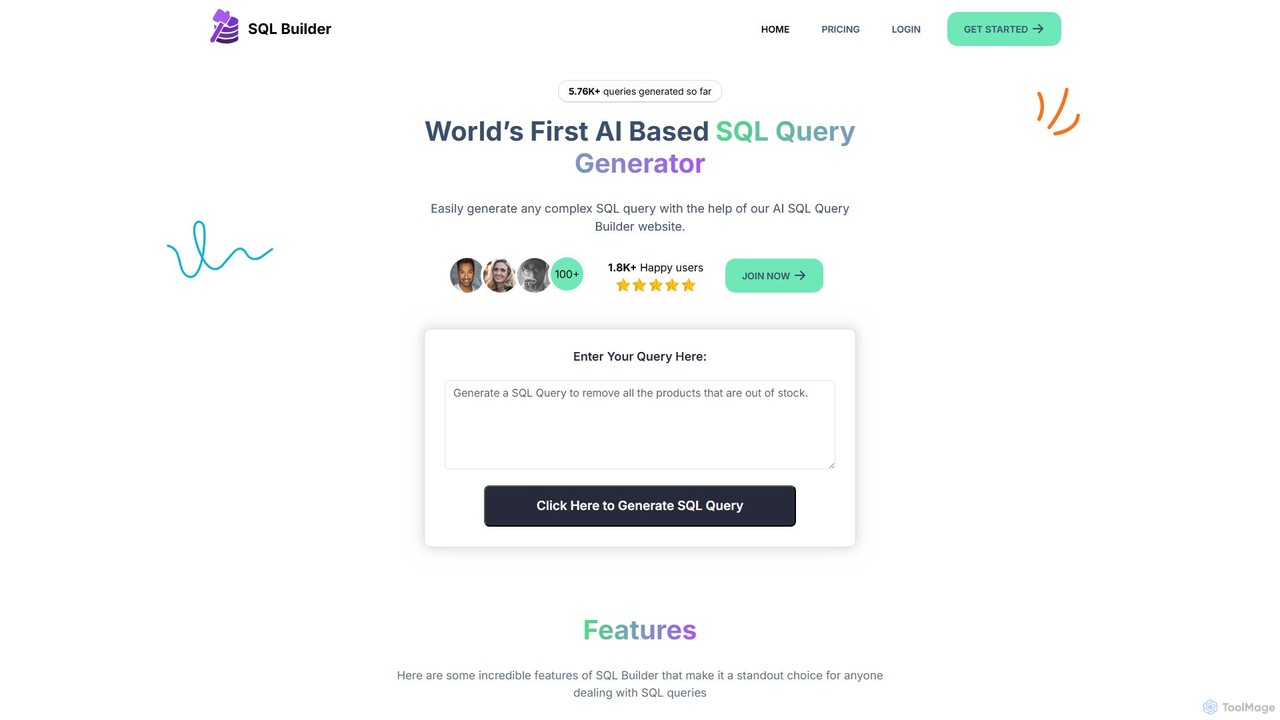
sqlbuilder Product overview

sqlbuilder is an AI-powered platform that simplifies database interactions. It enables users to generate, explain, optimize, and validate SQL and NoSQL queries using plain English. Designed for both developers and non-technical users, it accelerates data exploration, report generation, and database management, eliminating the need for deep SQL knowledge and reducing development time.

Preview

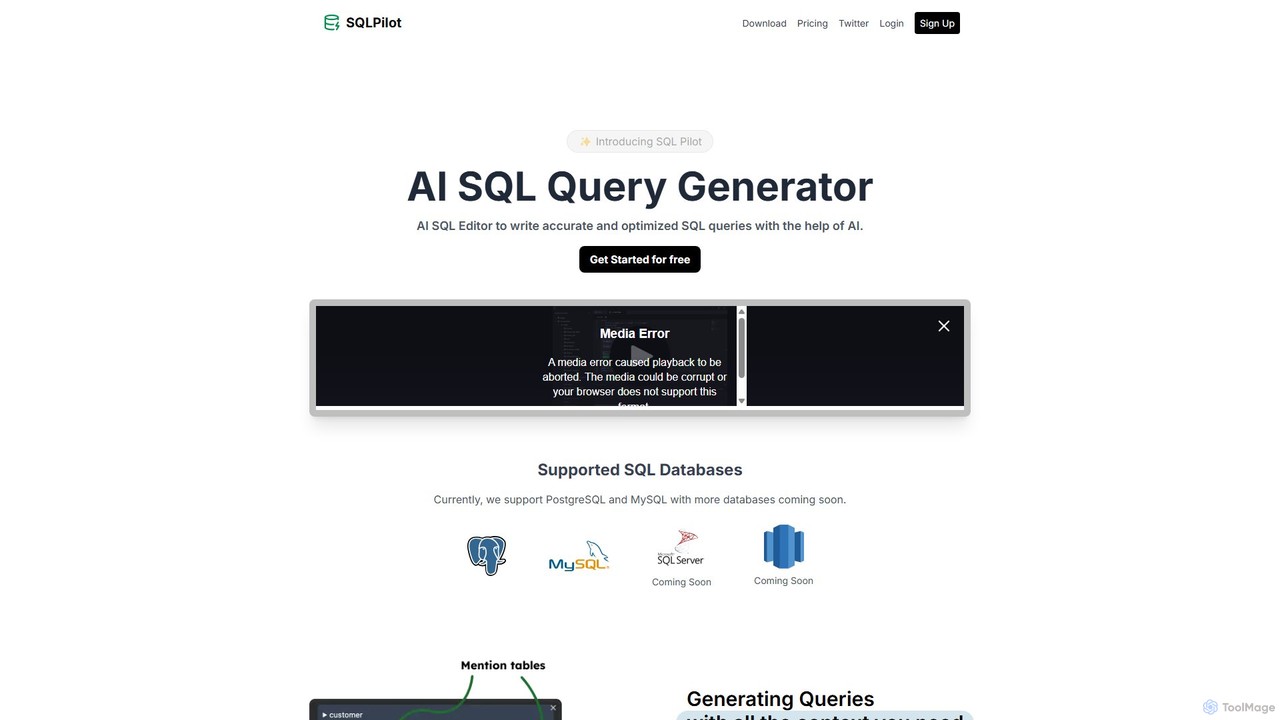
SQLPilot Product overview

SQLPilot is an AI-powered SQL query generator and editor that transforms natural language prompts into accurate, optimized SQL queries. It supports multiple databases like PostgreSQL and MySQL, various GPT models, and ensures data privacy by not storing your credentials or schemas.

Preview

Quick facts

Compare product focus, pricing models and audiences. Highlighted rows indicate different listed information; unknown pricing does not mean free.

sqlbuilder VS SQLPilot — Quick facts
Quick factssqlbuilderSQLPilot
Pricing modelFreemiumFreemium
Product typeWebWeb
Primary focusCode AssistantCode Assistant
Audience and rolesNo data availableNo data available
CategoriesCode Assistant · Database · AutomationCode Assistant · Database · Automation
AddedAug 16, 2025Aug 6, 2025
UpdatedNov 19, 2026Nov 19, 2026

Features, usage and use cases

Explore the listed product descriptions, features and workflows. Taxonomy labels alone are not feature evaluations.

sqlbuilder

sqlbuilder is a revolutionary AI-powered toolkit designed to streamline and simplify every aspect of working with SQL and NoSQL databases. Born from the real-world challenges faced by developers, its mission is to make database querying accessible to everyone, regardless of their technical expertise. By leveraging the power of advanced AI models like OpenAI, sqlbuilder transforms natural language prompts into accurate, efficient, and well-structured database queries. This empowers developers, data analysts, and business users to interact with their data more intuitively and productively, breaking down the barriers of complex query syntax.

The platform is more than just a query generator; it's a comprehensive suite of tools for database management. Whether you're a seasoned developer looking to speed up your workflow, a data analyst needing to pull specific insights, or a student learning the ropes of SQL, sqlbuilder provides the necessary features to enhance efficiency, reduce errors, and deepen understanding. From generating complex queries from a simple sentence to optimizing performance and ensuring code quality, sqlbuilder aims to be the go-to solution in every developer's toolkit.

How to use sqlbuilder

Using sqlbuilder is designed to be a straightforward and intuitive process. Users can harness its power in a few simple steps:

  1. Select a Tool: Navigate to the user-friendly dashboard and choose the desired function, such as 'No-Code SQL Builder', 'SQL Explainer', 'Optimizer', or 'Formatter'.
  2. Provide Input: Depending on the chosen tool, you will either type a command in plain English (e.g., "Show me all users from California who signed up last month") or paste an existing SQL/NoSQL query into the input field.
  3. Generate & Refine: Click the generate button. The AI will instantly process your input and produce the corresponding query, explanation, or optimized version.
  4. Review and Use: The output is displayed clearly for review. You can copy the generated code to use in your application, study the explanation to learn, or apply the suggested optimizations to improve your database performance.

Core Features of sqlbuilder

  • No-Code SQL & NoSQL Builder: Generate complex queries for various databases (including MySQL, PostgreSQL, and NoSQL databases like MongoDB) simply by describing what you need in plain English.
  • SQL Syntax Explainer: Demystifies intricate SQL queries by breaking them down into step-by-step, easy-to-understand explanations. It highlights keywords, tables, and functions to clarify the query's logic.
  • SQL Optimizer: Automatically analyzes your queries to identify bottlenecks and inefficiencies. It suggests optimizations, such as better joins and index recommendations, to significantly improve execution speed.
  • SQL Formatter: Cleans up and beautifies messy SQL code with a single click. It enforces consistent formatting, making queries organized, readable, and easier to maintain.
  • SQL Syntax Validator: Acts as an intelligent proofreader for your code. It instantly scans queries to catch syntax errors, misplaced commas, or forgotten keywords, providing detailed error messages and suggestions for fixes.

Use Cases for sqlbuilder

sqlbuilder is a versatile tool that caters to a wide range of professionals:

  • Software Developers: Can rapidly prototype and build data-driven features, debug complex queries, and ensure all database interactions are optimized for performance before deployment.
  • Data Analysts & Business Intelligence Professionals: Can perform ad-hoc data exploration and generate reports without writing code, allowing them to focus on extracting insights rather than struggling with syntax.
  • Students and Beginners: Provides an interactive learning environment to understand how SQL queries are constructed and to get instant feedback on their own code.
  • Database Administrators (DBAs): Can use the validator and optimizer to maintain database health, enforce coding standards, and troubleshoot slow-performing queries.

Advantages of sqlbuilder

The primary advantage of sqlbuilder is its ability to boost productivity and democratize data access. It significantly reduces the time and effort required to write, debug, and optimize queries. By translating natural language to code, it empowers non-technical team members to become self-sufficient in data retrieval. For developers, it automates tedious tasks, prevents common errors, and serves as a reliable assistant, allowing them to focus on higher-level problem-solving. Its support for both SQL and NoSQL databases makes it a uniquely versatile and indispensable tool in modern development environments.

Pricing and Plans

sqlbuilder offers a flexible pricing structure to suit different needs, including a free tier for individuals and paid plans for professionals and teams.

  • Free Plan: Ideal for students, hobbyists, and individuals with light usage. This plan typically includes a limited number of AI query generations per month and access to basic features like the SQL generator and explainer.
  • Pro Plan: Designed for individual developers and data analysts. This plan offers a much higher query limit, access to all advanced features including the SQL Optimizer and NoSQL Builder, and priority support.
  • Team/Enterprise Plan: Tailored for organizations and development teams. It includes unlimited query generation, collaboration features, centralized billing, and dedicated enterprise-level support.

SQLPilot

SQLPilot is an advanced AI-powered tool designed to streamline database management and data analysis by generating accurate and optimized SQL queries from natural language. It serves as an intelligent SQL editor and assistant, empowering developers, data analysts, and database administrators to interact with their data more efficiently. By simply describing the desired outcome in plain English, users can obtain complex SQL code in seconds, significantly reducing development time and minimizing the risk of syntax errors. The platform is built with a strong emphasis on user control, flexibility, and security.

Currently, SQLPilot supports popular databases like PostgreSQL and MySQL, with plans to expand its compatibility. It integrates seamlessly into existing workflows, allowing users to connect to an unlimited number of databases. One of its standout features is the commitment to privacy; SQLPilot does not store user database schemas, queries, or credentials, ensuring that sensitive information remains secure and confidential.

How to use SQLPilot

Using SQLPilot is an intuitive process designed for both technical and non-technical users:

  1. Connect Your Database: Start by establishing a secure connection to your PostgreSQL or MySQL database. You can add and manage an unlimited number of connections.
  2. Provide Context (Optional but Recommended): For more accurate queries, you can leverage the RAG (Retrieval-Augmented Generation) support by connecting your knowledge base. This allows the AI to understand your specific database schema and context.
  3. Write Your Prompt: In the editor, type a prompt in natural language. For example, you could write, "Show me all users who signed up in the last 30 days and have made more than 5 purchases."
  4. Select an AI Model: Choose from a range of powerful AI models, including GPT-3.5, GPT-4, and the latest GPT-4o, to balance speed and query complexity.
  5. Generate and Refine: Click the generate button. The AI will produce the corresponding SQL query. You can review, edit, and refine the query directly in the editor.
  6. Execute and Download: Once satisfied, you can execute the query. The results can be easily downloaded in CSV format for further analysis, with Excel support planned for the future.

Core Features of SQLPilot

  • Natural Language to SQL: Translates plain English prompts into precise and efficient SQL queries.
  • Multiple AI Model Support: Offers flexibility by supporting GPT-3.5, GPT-4, and GPT-4o models, allowing users to choose the best model for their needs.
  • Knowledge Base / RAG Support: Connects to your knowledge base to provide the AI with schema context, resulting in highly accurate and relevant queries.
  • Bring Your Own Key (BYOK): Users can add their own OpenAI API key for greater control and potentially lower costs.
  • Multi-Database Support: Natively supports PostgreSQL and MySQL, with more database systems to be added soon.
  • Unlimited Database Connections: Add and manage as many database connections as you need without any limitations.
  • Strict Privacy and Security: Guarantees user privacy by not storing any database schemas, queries, or connection credentials.
  • Downloadable Results: Export query results directly to a CSV file for easy integration with other tools and reports.

Use Cases for SQLPilot

SQLPilot is a versatile tool beneficial for various roles:

  • Data Analysts: Quickly generate complex queries for ad-hoc analysis and reporting without needing to write intricate SQL from scratch.
  • Software Developers: Accelerate backend development by rapidly creating queries for application features and database management tasks.
  • Database Administrators: Automate the creation of routine maintenance queries and get AI-powered suggestions for query optimization.
  • Business Professionals & Students: An excellent learning tool to understand SQL logic by seeing how natural language questions are translated into structured queries.

Advantages of SQLPilot

The primary advantage of SQLPilot is its ability to dramatically increase productivity. It acts as a co-pilot, saving countless hours typically spent on writing, debugging, and optimizing SQL code. This makes database interaction more accessible to team members who may not be SQL experts, fostering a more data-driven culture. The flexibility to choose AI models and bring your own API key provides users with unparalleled control over performance and cost. Above all, its strong commitment to security and privacy makes it a trustworthy tool for handling sensitive data.

Pricing and Plans

SQLPilot operates on a freemium model, making it accessible to everyone.

  • Free Plan: Ideal for individuals, students, and small-scale projects. This plan allows users to experience the core features of AI-powered SQL query generation at no cost. No credit card is required to get started.
  • Paid Plans (Inferred): While specific details are not provided on the homepage, it is expected that SQLPilot offers premium plans for professionals and teams. These plans would likely include a higher number of queries, access to the most advanced AI models (like GPT-4o), advanced features like RAG support, and priority customer support.

Positioning

Their taxonomy shows where the products overlap and where each one has a more distinct focus. Unknown fields are shown explicitly and are never filled with assumptions.

Categories

Shared
Code AssistantDatabaseAutomation
Only sqlbuilder
No listed items
Only SQLPilot
No listed items

Tags

Shared
databasedeveloper tools
Only sqlbuilder
code assistantcode explainercode formatternatural language to sqlnosqlquery buildersql generatorsql optimizer
Only SQLPilot
AI assistantcode generatordata analysismysqlnatural language processingpostgresqlRAGSQL

Audience and roles

Shared
No listed items
Only sqlbuilder
No listed items
Only SQLPilot
No listed items

Traffic comparison

Traffic is shown on the same scale so differences in market visibility are not visually understated.

How to interpret the traffic data

Both charts share the same months and vertical scale. Each tool identifies its latest reporting month; missing months are left blank, not counted as zero. Regional and source visit counts are estimates calculated from the reported shares.

sqlbuilder

No data available

SQLPilot monthly traffic:

Latest traffic · 2026-05

Monthly visits
279
Avg. visit duration
0:00
Pages per visit
1.01
Bounce rate
44.25%
Data updated 2026-06-11

Monthly traffic trend

  • 2025-09: 3.3K
  • 2026-01: 1.1K
  • 2026-02: 1.2K
  • 2026-03: 735
  • 2026-04: 1.4K
  • 2026-05: 279

Top regions

Top 5 countries/regions
Country/regionPercentageEstimated visits
🇩🇪Germany71.2%199
🇮🇩Indonesia28.8%80

Search keywords

ai sql query generatorsql code generatorusign ai to generate a queryusing ai to generate a query

Community signals

Ratings, comments, favorites, and likes are community signals—not a substitute for product fit.

sqlbuilder

Rating
No data available
Comments
0
Favorites
152
Likes
164

SQLPilot

Rating
No data available
Comments
0
Favorites
182
Likes
199

sqlbuilder vs SQLPilot · Comparison FAQ

What do sqlbuilder and SQLPilot have in common?
Both tools are listed under Code Assistant、Database、Automation. These categories indicate overlapping use cases; compare their detailed descriptions for workflows, capabilities and limitations.
Are sqlbuilder and SQLPilot free?
Listed pricing models: sqlbuilder — Freemium; SQLPilot — Freemium. Missing pricing is not proof of a free plan, and freemium does not mean every feature is free. Check official sites for current plans, limits and trials.
How should I choose between sqlbuilder and SQLPilot?
The primary listed category is Code Assistant for sqlbuilder, and Code Assistant for SQLPilot. Compare features, steps and use cases, then verify pricing, data permissions and deployment needs. This page does not include hands-on testing and does not declare a winner from traffic or tags.

Sources and comparison methodology

This page is assembled from ToolMage product listings, taxonomy, traffic statistics and on-site user feedback. It is not a hands-on test or an independent review.

  • Feature and plan descriptions reflect information in the listings, not real-time guarantees. Verify pricing, quotas, availability and privacy terms on the official sites.
  • Traffic uses the reporting months shown. Missing statistics do not mean zero visits, and different periods do not establish growth or superiority. Regional and source visit counts are estimates based on shares.
  • Different tags indicate differences in the listings, not proof that the other product lacks a capability. Ratings, favorites and visits are not used to declare a winner.

Related comparisons