Latext AI
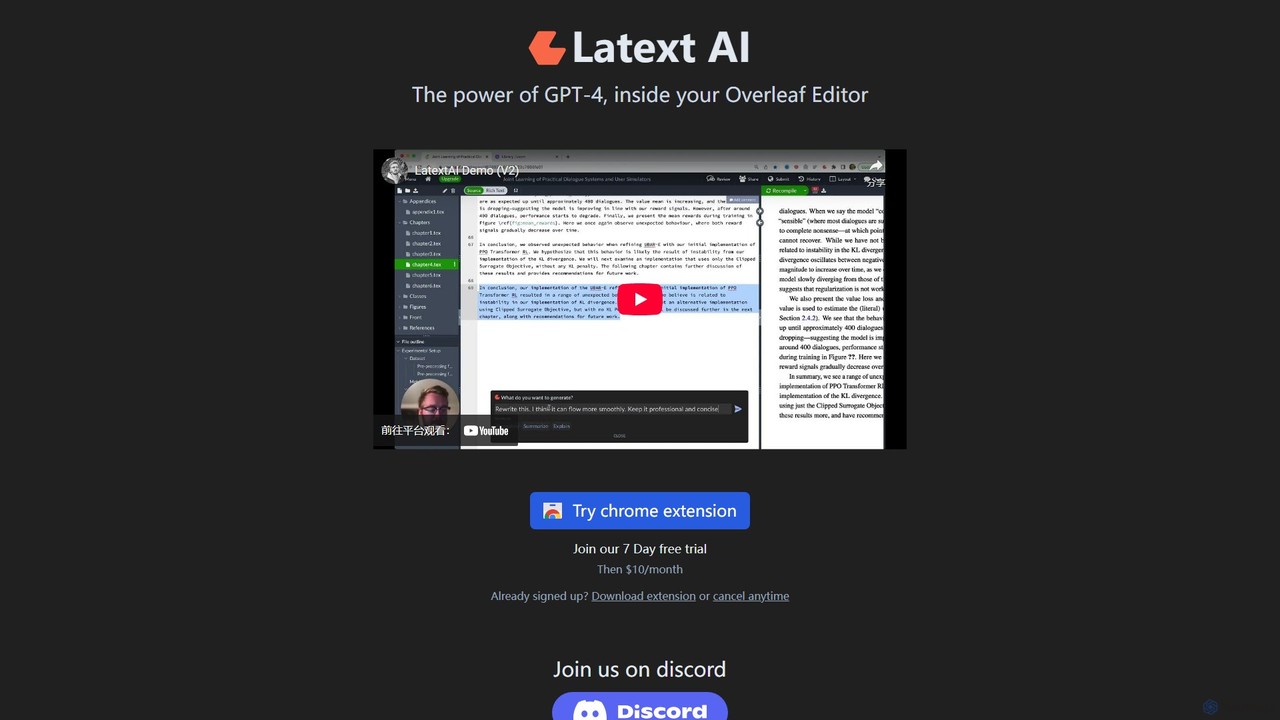
Latext AI is a powerful Chrome extension that integrates GPT-4 directly into your Overleaf editor. It helps you …
Latext AI is a powerful Chrome extension that integrates GPT-4 directly into your Overleaf editor. It helps you write, paraphrase, and summarize academic text, generate complex LaTeX code for tables and formulas, and debug errors, significantly boosting your productivity in scientific and technical writing.
Gatsbi
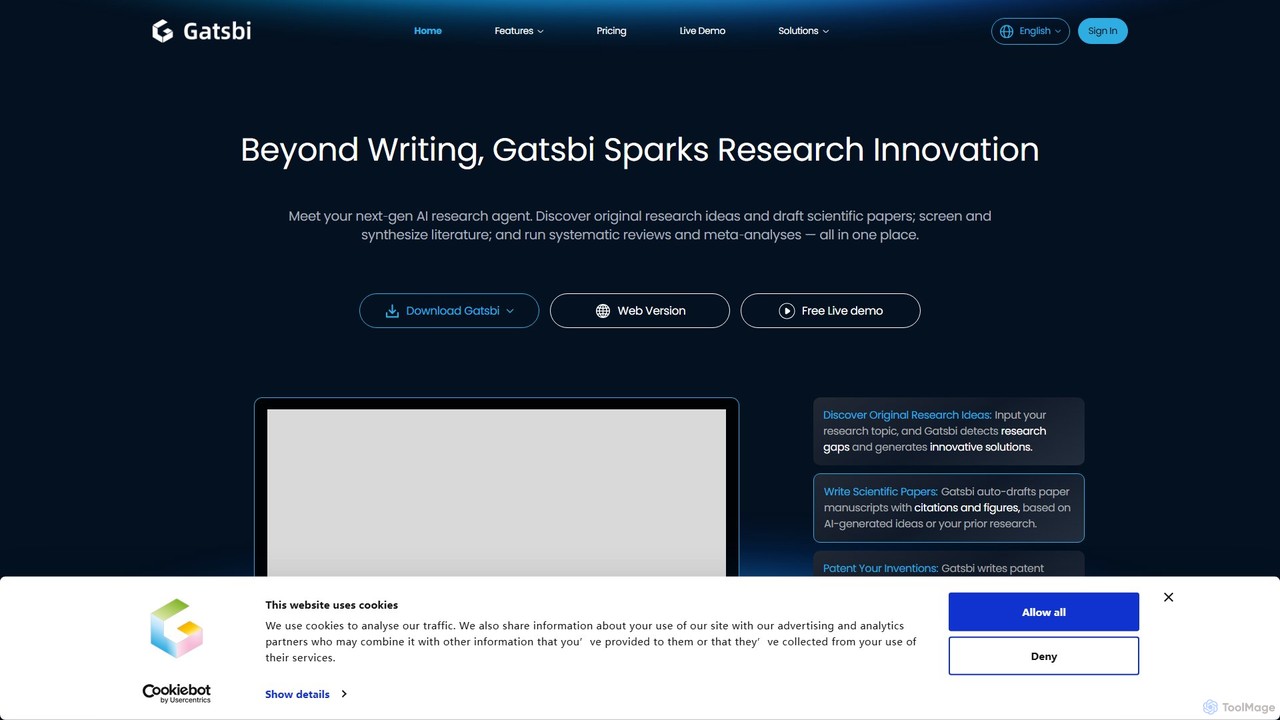
Gatsbi is an all-in-one AI research assistant designed to accelerate innovation. It helps researchers, engineers, and students discover …
Gatsbi is an all-in-one AI research assistant designed to accelerate innovation. It helps researchers, engineers, and students discover original research ideas, draft scientific papers and patent disclosures, and conduct systematic literature reviews and meta-analyses, streamlining the entire workflow from ideation to publication.
About Research
AI Research tools are a class of specialized software that use artificial intelligence to accelerate and enhance the entire academic and scientific research lifecycle. They employ machine learning, natural language processing (NLP), and advanced data analysis algorithms to automate tasks like literature discovery, complex data interpretation, and hypothesis generation. These tools empower researchers to manage vast amounts of information, uncover hidden patterns, and significantly shorten the path from data to discovery. Their primary function is to augment human intellect, allowing for more profound and efficient scientific inquiry.
Core Features
- Automated Literature Review: Rapidly scans, summarizes, and synthesizes thousands of academic papers to identify key themes and knowledge gaps.
- Advanced Data Analysis: Processes complex datasets (e.g., genomic, textual, numerical) to identify correlations, clusters, and predictive models.
- Hypothesis Generation: Analyzes existing data to propose novel, testable research questions and hypotheses.
- Experiment Simulation: Creates computational models to simulate experiments, predicting outcomes and reducing the need for physical trials.
- Academic Writing Assistance: Provides support for drafting, proofreading, and formatting research papers according to specific journal styles.
Applicable Scenarios
These tools are indispensable for PhD students, postdoctoral fellows, university professors, and corporate R&D scientists. They are applied across diverse fields, from drug discovery in bioinformatics and materials science to identifying trends in social sciences and modeling complex systems in environmental science. Any research-intensive role that involves extensive literature review or large-scale data analysis can benefit.
Selection Criteria
When choosing an AI Research tool, consider its specialization for your specific field (e.g., life sciences vs. humanities). Evaluate its data compatibility and integration capabilities with your existing software stack (like Zotero or Python libraries). Assess the balance between ease of use for quick analysis and the flexibility for custom model building. Finally, carefully review the platform's data security protocols and publication policies.
ResearchUse Cases
Accelerating Systematic Literature Reviews
A medical researcher conducting a meta-analysis on a new treatment protocol uses an AI Research tool to streamline their literature search. Instead of manually screening thousands of abstracts from databases like PubMed and Scopus, they input their inclusion and exclusion criteria into the AI. The tool automatically identifies, categorizes, and summarizes the most relevant studies, generating a preliminary synthesis matrix. This process reduces the time required for the initial screening phase from several months to just a few weeks, allowing the researcher to focus on in-depth analysis and quality assessment of the selected papers.
Analyzing Large-Scale Survey Data
A sociologist has collected a large dataset from a national survey containing thousands of responses with hundreds of variables. Manually identifying significant correlations would be extremely time-consuming. By uploading the data to an AI Research platform, they can use its analytical capabilities to automatically perform cluster analysis, identify key predictors for certain social outcomes, and visualize complex relationships between demographic variables. The AI highlights non-obvious correlations, such as the link between specific media consumption habits and political attitudes, providing a strong foundation for a new research paper.
Generating Novel Drug Compound Hypotheses
In a pharmaceutical R&D lab, a biochemist is searching for a new molecule to inhibit a specific protein target. They use an AI Research tool specialized in drug discovery. By inputting the known structural properties of the protein and desired chemical characteristics, the AI model generates a list of novel, viable molecular structures with a high predicted binding affinity. This generative capability allows the team to explore chemical spaces that humans might overlook, prioritizing the most promising candidates for synthesis and laboratory testing, thereby accelerating the preclinical discovery phase.
Coding Qualitative Interview Transcripts
A PhD student in sociology has conducted dozens of in-depth interviews for their dissertation. The process of manually coding transcripts for themes and patterns is laborious and prone to inconsistency. They use an AI Research tool with NLP capabilities to process the interview texts. The tool helps identify recurring concepts, analyzes sentiment, and suggests a thematic coding structure. While the student retains final control over the interpretation, the AI provides a first-pass analysis that saves hundreds of hours and ensures a more systematic and consistent approach to qualitative data analysis.
Simulating Complex Environmental Models
An environmental scientist is studying the long-term impact of deforestation on local rainfall patterns. Building and running physical or complex computational models can be resource-intensive. They use an AI Research platform to create a predictive model based on historical climate, satellite, and land-use data. The AI can simulate various deforestation scenarios over decades and predict their likely impact on precipitation, temperature, and biodiversity. This allows for rapid, cost-effective testing of multiple hypotheses before committing to more detailed, computationally expensive simulations.
Proofreading and Formatting Academic Manuscripts
A postdoctoral researcher, for whom English is a second language, has finished drafting a manuscript for a high-impact journal. To ensure the language is clear, concise, and professional, they use an AI research assistant specialized in academic writing. The tool checks for grammatical errors, suggests improvements for sentence structure and word choice, and helps format the entire manuscript—including citations and references—according to the journal's specific style guide (e.g., APA, MLA, Chicago). This enhances the paper's quality and increases its chances of passing the initial editorial review.