SciPub+
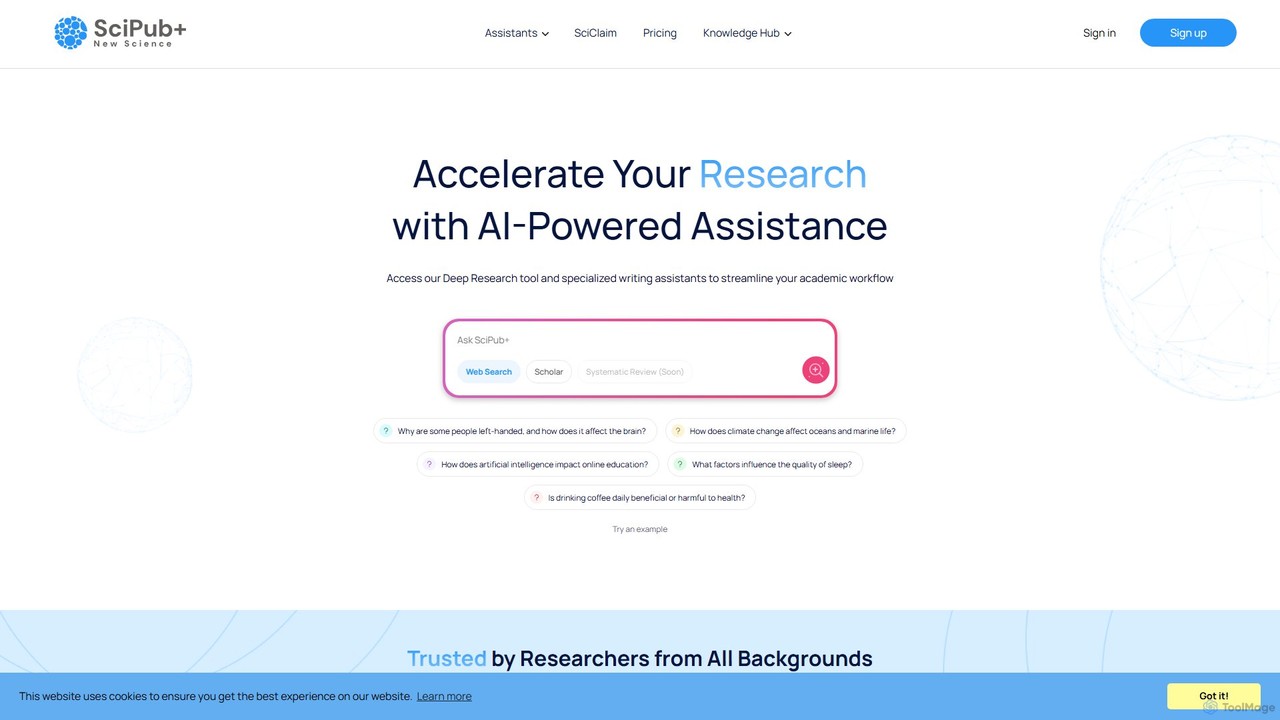
SciPub+ is an AI-powered academic writing platform designed by researchers for researchers. It offers a suite of 10 …
SciPub+ is an AI-powered academic writing platform designed by researchers for researchers. It offers a suite of 10 specialized assistants to streamline every stage of paper and thesis writing, from outlining and literature reviews to drafting results and conclusions. It accelerates the research workflow, enhances writing quality, and helps overcome writer's block.
About Scientific Writing
AI Scientific Writing tools are specialized assistants designed to help researchers, academics, and students draft, refine, and format scholarly documents. These tools utilize advanced natural language processing (NLP) to go beyond basic grammar checks, offering features like academic tone enhancement, sentence restructuring for clarity, and context-aware vocabulary suggestions. They streamline the entire manuscript preparation process, from literature review to final submission, ensuring the output is clear, concise, and compliant with academic standards. This focus on the nuances of scientific communication distinguishes them from general-purpose writing aids within the broader academic toolset.
Core Features
- Academic Paraphrasing: Rephrases sentences and paragraphs to improve clarity and flow while preserving the original scientific meaning.
- Citation & Bibliography Management: Automatically formats in-text citations and reference lists according to major academic styles like APA, MLA, and Chicago.
- Literature Summarization: Condenses key findings and arguments from research papers to accelerate the literature review process.
- Journal Template Adherence: Provides templates and formatting checks to ensure manuscripts comply with specific journal submission guidelines.
- Technical Language Check: Analyzes and suggests improvements for domain-specific terminology, ensuring precision and consistency.
Use Cases
These tools are invaluable for PhD students writing dissertations, postdoctoral researchers preparing manuscripts for high-impact journals, and international scholars aiming to publish in English. They are also used by research teams to maintain a consistent style and format across collaborative documents, and by academic institutions to support student writing programs.
How to Choose
When selecting a tool, consider the depth of its academic features, such as the number of citation styles supported and the quality of its paraphrasing engine. Evaluate its integration capabilities with word processors like Word or LaTeX editors. Also, assess the scope of its reference database for plagiarism checks and the user interface's ease of use, especially for complex projects.

Scientific WritingUse Cases
Drafting a Manuscript from Research Notes
A PhD candidate in biology has extensive research notes, experimental data, and fragmented paragraphs. Using an AI scientific writing tool, they can structure this information into a coherent first draft. The tool helps organize sections according to the IMRAD (Introduction, Methods, Results, and Discussion) format, suggests transition phrases to connect ideas, and paraphrases convoluted sentences into clear, academic prose. This process transforms scattered notes into a well-structured manuscript foundation in hours instead of weeks, allowing the student to focus on refining the scientific arguments.
Polishing a Paper for Non-Native English Speakers
A researcher whose first language is not English has completed a manuscript with sound scientific findings but struggles with linguistic nuances. An AI scientific writing tool can act as an expert language editor. It corrects subtle grammatical errors, suggests more appropriate academic vocabulary, and restructures sentences for better flow and readability. The tool ensures the tone is consistently formal and objective, helping the researcher present their work professionally and increasing its chances of acceptance in a high-impact, English-language journal.
Automating Literature Review Summaries
A postdoctoral fellow needs to conduct a comprehensive literature review for a new research project, which involves reading dozens of papers. Instead of spending weeks manually summarizing each one, they use an AI tool. They upload the PDFs of relevant articles, and the tool generates concise, structured summaries highlighting the key objectives, methods, findings, and limitations of each study. This allows the researcher to quickly grasp the state of the field, identify research gaps, and synthesize information for their review article far more efficiently.
Ensuring Consistent Citation Formatting
A research team is collaborating on a paper, with each member contributing different sections and references. Manually managing and formatting citations in a specific style (e.g., APA 7th ed.) can be tedious and error-prone. They use an AI scientific writing tool with an integrated citation manager. As they write, they insert citations from their shared library. The tool automatically formats both the in-text citations and the final bibliography according to the journal's requirements. If they need to submit to a different journal, they can switch the citation style with a single click, saving hours of manual reformatting.
Generating a Structured Abstract and Keywords
After completing the main body of a paper, a scientist needs to write a concise and impactful abstract that accurately reflects the study's content. They input their full manuscript into an AI tool. The AI analyzes the text and generates a structured abstract, clearly outlining the background, methods, results, and conclusion. It also suggests a list of relevant keywords based on the paper's terminology and themes, which helps improve the article's discoverability in academic databases. This automates a critical but often challenging final step in manuscript preparation.
Checking for Plagiarism and Originality
Before submitting a thesis to their university, a graduate student needs to ensure its originality and avoid any unintentional plagiarism. They use the plagiarism checker feature within their AI scientific writing tool. The software compares their text against a vast database of academic journals, publications, and web sources. It generates a detailed report highlighting any matching text segments and providing links to the original sources. This allows the student to review and properly cite or rephrase any problematic sections, ensuring academic integrity before final submission.