Koke
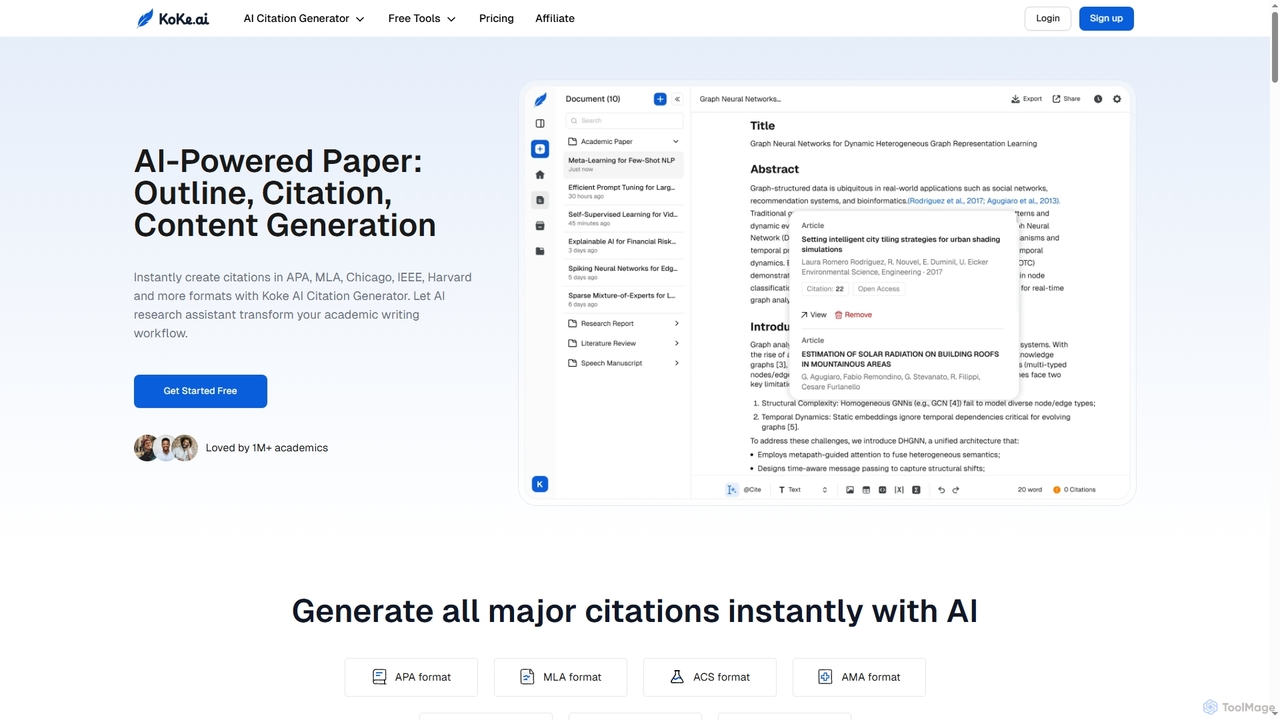
Koke is an AI-powered academic writing assistant that streamlines the entire paper creation process. It offers an instant …
Koke is an AI-powered academic writing assistant that streamlines the entire paper creation process. It offers an instant citation generator for APA, MLA, Chicago, IEEE, and Harvard styles, an outline generator, and advanced content generation tools for sentences, paragraphs, and research questions. Koke helps students and academics write smarter, manage references, and refine drafts efficiently.
About Research Assistant
AI Research Assistants are specialized tools designed to automate and accelerate the process of gathering, understanding, and synthesizing academic information. Leveraging natural language processing (NLP), these tools scan vast databases of scholarly articles, summarize complex papers, and extract key data points. They are invaluable for students, academics, and R&D professionals who need to conduct thorough literature reviews and build a strong evidence base. Unlike general academic writing tools, their primary focus is on the discovery and analysis phase of research, not just the final composition.
Core Features
- Automated Literature Search: Efficiently finds relevant papers and articles from vast scientific databases.
- Intelligent Summarization: Condenses long research papers or multiple sources into concise, understandable summaries.
- Data Extraction & Synthesis: Identifies and collates key findings, methodologies, and conclusions from various texts.
- Citation Management: Automatically generates and formats citations in various academic styles like APA, MLA, and Chicago.
Use Cases
These tools are primarily used by PhD students, university researchers, and corporate R&D teams. Common applications include preparing comprehensive literature reviews for a thesis, writing evidence-based grant proposals, and conducting market intelligence by quickly analyzing scientific papers and technical reports.
How to Choose
When selecting an AI Research Assistant, consider the scope of its database access (which journals it covers), the accuracy of its summarization, its ability to integrate with reference managers like Zotero or Mendeley, and its support for your specific field of study.
Research AssistantUse Cases
Accelerating Literature Reviews for Theses
A PhD student beginning their dissertation needs to review hundreds of academic papers to understand the current state of their field. Instead of spending weeks manually searching and skimming, they use an AI Research Assistant. They input keywords and filters, and the tool returns a prioritized list of the most relevant papers from multiple databases. It then generates concise summaries for the top 50 articles, allowing the student to quickly identify core themes, foundational studies, and research gaps. This reduces the initial screening time from weeks to just a few days.
Crafting Evidence-Based Grant Proposals
A university researcher needs to write a grant proposal for a new project. To secure funding, the proposal must be supported by strong evidence from existing literature. The researcher uses an AI assistant to input their hypothesis and find supporting and conflicting studies. The tool extracts key statistics, methodologies, and conclusions from relevant papers, which are then used to build a robust background section. This process ensures all claims are well-supported and significantly strengthens the proposal's credibility, increasing the chances of receiving funding.
Staying Current in a Fast-Moving Field
An R&D scientist in the pharmaceutical industry needs to monitor new publications and patents weekly to stay ahead of competitors. Manually tracking this is time-consuming. They set up automated alerts in an AI Research Assistant for specific topics and drug compounds. Each week, the assistant scans new entries across PubMed, patent databases, and preprint servers. It then delivers a summarized digest of the most relevant findings directly to their inbox, saving hours of manual searching and ensuring the team never misses a critical development.
Synthesizing Market Research Reports
A market analyst is tasked with identifying key industry trends from dozens of lengthy reports. Instead of reading each 100-page report, they upload all the PDFs to an AI Research Assistant. The tool processes the unstructured text and extracts specific data points requested by the analyst, such as market size figures, growth projections, and competitor mentions. It then synthesizes this information from all documents into a single, structured table, transforming hours of manual data extraction into a task that takes minutes and providing a clear overview for strategic briefings.
Validating Facts for Journalistic Articles
An investigative journalist is writing an in-depth article on a new medical breakthrough. To ensure accuracy, they need to verify claims made in press releases with primary scientific sources. They use an AI Research Assistant to quickly locate the original research papers cited. The tool helps them navigate directly to the methodology and results sections of the papers, allowing for efficient comparison with the public claims. This enhances journalistic accuracy and credibility by making the fact-checking process faster and more thorough, tracing information back to its source.
Preparing for Academic Debates and Presentations
A university student needs to prepare for a class debate on a complex topic, such as the economic impact of renewable energy. To build a strong case, they need to gather arguments and counter-arguments from academic literature. Using an AI Research Assistant, they input the debate topic. The tool retrieves a balanced set of papers presenting different viewpoints, summarizes their main arguments, and helps organize them for easy comparison. This allows for rapid and comprehensive preparation, equipping the student with a well-rounded understanding of the academic discourse on the topic.