Lingma
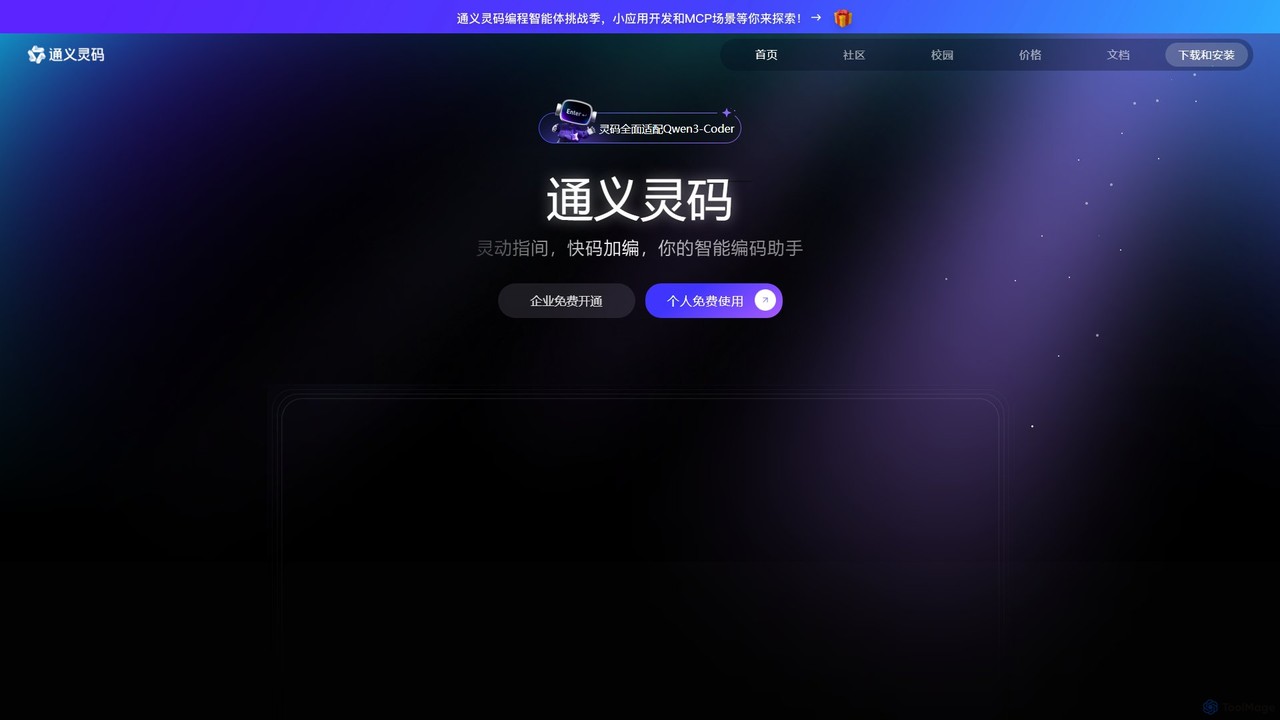
Lingma is an AI-powered coding assistant from Alibaba Cloud, designed to enhance developer productivity. It offers intelligent code …
Lingma is an AI-powered coding assistant from Alibaba Cloud, designed to enhance developer productivity. It offers intelligent code generation, real-time completion, code explanation, error diagnosis, and an autonomous programming agent that can handle complex coding tasks across multiple files. It supports over 200 languages and integrates seamlessly with major IDEs.
About Ai Agent
AI Agents are autonomous software programs designed to perceive their environment, make decisions, and take actions to achieve specific goals. They leverage large language models (LLMs) and planning algorithms to independently execute complex, multi-step tasks by interacting with other software and websites. This enables them to automate intricate workflows, conduct comprehensive research, and manage digital tasks on a user's behalf. Unlike simpler AI tools, AI Agents possess memory and the ability to self-correct, allowing them to handle dynamic and unforeseen challenges.
Core Features
- Autonomous Task Execution: Independently performs multi-step tasks from start to finish without constant human intervention.
- Goal-Oriented Planning: Decomposes a high-level objective into a sequence of executable sub-tasks.
- Tool Integration & Usage: Accesses and utilizes external APIs, websites, and local applications to gather information or perform actions.
- Contextual Memory: Maintains short-term and long-term memory to inform future decisions and actions.
- Self-Correction Capability: Analyzes outcomes, identifies errors, and adjusts its strategy to successfully complete the goal.
Applicable Scenarios
AI Agents are used by developers for code generation and debugging, researchers for automated data collection and analysis, and marketers for managing complex digital campaigns. For instance, a developer can delegate bug fixing to an agent, while a business analyst can task an agent with monitoring market trends and generating weekly reports by browsing multiple news sources and financial sites.
Selection Criteria
When choosing an AI Agent, evaluate its task complexity capabilities—can it handle the multi-step workflows you need? Assess its integration ecosystem to ensure it connects with your essential tools (e.g., GitHub, Slack, Google Workspace). Consider the level of autonomy and control, allowing you to balance independent operation with necessary human oversight. Finally, prioritize agents with strong security protocols for handling sensitive data and system access.
Ai AgentUse Cases
Automated Market Research and Reporting
A market analyst needs to compile a report on a new competitor. They instruct an AI Agent to 'Research competitor X, analyze their product offerings, pricing, and recent news, and summarize the findings in a report.' The agent autonomously browses websites, reads articles, extracts key data points, and structures the information into a coherent document. This process generates a comprehensive report in minutes, a task that would manually take hours, freeing the analyst to focus on strategic interpretation and decision-making.
Autonomous Software Development and Debugging
A software developer is facing a complex bug in a large codebase. Instead of spending hours manually tracing the issue, they provide an AI Agent with access to the code repository and the bug report. The agent analyzes the code, formulates hypotheses about the cause, writes and runs new tests to isolate the problem, and ultimately proposes a code patch for the developer to review. This significantly reduces debugging time and accelerates the development cycle, allowing developers to focus on building new features.
Personalized Travel Itinerary Planning
A user planning a vacation provides an AI Agent with a high-level goal: 'Plan a 7-day trip to Italy for two, focusing on history and food, with a budget of $3000.' The agent then breaks this down into sub-tasks: researching affordable flights, finding well-rated hotels in Rome and Florence, identifying historical sites and top-rated restaurants, and creating a day-by-day schedule. It interacts with booking websites and map services to assemble a complete, actionable itinerary, saving the user dozens of hours of planning.
Proactive Customer Support Ticket Resolution
A customer support team integrates an AI Agent with their helpdesk system. When a new technical support ticket arrives, the agent reads it, accesses the knowledge base to understand the issue, and runs diagnostics by connecting to the user's account data (with permission). If it identifies a common problem, it automatically sends a solution to the customer. If the issue is complex, it gathers all relevant data, summarizes its findings, and escalates the ticket to a human agent, ensuring they have all the context needed to solve it quickly.
Automated Social Media Content Curation
A social media manager sets a content strategy for an AI Agent: 'Find and share 3 relevant industry news articles and create one original post about our new feature each day on Twitter and LinkedIn.' The agent continuously browses the web for trending articles, drafts posts in the company's brand voice, suggests relevant hashtags, and even creates simple visuals. It then presents the drafted content in a queue for the manager's final approval before scheduling, ensuring a consistent and relevant content stream with minimal manual effort.
Complex Data Analysis and Visualization
A business analyst uploads a large sales dataset and instructs an AI Agent: 'Analyze this data to find the top-performing products by region and visualize the quarterly growth trends.' The agent first cleans and structures the data, then performs statistical analysis to identify key insights. It proceeds to generate various charts and graphs (e.g., bar charts for regional sales, line graphs for growth trends) and compiles them into a dashboard with a written summary of its findings. This automates the entire workflow from raw data to actionable insights.