MarsX
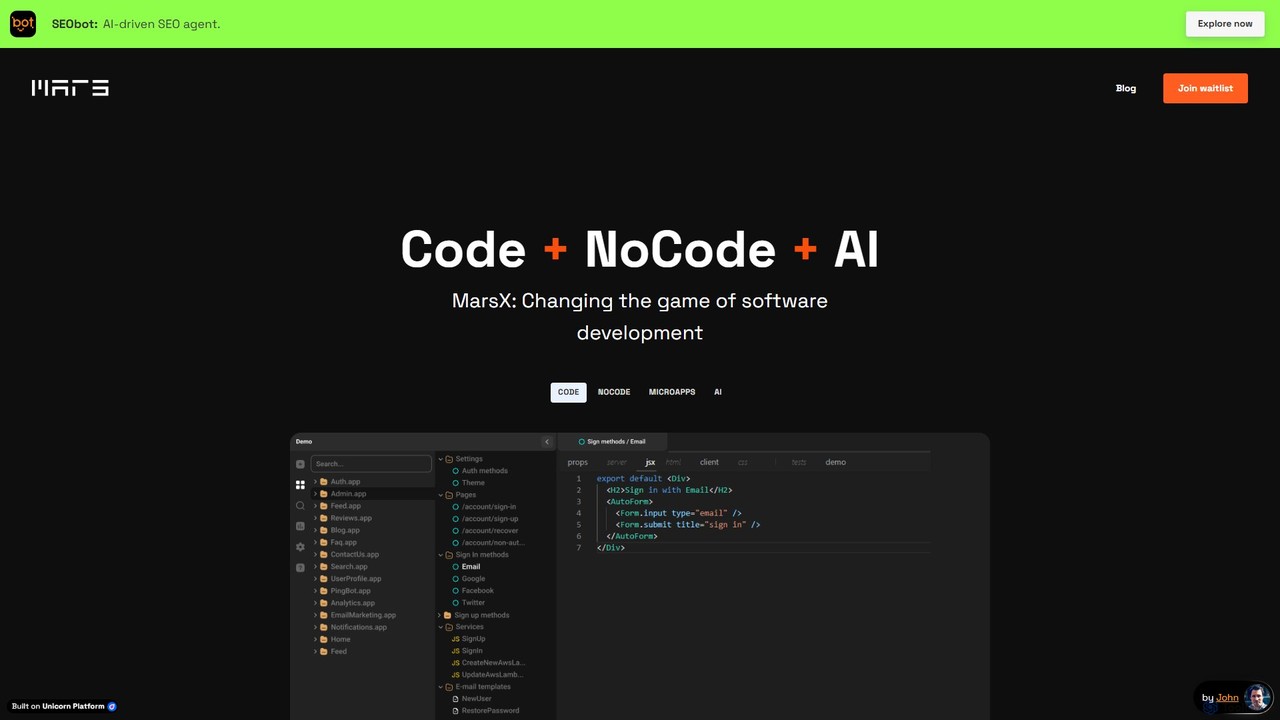
MarsX is an integrated development platform that unifies AI, No-Code, and traditional coding. It empowers developers and entrepreneurs …
MarsX is an integrated development platform that unifies AI, No-Code, and traditional coding. It empowers developers and entrepreneurs to rapidly build, test, and launch sophisticated web applications, micro-apps, and AI-powered tools, significantly reducing development time and costs.
About Ai App Building
AI App Building refers to a category of tools designed to simplify and accelerate the creation of intelligent applications, often leveraging pre-built AI models and low-code/no-code interfaces. These platforms empower users, from citizen developers to seasoned engineers, to integrate sophisticated AI capabilities like natural language processing, computer vision, and predictive analytics into their software solutions. They significantly reduce the technical barriers and development time traditionally associated with deploying AI, enabling rapid prototyping and deployment of AI-powered features across various industries.
Core Features
- Pre-built AI Models: Access to a library of trained AI models for common tasks like sentiment analysis, object detection, or text generation.
- Visual Development Interfaces: Drag-and-drop builders and graphical workflows to design application logic and integrate AI components without extensive coding.
- Data Integration & Management: Tools to connect, prepare, and manage data sources for training custom models or feeding pre-trained ones.
- Deployment & Scaling: Capabilities for deploying AI applications to various environments (cloud, edge) and managing their performance and scalability.
- Monitoring & Retraining: Features to track AI model performance, identify drift, and facilitate continuous improvement through retraining.
Use Cases
These tools are invaluable for businesses and individuals looking to infuse intelligence into their operations without deep AI expertise. They are used by product managers to quickly prototype new AI features, by small businesses to automate customer interactions, and by developers to accelerate the integration of complex AI functionalities into larger systems. The focus is on democratizing AI development, making it accessible for a wider range of creators to build innovative, smart applications.
How to Choose
When selecting an AI App Building platform, consider its ease of use and whether it supports no-code or low-code development for your team's skill level. Evaluate the breadth and quality of its pre-built AI model library, ensuring it covers your specific application needs. Assess its integration capabilities with existing data sources and other software, as well as its scalability options for future growth. Finally, compare pricing models and the level of community support or documentation available.
Ai App BuildingUse Cases
Building an Intelligent Customer Service Chatbot
Small business owners or customer service managers can utilize AI App Building tools to create custom chatbots that handle frequently asked questions, guide users through processes, and even perform basic troubleshooting. By integrating natural language processing (NLP) models, these chatbots can understand user intent, provide instant, accurate responses 24/7, and escalate complex queries to human agents, significantly reducing support workload and improving customer satisfaction.
Developing a Personalized E-commerce Recommendation Engine
E-commerce product managers or marketing teams can leverage these platforms to build recommendation systems that analyze customer browsing history, purchase patterns, and product attributes. This allows for the dynamic suggestion of relevant products to individual shoppers, enhancing the user experience, increasing engagement, and ultimately driving higher conversion rates and average order values by presenting tailored offerings.
Creating an AI-Powered Data Analysis & Reporting Dashboard
Business analysts or data scientists, even without extensive machine learning coding skills, can use AI App Building tools to construct interactive dashboards. These dashboards can incorporate predictive analytics models to forecast sales, identify market trends, or detect anomalies in operational data. This empowers decision-makers with real-time, intelligent insights, enabling more proactive and data-driven strategic planning.
Automating Content Generation for Marketing Campaigns
Marketing professionals or content creators can build applications that automate the drafting of marketing copy, social media posts, or email newsletters. By integrating generative AI models, these tools can produce multiple content variations based on specific prompts, target audiences, and brand guidelines. This accelerates content production cycles, maintains brand consistency, and frees up creative teams for higher-level strategic tasks.
Prototyping AI Features for Mobile & Web Applications
Software developers and product designers can rapidly prototype and test new AI functionalities for their mobile or web applications. Instead of starting from scratch, they can drag-and-drop pre-configured AI components for tasks like image recognition, voice command processing, or intelligent search. This significantly shortens the development lifecycle for integrating cutting-edge AI features, allowing for quicker iteration and validation.
Implementing Predictive Maintenance Solutions in Manufacturing
Operations managers or industrial engineers in manufacturing can build AI applications to monitor sensor data from machinery and predict potential equipment failures before they occur. By applying machine learning models to historical performance data, these tools can alert maintenance teams to schedule proactive interventions, minimizing downtime, reducing repair costs, and extending the lifespan of critical assets.