Tiptap
Tiptap is a headless, open-source, and framework-agnostic editor toolkit for developers. It allows for the creation of highly …
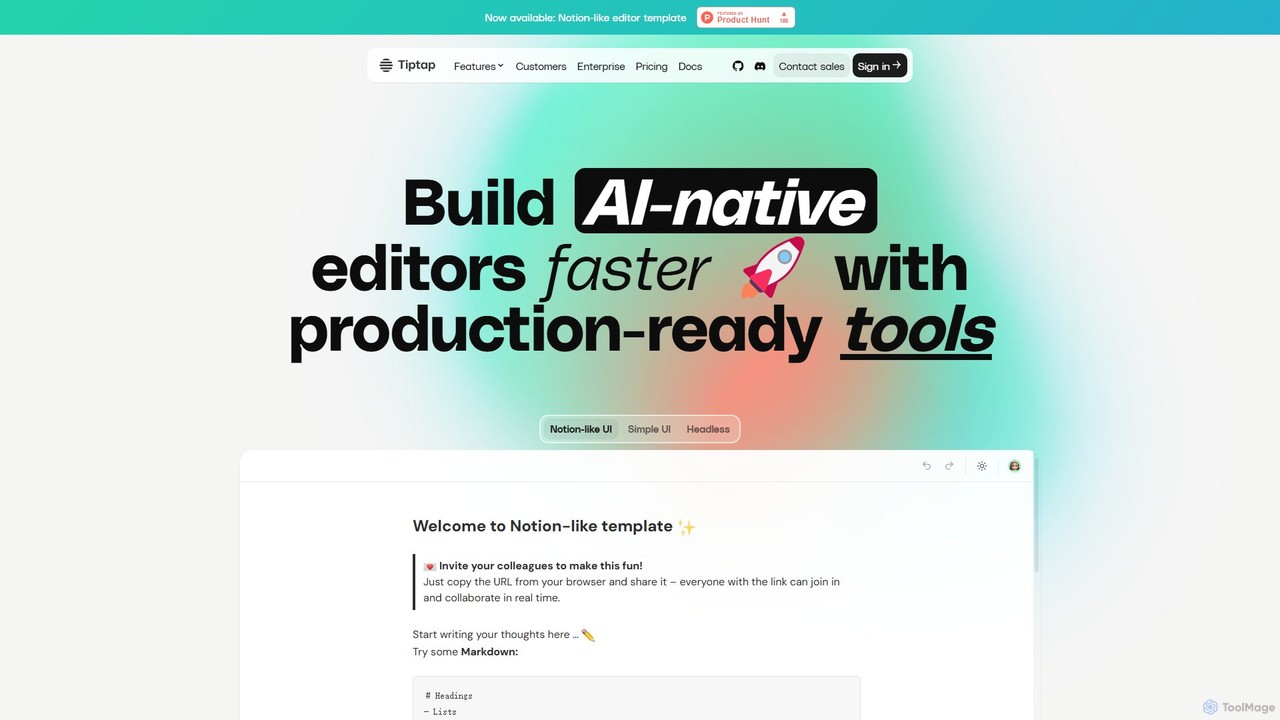
Tiptap is a headless, open-source, and framework-agnostic editor toolkit for developers. It allows for the creation of highly customizable rich text editors with over 100 extensions. Tiptap also offers premium cloud services, including real-time collaboration, AI-powered content generation and editing, document conversion, and commenting features, enabling developers to build sophisticated, modern editing experiences into their applications with ease.
About Text Generation
Text Generation tools are AI-powered applications that automatically produce human-like text based on given prompts or data. As a specialized segment within AI APIs, these tools leverage advanced Natural Language Processing (NLP) and large language models (LLMs) to understand context and generate coherent, relevant, and creative content. They significantly streamline content creation workflows, automate communication, and enhance productivity across various industries, offering a scalable solution for diverse textual needs.
Core Features
- Content Creation: Generating articles, blog posts, marketing copy, social media updates, and product descriptions.
- Summarization: Condensing long documents, reports, or web pages into concise summaries.
- Translation: Converting text from one language to another while maintaining context and nuance.
- Code Generation: Assisting developers by generating code snippets, functions, or even entire scripts.
- Chatbot Responses: Crafting natural and contextually appropriate replies for conversational AI systems.
Applicable Scenarios
Content marketers use text generation tools to quickly draft blog posts, social media captions, and ad copy, accelerating their campaign launches. E-commerce businesses leverage them for generating unique product descriptions at scale, improving SEO and customer engagement. Customer service teams integrate these tools into chatbots to provide instant, accurate, and personalized responses to common queries, enhancing user experience.
How to Choose
When selecting a text generation tool, consider the quality and coherence of the generated output, which often depends on the underlying AI model's sophistication. Evaluate its customization options for tone, style, and length, ensuring it aligns with your brand voice. Assess integration capabilities with existing platforms via APIs, the range of supported languages, and the pricing model based on usage volume. Finally, review the tool's ability to handle specific content types relevant to your needs, such as creative writing, technical documentation, or marketing materials.

Text GenerationUse Cases
Automating Marketing Copy Creation
Marketing teams can utilize text generation tools to rapidly produce diverse marketing copy for various channels. By inputting product features or campaign themes, they can generate multiple versions of ad headlines, body text, and call-to-actions. This process significantly reduces the time spent on copywriting, allowing marketers to test different messages efficiently and optimize campaign performance, leading to higher engagement and conversion rates.
Generating Personalized Email Campaigns
Sales and marketing professionals can employ text generation to create highly personalized email campaigns at scale. By feeding customer data points like purchase history or browsing behavior, the AI can craft unique subject lines and email body content tailored to individual recipients. This personalization enhances open rates and click-through rates, fostering stronger customer relationships and driving sales more effectively than generic mass emails.
Drafting Blog Posts and Articles
Content creators and bloggers can streamline their writing process by using text generation tools to draft initial blog posts or articles. Providing a topic, keywords, and desired tone allows the AI to generate outlines, paragraphs, or even full drafts. This accelerates the content production cycle, enabling creators to publish more frequently and maintain a consistent online presence, while still allowing for human refinement and expertise.
Summarizing Long Documents for Research
Researchers, analysts, and students can leverage text generation tools for efficient summarization of lengthy documents, reports, or academic papers. By inputting the full text, the AI can extract key information and condense it into a concise summary, highlighting the main points and conclusions. This saves considerable time in information gathering and comprehension, allowing users to quickly grasp essential content without reading every detail.
Creating Dynamic Chatbot Responses
Customer support departments can enhance their conversational AI systems by integrating text generation capabilities for dynamic chatbot responses. Instead of relying solely on pre-scripted answers, the AI can generate contextually relevant and natural-sounding replies to complex user queries. This improves the chatbot's ability to handle a wider range of interactions, leading to more satisfying customer experiences and reducing the workload on human agents.
Assisting Developers with Code Generation
Software developers can utilize text generation tools to accelerate their coding process. By describing the desired functionality in natural language, the AI can generate code snippets, functions, or even entire scripts in various programming languages. This assistance helps in boilerplate code creation, debugging, and exploring new solutions, significantly boosting developer productivity and allowing them to focus on more complex architectural challenges.