Best of the Year 1 results Ai Api AI Tools

Popular AI tools in the Ai Api field include Tiptap, etc., helping you quickly improve efficiency.

Tiptap

Tiptap

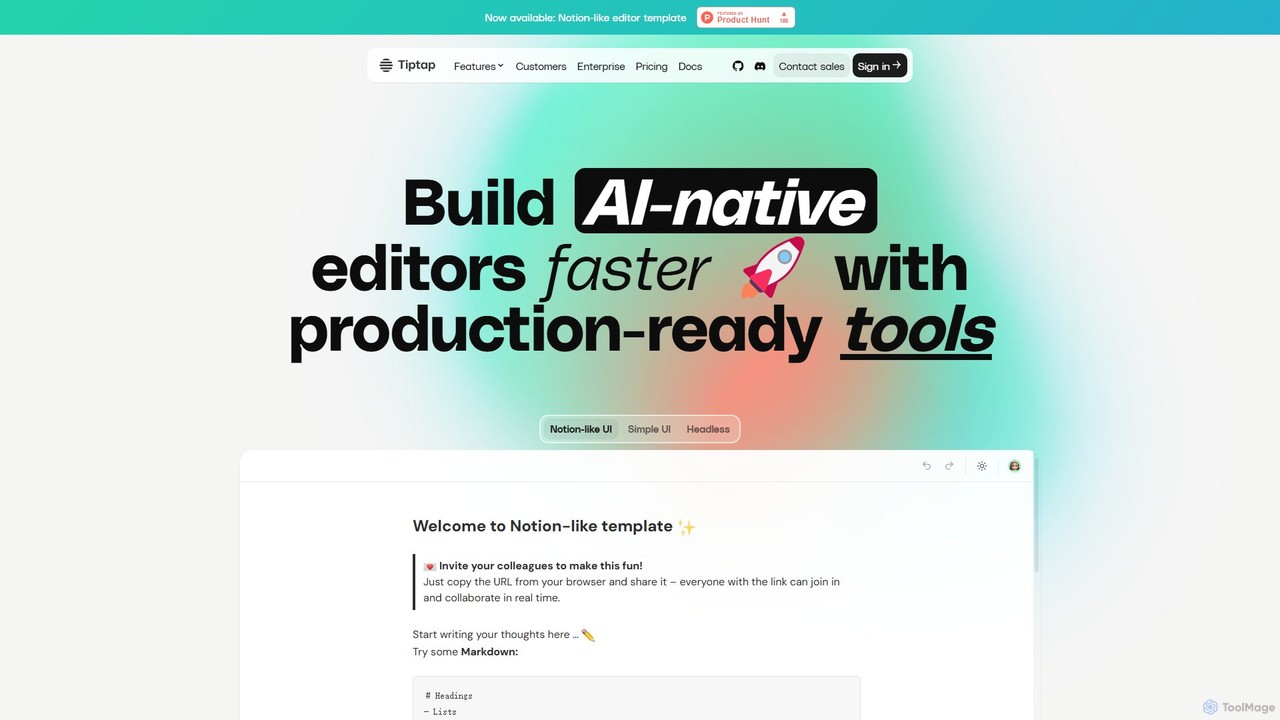
Tiptap is a headless, open-source, and framework-agnostic editor toolkit for developers. It allows for the creation of highly …

352.1K

About Ai Api

AI APIs are programmatic interfaces that allow developers to integrate pre-trained artificial intelligence models into their applications. These tools provide access to complex capabilities like natural language processing, computer vision, and speech recognition without requiring deep machine learning expertise. By using an AI API, developers can accelerate product development, reduce infrastructure costs, and leverage state-of-the-art models maintained by providers. This approach enables the rapid creation of intelligent features and services with high scalability and reliability.

Core Features

  • Pre-trained Model Access: Provides ready-to-use access to sophisticated AI models for tasks like text generation, image analysis, or translation.
  • Scalable Endpoints: Offers robust, managed infrastructure that handles request volume and scales automatically based on demand.
  • Standardized Integration: Delivers well-documented REST or GraphQL endpoints, making it easy to connect with various programming languages and platforms.
  • Usage-based Pricing: Typically operates on a pay-as-you-go model, charging based on the number of API calls or the amount of data processed.

Use Cases

AI APIs are primarily used by software developers, data scientists, and product teams across various industries, including technology, e-commerce, healthcare, and finance. They are essential for building intelligent chatbots, automating content moderation, analyzing customer feedback from text, or adding visual search capabilities to an online store. These APIs serve as the building blocks for adding AI-powered functionality to new or existing software products.

How to Choose

When selecting an AI API, consider the model's performance and suitability for your specific task, including its accuracy and latency. Evaluate the quality of the documentation, the availability of SDKs for your preferred programming language, and the level of developer support. Analyze the pricing structure and rate limits to ensure they align with your budget and scaling needs. Finally, review the provider's data privacy and security policies, especially if handling sensitive information.

Ai ApiUse Cases

1

Build an Intelligent Customer Service Chatbot

A SaaS company's development team needs to reduce the load on their human support agents. By integrating a natural language processing (NLP) API, they can build a chatbot that understands complex user queries, accesses a knowledge base, and provides instant, accurate answers 24/7. This allows the chatbot to handle common questions, freeing up human agents to focus on more complex issues. The implementation can lead to a significant reduction in response times and an increase in customer satisfaction scores.

2

Automate Content Moderation for Social Platforms

A user-generated content platform needs to ensure community safety by filtering out inappropriate content in real-time. Instead of relying solely on manual review, they can use a content moderation API. This API analyzes uploaded text, images, and videos for harmful content like hate speech or violence. It automatically flags or removes violating content, significantly reducing the volume that needs human review and enabling faster enforcement of community guidelines.

3

Enhance E-commerce with Visual Search

An online fashion retailer wants to allow customers to find products by uploading a photo. By implementing a computer vision API, their application can analyze the uploaded image, identify key attributes like clothing type, color, and pattern, and then search the product catalog for visually similar items. This creates a more intuitive and engaging shopping experience, helping customers discover products they might not have found using traditional text-based search, potentially increasing conversion rates.

4

Transcribe and Analyze Audio Content at Scale

A market research firm conducts hundreds of hours of interviews and focus groups. Manually transcribing this audio is slow and costly. By using a speech-to-text API, they can automatically convert all audio recordings into accurate text transcripts in a fraction of the time. Subsequently, they can use a text analysis API to extract key themes, sentiment, and topics from the transcripts, enabling them to generate insights much faster and more efficiently than with manual methods.

5

Automate Document Data Extraction

A financial services company processes thousands of invoices and receipts daily. Manual data entry is prone to errors and is time-consuming. By integrating an Optical Character Recognition (OCR) API combined with a natural language processing model, they can automate the entire process. The API scans the document, extracts key information like invoice number, date, and total amount, and populates it into their accounting system. This automation reduces manual labor, improves data accuracy, and accelerates payment processing cycles.

6

Generate Personalized Marketing Content

A marketing team needs to create tailored email campaigns for different customer segments. Using a generative AI API, they can input customer data and campaign goals to automatically generate multiple variations of email subject lines, body copy, and calls-to-action. The API can adapt the tone and content to match each segment's preferences. This allows the team to scale their personalization efforts, A/B test different messages efficiently, and improve overall campaign engagement and conversion rates.

Ai ApiFrequently Asked Questions